Biochemistry vs Molecular Biology: Which Fits You?
A scientist sees a protein that has stopped working. One question is what changed in its chemistry. Another is whether the gene that produces it is being expressed correctly. Follow these two questions to understand the degrees, laboratory methods, and careers behind biochemistry and molecular biology.

Short answer
Choose biochemistry if you are drawn to proteins, enzymes, metabolism, molecular structure, and the chemistry of living systems. Choose molecular biology if DNA, RNA, gene expression, and genetic regulation interest you more. Neither choice puts the other science out of reach. The courses and laboratories available at a particular university matter more than the label alone.
Biochemistry vs molecular biology at a glance
Imagine a laboratory investigating why a protein is no longer doing its job. A biochemist may examine the protein’s structure, binding, or reaction rate. A molecular biologist may investigate the DNA sequence or whether the cell is making the correct RNA. Both are looking at the same biological problem, but from different starting points. And when one investigation ends, the other often begins.
| Factor | Biochemistry | Molecular biology |
|---|---|---|
| Central lens | Chemical structure, reactions, energy and molecular function | DNA, RNA, gene expression and molecular regulation |
| Typical question | How does this enzyme catalyze a reaction? | How is the enzyme’s gene expressed or silenced? |
| Common emphasis | Proteins, enzymes, metabolism, kinetics and bioenergetics | Genes, transcription, translation, regulation and genome manipulation |
| Quantitative work | Thermodynamics, kinetics, binding and spectroscopy | Sequence data, expression levels, experimental controls and statistics |
| Typical samples | Purified proteins, metabolites, membranes and enzyme systems | DNA, RNA, cells, plasmids and genetically modified systems |
| Academic home | Chemistry, biology or joint department | Biology, genetics, biomedical or joint department |
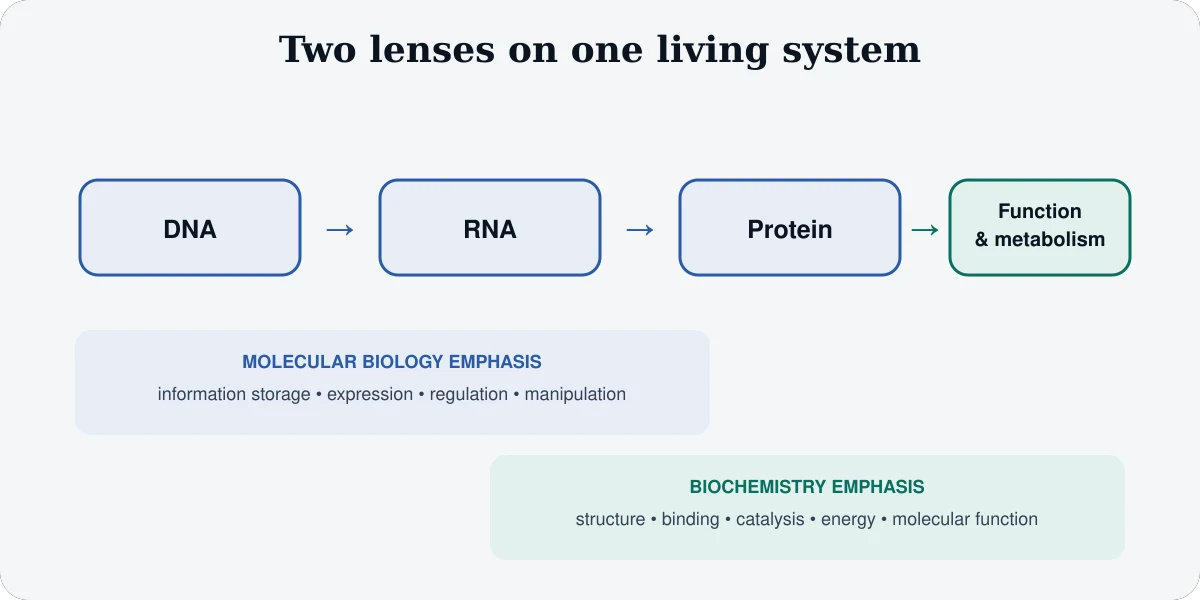
Where does your curiosity begin?
Why does this protein bind, fold or catalyze?
You may enjoy protein structure, enzyme kinetics, molecular interactions, purification and spectroscopy.
Overlap: molecular biology can reveal how the protein is produced and regulated.How the degree coursework differs
Biochemistry commonly emphasizes
- general and organic chemistry;
- proteins and enzyme mechanisms;
- metabolism and bioenergetics;
- thermodynamics and kinetics;
- analytical or physical methods; and
- quantitative laboratory work.
Molecular biology commonly emphasizes
- general biology and chemistry;
- genetics and genomics;
- DNA replication and repair;
- transcription and translation;
- gene regulation and cell biology; and
- molecular cloning or sequence analysis.
The course lists are not competing territories. A student learning about gene expression still needs to understand proteins. Someone studying an enzyme often needs to know how the cell produces and regulates it. That is why the ASBMB foundational framework brings together energy transformation, macromolecular structure and function, information storage and flow, and quantitative discovery. The real difference often appears in advanced electives and sustained laboratory work.
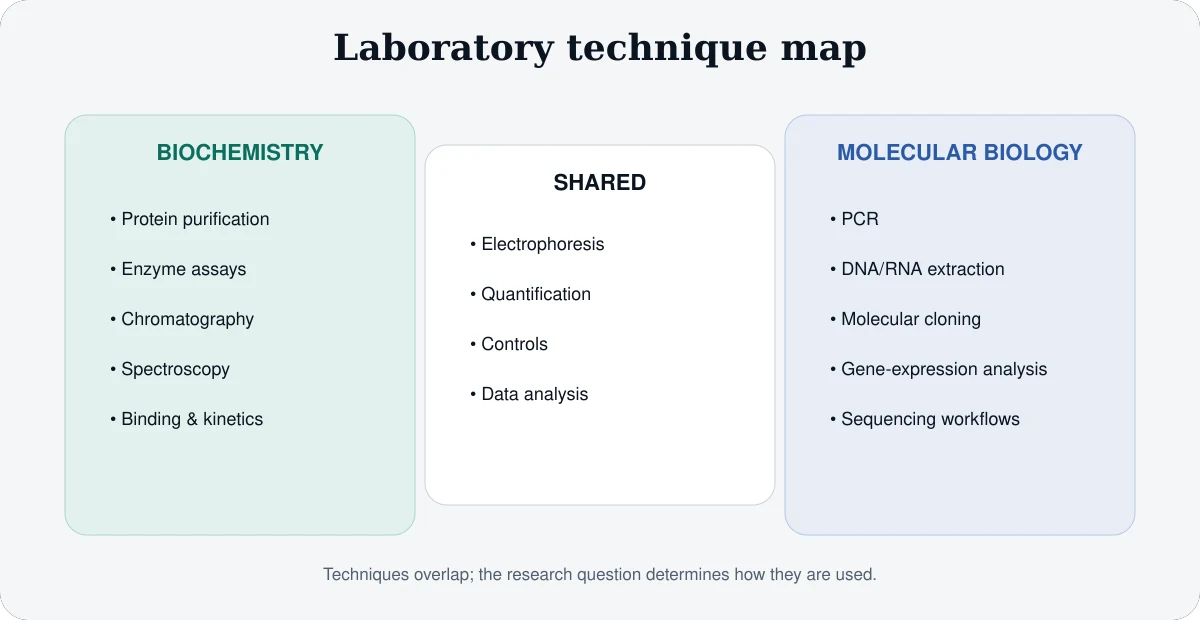
Laboratory techniques: different questions, shared tools
Which one is harder?
There is no honest universal answer. If reaction mechanisms, thermodynamics, or enzyme kinetics feel difficult, biochemistry may demand more from you. If genetic regulation, long molecular pathways, or experimental controls are harder to follow, molecular biology may feel more demanding. Difficulty follows the work you do, not merely the name on your degree.
Before choosing, put two real university catalogs beside each other. Compare the mathematics, physical chemistry, genetics, laboratory hours, research opportunities, and advanced electives. A demanding program with the right laboratory experience may suit your goals better than an easier one with a more attractive title.
Career paths and research directions
Biochemistry-heavy work
Protein science, enzymology, metabolism, structural biology, analytical development and biochemical assays.
Overlapping work
Biotechnology, drug discovery, diagnostics, pharmaceutical research, molecular medicine and academic laboratories.
Molecular-biology-heavy work
Genomics, gene-expression research, molecular diagnostics, genetic engineering, cell-line development and sequencing.
The job market rarely sorts positions into neat boxes marked “biochemistry” and “molecular biology.” Employers may recruit research assistants, laboratory associates, assay-development scientists, or molecular technologists. Read the required techniques and education level. A job involving protein purification and PCR may welcome graduates from either route, provided they have the relevant training.
Why a clean salary comparison is misleading
Salary comparisons are tempting because a single number feels decisive. But this comparison has a problem: the U.S. Bureau of Labor Statistics reports a combined occupation for biochemists and biophysicists, not a matching standalone occupation for every molecular biologist. Putting those figures side by side as though they describe two degrees would give a misleading impression of precision.
U.S. median annual wage, May 2025. BLS lists a doctoral or professional degree as the typical entry-level education for this occupation.
U.S. median annual wage, May 2025. BLS lists a bachelor’s degree as the typical entry-level education for this broader laboratory occupation.
These figures are education-level and occupation benchmarks, not a head-to-head degree ranking. Neither is the expected starting salary of every graduate. Compare real job postings by location, degree level, laboratory techniques, industry and responsibility.
Which should you choose?
You keep asking how molecules bind, react, fold, transfer energy or produce measurable chemical effects.
You keep asking how genetic information is copied, expressed, regulated, edited or inherited at the molecular level.
You want biotechnology, molecular medicine or research flexibility and the curriculum provides solid chemistry, genetics and hands-on research.
Here is a useful final test. Open the four-year study plans, then look at the laboratories where undergraduates can actually work. Which experiments would you want to repeat even after the first attempt failed? Which questions would keep you interested long enough to troubleshoot the result? Those answers, supported by course requirements and career research, are more useful than a ranking of degree names.
Frequently asked questions
Is biochemistry the same as molecular biology?
No, but they overlap extensively. Biochemistry centers on the chemistry and function of biomolecules; molecular biology centers on molecular information flow and regulation.
Which has more chemistry?
Biochemistry usually requires and applies more chemistry, although individual curricula vary.
Which has more genetics?
Molecular biology usually places greater emphasis on genetics, genomics, gene expression and regulation.
Which is better for biotechnology?
Both can be excellent. Biotechnology frequently combines protein, cellular and genetic methods, so laboratory experience and electives matter greatly.
Which is better for medical school?
Neither title guarantees an advantage. Verify every target school’s prerequisites and consider performance, admissions testing and relevant experience.
Can a biochemist work in molecular biology?
Yes, particularly with training in PCR, cloning, nucleic-acid methods, cell culture or gene-expression analysis.
Can a molecular biologist work in biochemistry?
Yes, especially with protein purification, enzyme assays, analytical methods and quantitative chemistry preparation.
Do both require graduate school?
Some entry-level laboratory roles accept a bachelor’s or master’s degree, while independent research positions commonly require a Ph.D. Employer requirements vary.
Sources and methodology
This guide separates field emphasis, degree curricula and occupation statistics. Sources were checked September 23, 2026.
- ASBMB: Characteristics of an accredited BMB program
- ASBMB foundational concepts
- NHGRI: Gene expression
- NHGRI: Central dogma
- U.S. BLS: Biochemists and Biophysicists
- U.S. BLS: Biological Technicians
Curricula, job titles and employer requirements vary. Occupation medians are not starting salaries or degree-level earnings.