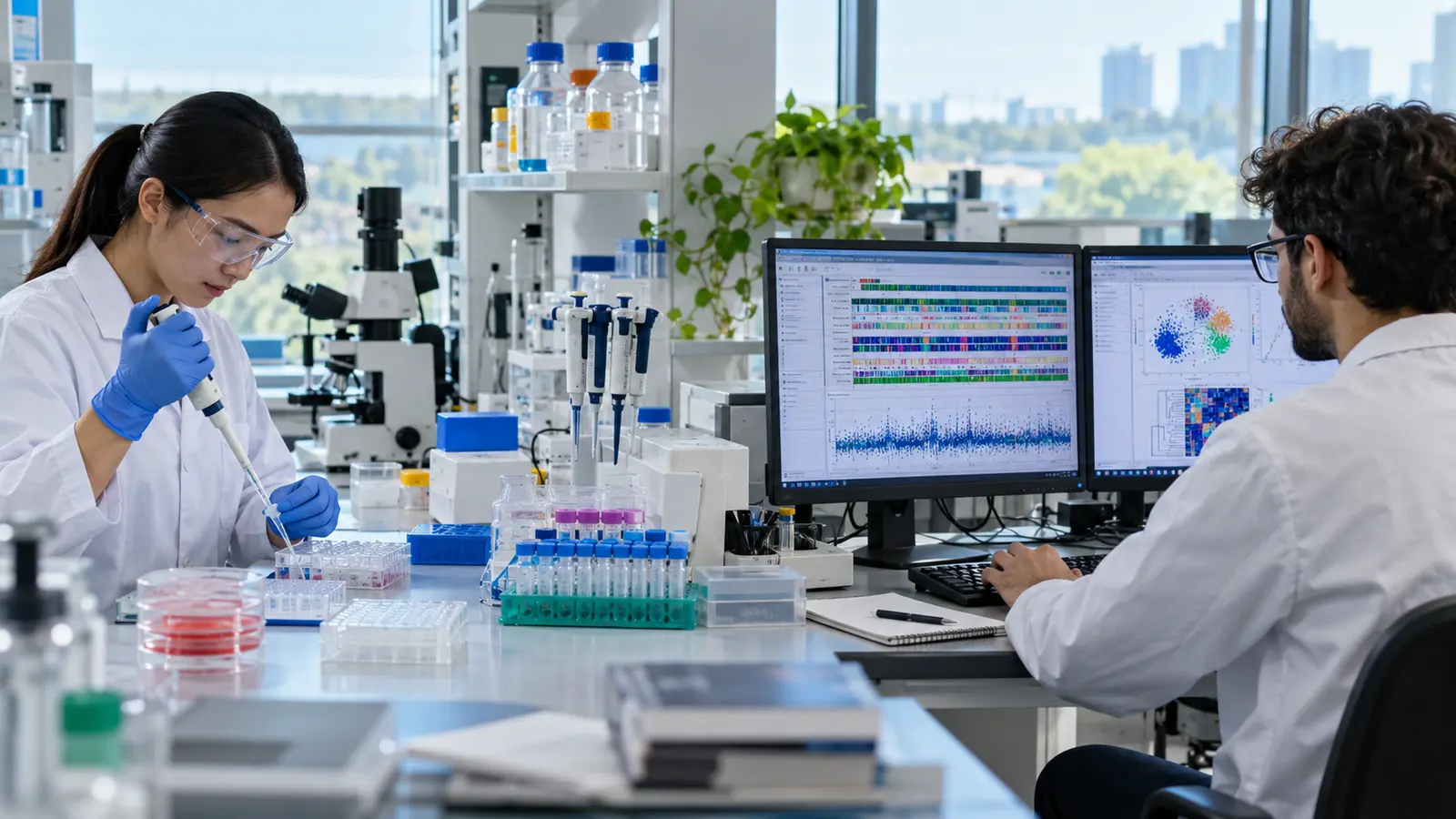
Picture a small lab that has just sequenced a set of bacterial samples. This is an invented scene, used only to make the idea concrete. The bench scientist grew the cultures and knows which tube was handled differently. The analyst opens the data file and sees the read quality fall off for one sample. Is that contamination, a bad library prep or a bug in the pipeline? Neither person can answer alone, and that handoff is the real difference between these two majors.
Short answer
Choose biotechnology if you want hands-on work with cells, DNA, proteins, microbes, assays or biomanufacturing. Choose bioinformatics if you want to analyze biological questions through Python or R, statistics, algorithms and databases. The strongest modern teams need both: experiments generate the data, and computation converts it into evidence for the next experiment.
What is the difference between bioinformatics and biotechnology?
Biotechnology applies living organisms, cells or biological components to create products and processes. Work can involve genetic engineering, cell culture, recombinant proteins, diagnostics, fermentation, biologics production, agricultural biotechnology or quality systems.
Bioinformatics applies computation and analysis to biological data. A 2002 BMJ article hosted by NIH's PubMed Central defines it as the application of computation and analysis tools to the capture and interpretation of biological data. Common data include DNA and RNA sequences, gene-expression measurements, proteins, populations and clinical or experimental metadata.
The simplest distinction is physical biological system versus digital biological evidence. But this is not a rivalry. A bioinformatics prediction still needs biological interpretation and often experimental validation. A biotechnology experiment can produce too much data to interpret reliably without computation.
How bioinformatics is used in biotechnology
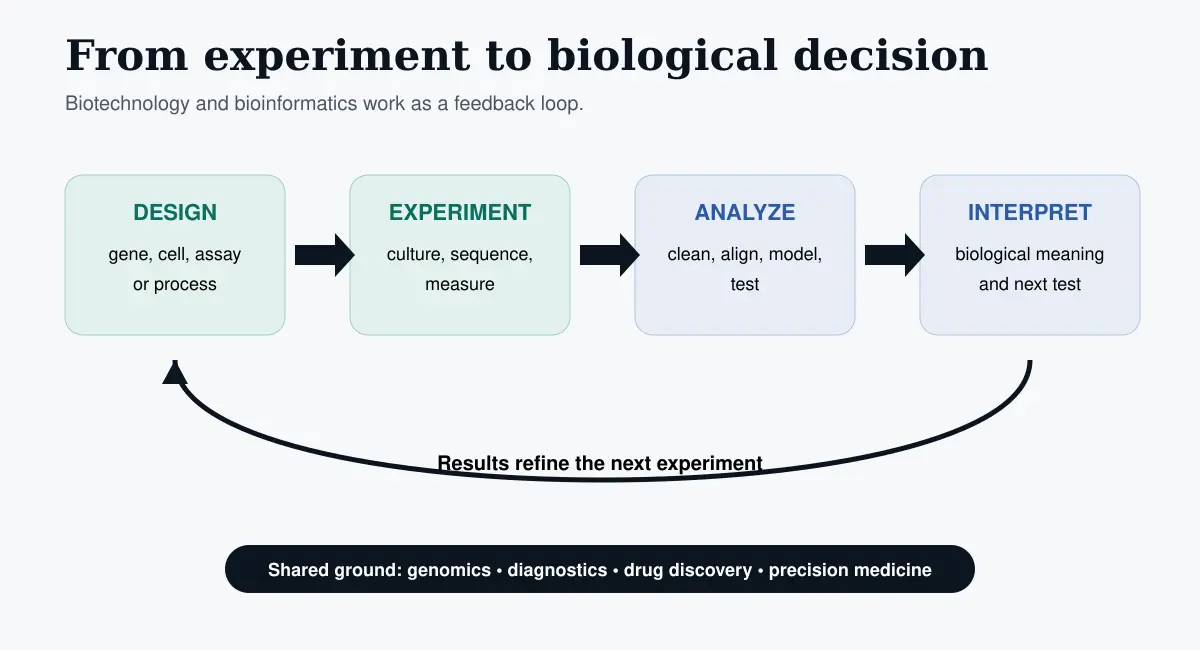
Drug discovery
Biotechnology teams create assays and biological models. Bioinformatics teams analyze targets, variants, pathways and omics evidence to prioritize experiments.
Genomics
Laboratories extract and sequence DNA. Bioinformatics pipelines check quality, align reads, detect variants and support interpretation.
Biomanufacturing
Biotechnology teams optimize cells and processes. Computational analysis can identify expression patterns, monitor performance and investigate deviations.
Precision medicine
Molecular tests generate patient data. Bioinformatics supports classification and interpretation, while clinical decisions require validated evidence and professional oversight.
Bioinformatics vs biotechnology at a glance
| Factor | Biotechnology | Bioinformatics |
|---|---|---|
| Main question | How can we use or modify biology? | What does the biological data show? |
| Primary environment | Wet laboratory, pilot plant or manufacturing setting | Computer workstation, research group or data platform |
| Core subjects | Molecular biology, genetics, microbiology, biochemistry | Biology, programming, statistics, algorithms and databases |
| Typical tools | Pipettes, PCR, cell culture, chromatography, bioreactors | Python/R, Linux, SQL, workflows, cloud or computing clusters |
| Math level | Statistics and quantitative lab analysis; varies by program | Statistics, probability, discrete math and quantitative modeling |
| Programming | Helpful but not always central | Central and continuously practiced |
| Main outputs | Assays, engineered cells, biologics and processes | Pipelines, models, software, databases and interpreted results |
| Remote-work potential | Limited for hands-on laboratory roles | Higher, though secure data and team needs may limit it |
| Best fit | You enjoy experimental biology and tangible processes | You enjoy debugging, data and biological reasoning |
Degree coursework and the hidden skill gap
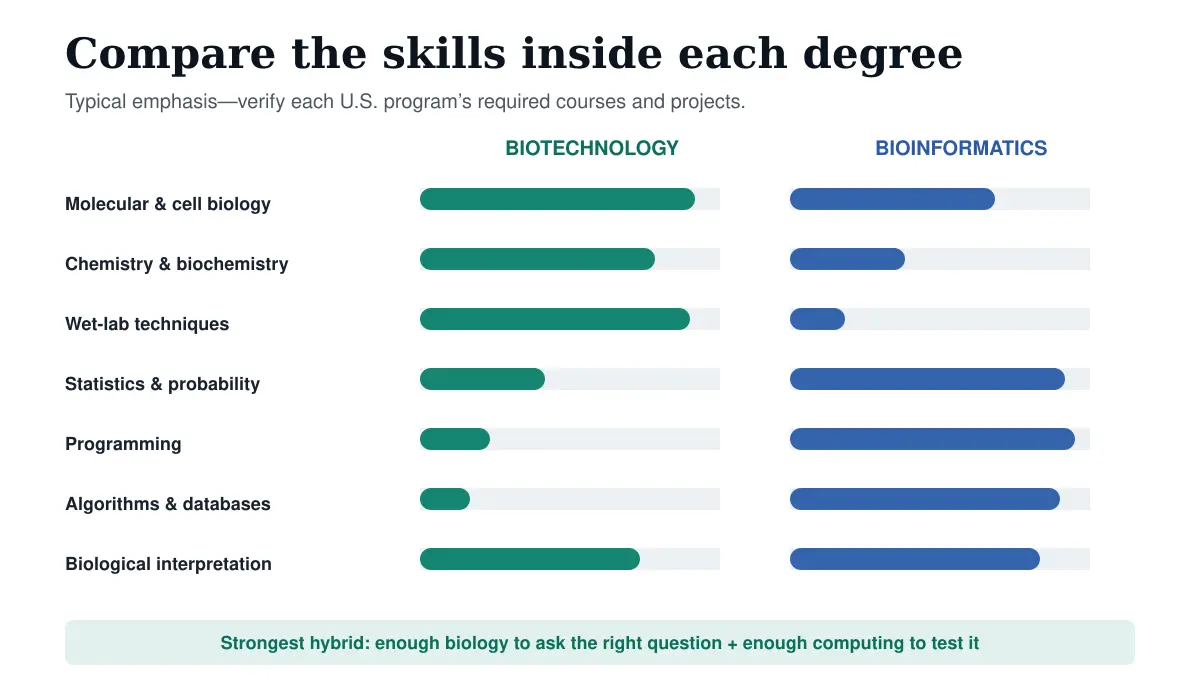
The University of Arizona describes bioinformatics as an integrated curriculum across biology, chemistry, mathematics and computer science. UMBC’s program illustrates the balance directly through required credits: 22 in biology, 13 in chemistry, 19 in physics, mathematics and statistics, and 17 in computer science. Biotechnology degrees such as Indiana University’s instead emphasize scientific principles and biotechnology techniques and applications.
Learn to generate reliable biology
- cell and molecular biology;
- genetics and genetic engineering;
- microbiology and biochemistry;
- cell culture and immunology;
- analytical laboratory methods;
- fermentation or bioprocessing; and
- quality and regulatory concepts.
Learn to analyze biological information
- molecular biology and genomics;
- Python, R or another programming language;
- statistics and probability;
- algorithms and data structures;
- databases and data management;
- Linux and reproducible workflows; and
- sequence or omics analysis.
What daily work actually feels like
Biotechnology day
Prepare samples, culture cells, run an assay, troubleshoot contamination, document conditions and interpret experimental variability.
You must tolerate: time-sensitive protocols, physical presence and experiments that fail despite careful technique.Bioinformatics day
Clean data, write code, run pipelines, check quality, explore results, debug errors and explain findings to scientists.
You must tolerate: long debugging sessions, ambiguous datasets and results that depend on assumptions.Neither field is “easier.” Biotechnology is difficult because living systems vary and laboratory work demands precision. Bioinformatics is difficult because it combines biology with statistics and computing; a pipeline running successfully does not guarantee a biologically meaningful answer.
Which problem would you rather solve?
Select the task you would be happiest spending hours on. This is a reflection tool, not an aptitude test.
Improve the biological system
You may enjoy cell culture, molecular methods, experimental controls and biological optimization.
Check next: hands-on lab hours, research access and bioprocessing facilities.Career paths after each degree
Biotechnology-leaning roles
- research associate;
- cell-culture associate;
- molecular biology technician;
- bioprocessing associate;
- quality-control analyst;
- manufacturing associate; and
- validation or regulatory support.
Hybrid roles
- genomics research;
- assay data analysis;
- computational biology;
- precision-medicine support;
- laboratory automation;
- biostatistical programming; and
- scientific data management.
Bioinformatics-leaning roles
- bioinformatics analyst;
- genomics data analyst;
- bioinformatics scientist;
- computational biologist;
- pipeline developer;
- scientific software engineer; and
- biological data scientist.
“Bioinformatician” is not one standardized job. Some roles are biology-facing analysts; others demand production software, cloud infrastructure or advanced statistics. Read job descriptions for Python, R, SQL, Linux, Git, workflow managers, cloud platforms, statistics, genomics and communication requirements.
Bioinformatics vs biotechnology salary
BLS does not publish one national occupation called “bioinformatician” or “biotechnologist.” Assigning one salary to either degree would therefore be misleading. Graduates enter different occupations with different education requirements.
Bioinformatics graduates may enter data-science, research-computing or biological-science roles. Biotechnology graduates may enter laboratory, manufacturing, quality or research roles.
BLS states that data scientists typically need at least a bachelor’s degree, while some employers prefer graduate education. Independent biological research commonly requires advanced study.
| Occupation | Median pay | Projected growth | Typical entry education |
|---|---|---|---|
| Data scientists | $120,230 | 35 percent | Bachelor's degree |
| Biological technicians | $57,510 | 7 percent | Bachelor's degree |
| Biochemists and biophysicists | $127,410 | 12 percent | Doctoral or professional degree |
These three occupations are reference points, not forecasts for either degree. BLS reports about 24,800 openings a year for data scientists, 9,400 for biological technicians and 2,900 for biochemists and biophysicists, who generally need a Ph.D. for independent research and development. Where a graduate lands depends on the role, not the major's name.
Use salary websites cautiously because similar titles can describe very different work. Compare location, industry, degree level, years of experience and required technical stack. A senior bioinformatics software role should not be compared with an entry-level laboratory technician position as though the degree alone caused the difference.
Will AI replace bioinformatics or biotechnology jobs?
AI will change both fields, but it does not remove the need for domain judgment. In bioinformatics, AI can generate code, suggest analyses, classify patterns and accelerate documentation. It can also produce incorrect code, leak information between training and testing, overfit data or return biologically implausible conclusions.
In biotechnology, automation can improve liquid handling, imaging, process monitoring and experiment planning. But physical experiments, contamination control, validation, regulated documentation and responsibility for real-world biological outcomes remain human-accountable work.
- code scaffolding and documentation;
- routine data cleaning;
- literature triage;
- pattern detection; and
- experimental prioritization.
- experimental design;
- statistics and validation;
- biological interpretation;
- data provenance and reproducibility; and
- clear communication with laboratory teams.
The safer strategy is not to avoid bioinformatics because AI writes code. Build the ability to frame the biological question, inspect data quality, test assumptions, validate outputs and explain limitations.
How to choose, and how to build a hybrid advantage
- Test both workflows. Complete one wet-lab project and one small Python or R biological-data project before committing.
- Audit the curriculum. Count required lab courses, programming courses, statistics, databases and independent projects.
- Check access. Verify whether undergraduates use research labs, real datasets, computing resources and internships.
- Read twenty U.S. job descriptions. Record repeated tools and education requirements.
- Build visible evidence. Biotechnology students can add reproducible analysis; bioinformatics students can add molecular biology and experimental-design experience.
- Choose the work you can practice repeatedly. Career fit depends more on daily tasks than an impressive title.
Back to the lab with the odd sample. The bench scientist and the analyst solved it together: one checked the handling notes, the other re-ran the pipeline. Pick the seat you would be glad to sit in on the hundredth sample, when the novelty has worn off.
Frequently asked questions
Is bioinformatics better than biotechnology?
Neither is universally better. Bioinformatics suits computational biological analysis; biotechnology suits laboratory and biological product development.
Which has more coding?
Bioinformatics. Programming, Linux, statistics, databases and reproducible workflows are central rather than optional.
Can a biotechnology graduate become a bioinformatician?
Yes, with substantial training in programming, statistics, data management and portfolio projects. Graduate study may help for research-intensive roles.
Can a bioinformatics graduate work in biotechnology?
Yes. Biotechnology companies employ bioinformatics graduates in genomics, drug discovery, diagnostics, data platforms and computational research.
Which has more wet-lab work?
Biotechnology. Bioinformatics can collaborate closely with laboratories but most of its primary work occurs on computers.
Is bioinformatics the same as data science?
No. Bioinformatics applies computational methods specifically to biological questions and data. Data science is broader and may not require biological knowledge.
Is computational biology the same as bioinformatics?
The terms overlap. Bioinformatics often emphasizes tools, data and pipelines, while computational biology may emphasize models and biological discovery. Employers use the labels inconsistently.
Will AI replace bioinformatics careers?
AI will automate parts of coding and analysis, but reliable work still requires data-quality checks, statistics, biological interpretation, validation and accountability.
Sources and research method
This comparison uses primary definitions, current U.S. curricula and federal occupational guidance. Salary and outlook figures are BLS May 2025 wages and 2025 to 2035 projections, checked October 18, 2026.
- Bayat, Bioinformatics (BMJ, 2002), hosted by NIH PubMed Central
- University of Arizona: BS Bioinformatics curriculum
- UMBC: BS Bioinformatics and Computational Biology
- Indiana University: BS Biotechnology
- U.S. Bureau of Labor Statistics: Data Scientists
- U.S. Bureau of Labor Statistics: Biological Technicians
- U.S. Bureau of Labor Statistics: Biochemists and Biophysicists