
Short answer
Choose chemistry if you are most interested in molecules, reactions, measurement, synthesis and hands-on laboratory investigation. Choose chemical engineering if you want to use chemistry with advanced mathematics, physics and engineering design to build, improve or control production processes. Neither degree is universally better. The right choice depends on the problems and work environment you prefer.
Chemistry vs chemical engineering at a glance
Picture a chemist who perfects a new skin lotion in a 250 mL beaker. It mixes smoothly, feels right and passes every stability test. Then the company asks for 10,000 liters. In the big tank, heat takes longer to leave, the mixing is uneven and the lotion starts to separate. Someone now has to work out the pumps, mixers, temperatures and timing that make every batch come out the same. (This scenario is invented for illustration.)
The first person is doing chemistry. The second is doing chemical engineering. Most of the difference between the two majors lives in that gap.
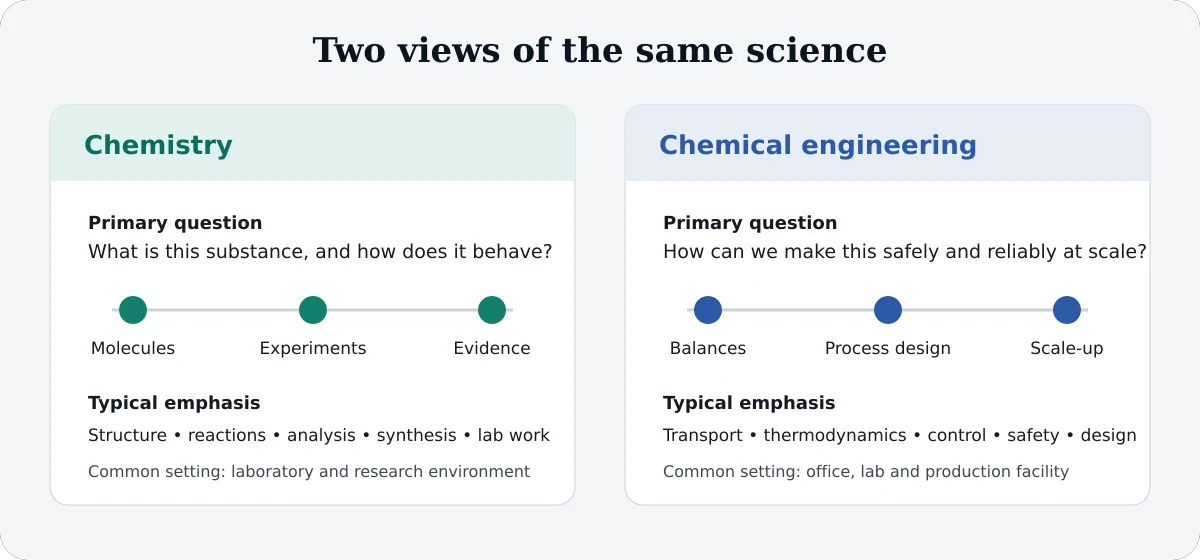
The names overlap, but the academic goals are different. Chemistry investigates matter at the atomic, molecular and material levels. Chemical engineering uses scientific principles to design and control processes, including their safety, efficiency and scale.
| Factor | Chemistry | Chemical engineering |
|---|---|---|
| Main focus | Composition, structure, properties, reactions and analysis of substances | Design, analysis, control and scale-up of processes that transform materials |
| Typical questions | What is present? Why did it react? How can it be measured or synthesized? | How can it be produced safely, consistently, efficiently and economically? |
| Academic emphasis | Chemistry subdisciplines and laboratory practice | Mathematics, physics, engineering science, process design and safety |
| Common work | Testing, analysis, formulation, synthesis, quality and research | Process design, production, scale-up, optimization, control and troubleshooting |
| Typical setting | Laboratory, office, research center or manufacturing facility | Office, laboratory, pilot plant or industrial facility |
| Program quality signal | ACS approval or an ACS-certified degree can be useful signals; not every good program follows this route | ABET accreditation is an important signal, especially when engineering licensure may matter |
What will you study?
Typical chemistry coursework
A chemistry curriculum normally builds depth across analytical, biochemistry, inorganic, organic and physical chemistry, alongside substantial laboratory work. The American Chemical Society (ACS) sets the bar for its certified degree with foundation study across those areas, additional in-depth coursework and at least 400 laboratory hours beyond the introductory course. Mathematics, physics and sometimes biology support the chemistry core.
Common classes include general chemistry, organic chemistry, analytical chemistry, inorganic chemistry, physical chemistry, instrumental analysis and laboratory courses. Programs may add concentrations in materials, environmental, medicinal, computational or biochemistry.
Typical chemical engineering coursework
ABET's 2026 to 2027 criteria require chemical engineering programs to apply mathematics, including differential equations and statistics, along with college-level chemistry and physics to engineering problems. Students learn to design, analyze and control processes while accounting for hazards.
Common classes include material and energy balances, engineering thermodynamics, fluid mechanics, heat and mass transfer, reaction engineering, separations, process control, process safety and a senior design project. Individual programs differ, so compare actual degree plans rather than relying on the major's title alone.
Is chemistry or chemical engineering harder?
There is no objective winner. Chemical engineering typically has a heavier, more continuous load in calculus, differential equations, physics, modeling and engineering design. Chemistry typically demands deeper study of molecular behavior, experimental technique, instrumentation and careful laboratory documentation.
Your strengths matter more than the label. A student who enjoys mathematical models and systems may find chemical engineering more intuitive. A student who likes experimental detail and molecular explanations may feel more at home in chemistry. Review required courses, lab hours and sample assignments at the universities you are considering.
Career paths after each degree
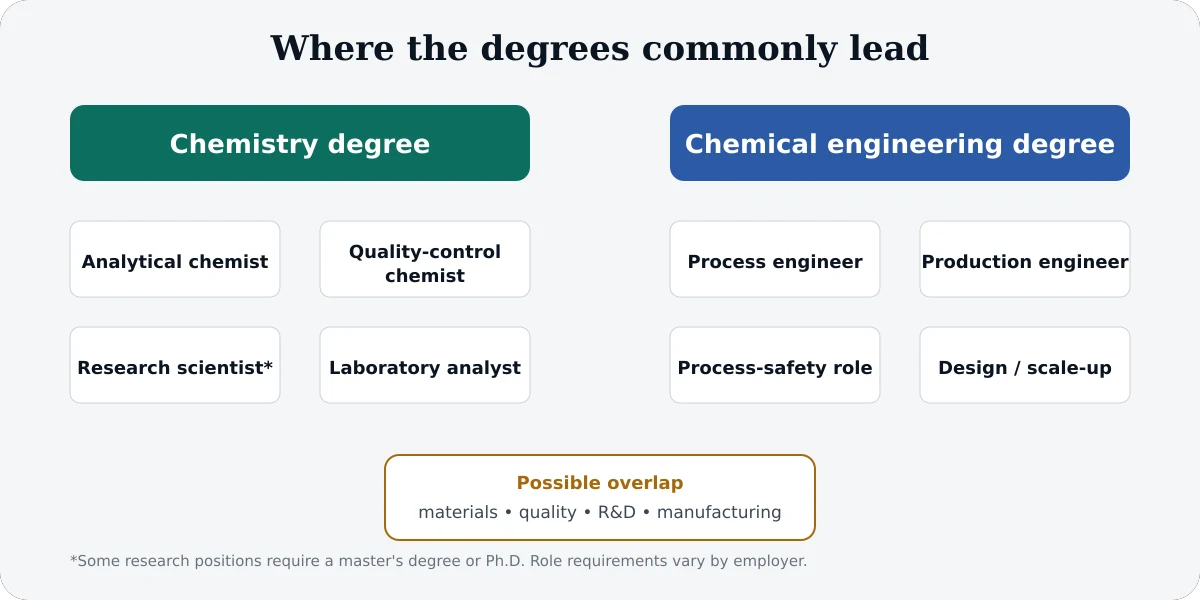
A degree and an occupation are not identical. Graduates enter different roles depending on internships, electives, location, industry and further education. The paths below are examples, not guarantees.
Common chemistry-aligned roles
- Analytical chemist
- Quality-control chemist or analyst
- Formulation or product-development scientist
- Laboratory analyst
- Materials or environmental laboratory roles
- Research scientist, often with graduate study
Common chemical-engineering roles
- Process engineer
- Production or manufacturing engineer
- Process-development engineer
- Process-safety engineer or specialist
- Plant, design or project engineering roles
- Scale-up and continuous-improvement roles
There is real overlap in pharmaceuticals, energy, food, consumer products, materials, biotechnology and chemical manufacturing. The difference is often the angle. A chemist may characterize a formulation or develop an analytical method, while a chemical engineer may design the process that produces it reliably at larger scale.
What "scale-up" actually changes
Scale-up is more than making a laboratory recipe bigger. A reaction that works in a flask can behave differently in a large vessel because heat removal, mixing, mass transfer, pressure, residence time, equipment limits, waste handling and process hazards all change with scale. That is one reason chemical engineering includes transport, thermodynamics, control and process safety instead of simply adding more chemistry courses.
Salary and job outlook in the United States
The U.S. Bureau of Labor Statistics (BLS) reports occupation-level data, not salaries for everyone who holds a particular degree. In May 2025, the median annual wage was $91,240 for chemists and $125,040 for chemical engineers.
May 2025 U.S. median annual wage. Chemist employment is projected to grow 6% from 2025 to 2035, with about 5,500 additional chemist jobs projected over the decade. BLS reports about 6,500 openings a year for chemists and materials scientists combined.
May 2025 U.S. median annual wage. Employment is projected to grow 5% from 2025 to 2035, with about 1,100 openings per year on average.
BLS estimates about 84,900 chemist jobs and 21,900 chemical engineer jobs in 2025. Chemistry therefore maps to a larger named occupation, while chemical engineering has the higher occupation-wide median pay. These statistics describe labor markets, not the value of the degrees themselves. A chemistry graduate may work outside the chemist occupation, and a chemical engineering graduate may enter manufacturing, process development, consulting, materials, energy or other engineering roles.
How the work environment differs
Chemists commonly work in laboratories and offices, and some work in manufacturing facilities. Their days may involve preparing samples, operating instruments, validating methods, analyzing results, documenting experiments and collaborating with scientists or engineers.
Chemical engineers commonly work in offices or laboratories and may visit plants, refineries or other production settings. Their work may involve process calculations, equipment layouts, simulations, safety reviews, production monitoring and troubleshooting. Some roles require extra hours when a process problem or production target demands attention.
Which degree should you choose?
Choose chemistry if you…
- want deeper study of molecules, reactions and measurement;
- enjoy laboratory experiments and analytical instruments;
- are interested in testing, synthesis, formulation or scientific research;
- may consider graduate study for research-intensive work; and
- prefer investigating materials over designing full production systems.
Choose chemical engineering if you…
- enjoy calculus, physics and systems-level problem solving;
- want to design or improve industrial processes;
- are interested in scale-up, production, efficiency and process safety;
- prefer combining technical analysis with economic and operating constraints; and
- want an engineering curriculum and related professional pathways.
A practical decision test
Open the four-year plans for both majors at the same university. Mark the required courses you would genuinely be willing to take, not only the careers that sound attractive. Then compare internship postings in your target region. Degree content and local opportunities often clarify the decision better than broad major rankings.
Can you move from one field to the other?
A chemistry graduate can enter some process, manufacturing or quality roles, especially with relevant experience, but a chemistry degree does not automatically substitute for an engineering degree. BLS says chemical engineers typically need a bachelor's degree in chemical engineering or a related field. A Professional Engineer (PE) license is not required for entry-level chemical engineers, but when licensure matters, state boards set education, examination and experience requirements. Students who may want that path should verify both ABET accreditation and the rules in the state where they expect to practice.
A chemical engineering graduate can enter some laboratory, materials and R&D roles, but chemistry-intensive positions may prefer deeper training in synthesis, analytical methods or a chemistry specialization. Job titles are inconsistent, so examine the actual duties and education requirements.
If you are comparing the jobs rather than the college majors, read Chemist vs Chemical Engineer. It looks at daily work and career paths, while this page focuses on the degree decision.
Cost, graduate school and education ROI
Chemical engineering's occupation median is higher, but salary alone does not establish return on investment. Compare net tuition, grants, time to graduate, internship access, expected debt and the roles you are realistically likely to pursue.
The graduate school question is especially important for chemistry. BLS lists a bachelor's degree as the typical entry-level education for chemists and materials scientists, but notes that some research positions require a master's degree or Ph.D. A bachelor's in chemistry can still lead directly to laboratory, quality, testing, formulation and manufacturing roles, so graduate school should be treated as career dependent rather than automatic.
Chemical engineering is also typically a bachelor's-entry occupation. BLS notes that some employers prefer internship or cooperative education experience. For students comparing two four-year degrees, this means internship access, co-op structure and employer recruiting can matter as much as the published national median salary.
Use Choicelyt's education ROI guide to evaluate cost and career value without treating one national salary number as a personal forecast.
Back to the lotion that separated in the big tank. The chemist who built the formula and the engineer who fixed the mixing were never rivals. They were two halves of one product. Choose the half whose daily problems you would still enjoy solving in year three, when the novelty has worn off and the work is simply yours.
Frequently asked questions
What is the main difference between chemistry and chemical engineering?
Chemistry focuses on substances: their composition, properties and reactions. Chemical engineering applies chemistry, physics, mathematics and engineering to processes that make or transform products safely and efficiently at scale.
Which degree uses more mathematics?
Chemical engineering normally places more sustained emphasis on calculus, differential equations, statistics and modeling. Chemistry also uses mathematics, particularly in physical and analytical chemistry.
Does chemical engineering include more chemistry?
Usually not. Chemical engineering includes chemistry, but much of the degree focuses on balances, thermodynamics, transport, process design, control and safety. Chemistry goes deeper across chemical subdisciplines and laboratory practice.
Can I become a chemical engineer with a chemistry degree?
Some graduates move into process-related work through experience or further study, but a chemistry degree does not automatically meet every employer's or licensing body's engineering requirements. Verify the exact role and state rules.
Can a chemical engineer work as a chemist?
There are overlapping laboratory, materials and R&D roles, but chemistry-intensive jobs may prefer chemistry-specific laboratory and analytical preparation. Employer requirements vary.
Which degree pays more?
Current BLS occupation data show a higher 2025 median annual wage for chemical engineers than chemists. That is an occupation comparison, not a guarantee about starting pay or the outcome of every graduate.
Which major is better for pharmaceuticals?
Both can fit. Chemists may focus on discovery, formulation or analysis; chemical engineers may focus on process development, scale-up and manufacturing. The best choice depends on which part of the product lifecycle interests you.
Do chemical engineers need a PE license?
Not to start. BLS says licensure is not required for entry-level chemical engineers, and experienced engineers may obtain a Professional Engineer license. If you think you may want one, check ABET accreditation and your state board's rules early.
Can I get a chemistry job with only a bachelor's degree?
Often, yes. BLS lists a bachelor's degree as the typical entry-level education for chemists, with a master's degree or Ph.D. needed for some jobs, such as research positions. Internships and laboratory experience help.
Should I choose an ACS-approved or ABET-accredited program?
These are useful, discipline-specific quality signals. ACS approves chemistry programs and certifies qualifying degree paths; ABET accredits engineering programs. Check the relevant database and the exact program, not only the university.
Sources and methodology
This comparison uses current U.S. sources and separates degree curricula from occupation outcomes. The BLS salary and outlook figures were rechecked on October 17, 2026 against pages last modified August 27, 2026, and the ABET 2026 to 2027 engineering criteria were rechecked the same day. The ACS site blocks automated checking, so its 400-hour laboratory figure was confirmed from a college degree plan that follows the ACS guidelines; confirm it on the ACS pages linked below.
- U.S. Bureau of Labor Statistics: Chemists and Materials Scientists
- U.S. Bureau of Labor Statistics: Chemical Engineers
- American Chemical Society: Guidelines for Bachelor's Degree Programs
- American Chemical Society: Laboratory Curriculum and Skills Requirements
- ABET: Criteria for Accrediting Engineering Programs, 2026 to 2027
Data note: BLS figures are national occupation statistics and may change in later releases. Individual university curricula and state licensure rules vary.