
Short answer
Choose biotechnology if cells, genes, microbes, assays, fermentation or biological manufacturing interest you most. Choose bioengineering if you want more calculus, physics, programming, modeling and engineering design applied to biology. Degree titles are inconsistent, though. Some biotechnology degrees are engineering-heavy, and some universities use bioengineering and biomedical engineering almost interchangeably. Compare the required courses, not the names alone.
What is the difference between biotechnology and bioengineering?
Picture two first-year students at the same lab bench. The first is thrilled that the bacteria she streaked last week have grown into clean, separate colonies. Her next question is which colony makes the enzyme she wants. The second student is looking at the same incubator and wondering why cells at the center of a flask get less oxygen than cells at the edge, and how he could design a vessel that fixes it. (These two students are invented for illustration.)
Neither question is better. But they point toward different degrees. The first leans toward biotechnology. The second leans toward bioengineering.
Biotechnology uses living organisms, cells or biological components to develop useful products and processes. Common examples include recombinant proteins, vaccines, diagnostic assays, engineered microbes, cultured cells, fermentation and biological manufacturing.
Bioengineering applies engineering principles to analyze, model, design or control biological systems. Its projects can involve biomaterials, tissue engineering, biosensors, imaging, biomechanics, computational models, bioreactors or medical devices.
The cleanest distinction is the starting question. Biotechnology often asks, "How can we use or modify this biology?" Bioengineering often asks, "How can we quantitatively analyze or design this biological system?" Real projects overlap. A cell-based therapy, for example, can require molecular biotechnology, bioprocess engineering, biomaterials, modeling, quality systems and clinical translation.
Biotechnology, bioengineering and biomedical engineering
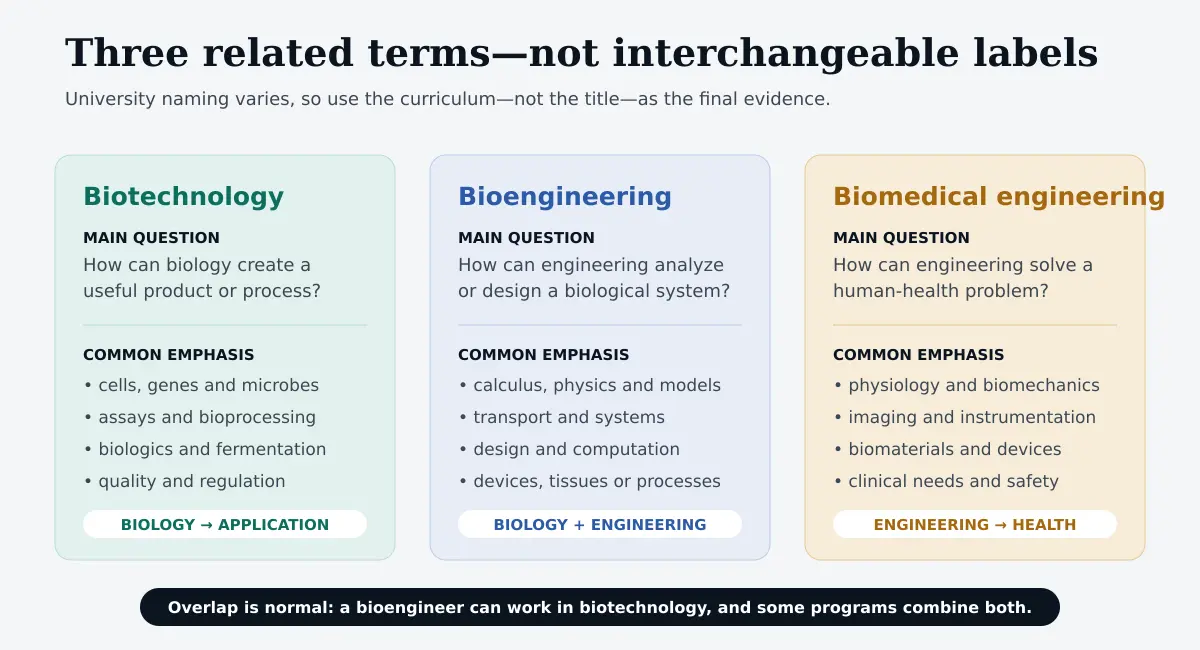
Bioengineering can be the broadest engineering label, covering biological systems in health, agriculture, environment and industry. Biomedical engineering usually narrows the application toward human health, including devices, imaging, biomechanics, biomaterials and clinical needs. Universities define these labels differently, so treat them as starting points.
Biotechnology vs bioengineering at a glance
| Factor | Biotechnology | Bioengineering |
|---|---|---|
| Central question | How can biology create a useful product or process? | How can engineering analyze or design a biological system? |
| Common academic home | Life sciences, applied biology or biotechnology | School of engineering |
| Biology | Usually strong in molecular biology, genetics, cells and microbiology | Strong, but often paired with physiology, systems or quantitative biology |
| Math | Statistics and quantitative laboratory analysis; calculus depth varies | Typically calculus through differential equations, statistics and mathematical modeling |
| Physics | Often foundational rather than central | Often central to mechanics, transport, circuits, imaging or instrumentation |
| Programming | May appear in bioinformatics, data analysis or automation | Often used for modeling, simulation, signals, control or design |
| Laboratory work | Cell culture, microbiology, molecular methods, assays and fermentation | Measurement, prototyping, biomaterials, instrumentation and quantitative experiments |
| Design component | Experimental or process development; varies substantially | Engineering design and a capstone are commonly prominent |
| Typical outputs | Biologics, assays, engineered cells, processes and production systems | Devices, models, materials, sensors, tissues and engineered processes |
| Best fit | You enjoy working with biological systems at the bench or in production | You enjoy solving biological problems with math, physics and design |
What would you actually build or improve?
Job titles blur, but daily tasks do not. Ask which of these lists sounds like a good Tuesday.
Use the biology
- engineer a microorganism to produce an enzyme;
- develop or validate a diagnostic assay;
- optimize mammalian-cell culture;
- increase fermentation yield;
- purify a recombinant protein; or
- support biologics manufacturing and quality.
Engineer the system
- design a biosensor or wearable device;
- model oxygen transport through tissue;
- test a scaffold or biomaterial;
- analyze physiological signals;
- design a bioreactor or control strategy; or
- prototype a diagnostic instrument.
Where the fields meet
Tissue engineering, synthetic biology, bioprocessing, organ-on-chip systems, diagnostics and cell therapies frequently sit in the overlap. A biotechnology graduate may optimize the cells and the assay. A bioengineer may model transport, design the device or scale the process. Neither contribution is more important. They answer different parts of the same development problem.
Coursework: where the degrees usually separate
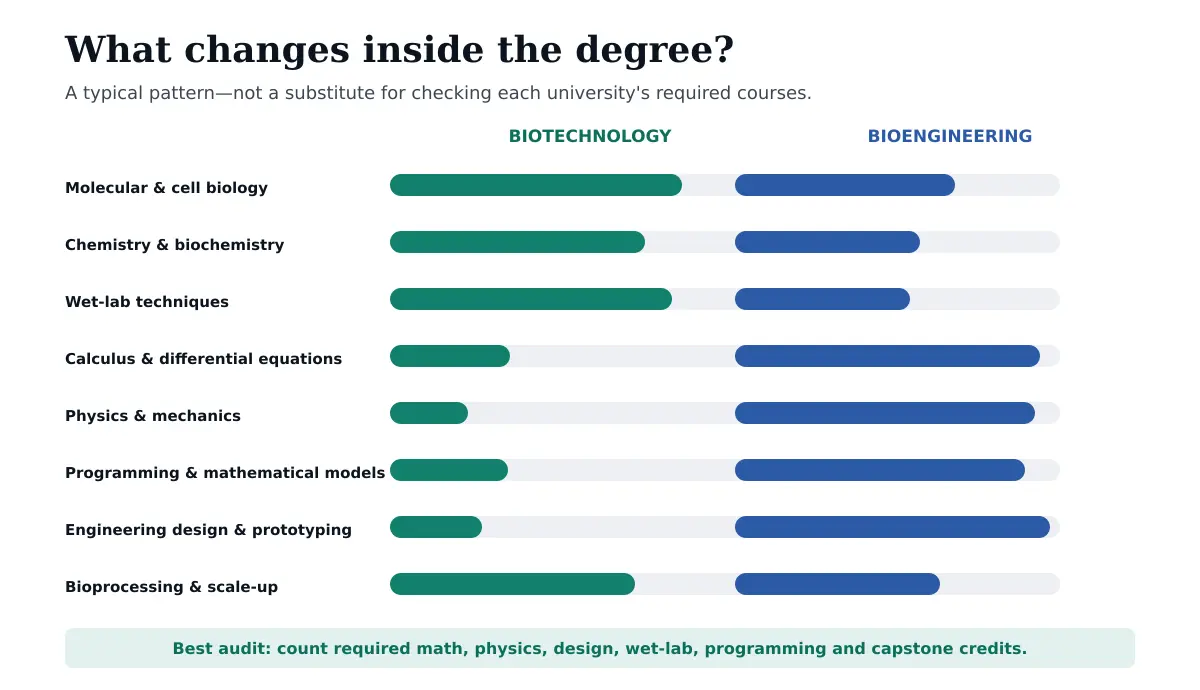
ABET's current program criteria help define the engineering side. Bioengineering and biomedical engineering programs are expected to integrate biology, physiology, chemistry, calculus-based physics, mathematics through differential equations and statistics, then apply them to modeling, design, measurement and the interaction between living and nonliving systems.
Biology and application
- cell and molecular biology;
- genetics and genetic engineering;
- microbiology and immunology;
- biochemistry and analytical methods;
- cell culture or fermentation;
- bioinformatics or biostatistics; and
- quality, regulation or biomanufacturing.
Quantitative analysis and design
- calculus and differential equations;
- calculus-based physics;
- programming and computation;
- mass and energy balances or transport;
- systems, signals or mechanics;
- biomaterials, physiology or instrumentation; and
- engineering laboratory and capstone design.
Which degree is harder?
Bioengineering is usually more mathematically demanding because engineering accreditation and design work require sustained calculus, physics and modeling. Biotechnology is difficult in a different way: dense molecular detail, experimental variability, aseptic technique and long wet-lab workflows. Which one is harder for you depends on whether you struggle more with quantitative abstraction or biological complexity.
Choose the problem you want to solve
Select the work that sounds most satisfying. This is a reflection tool, not an aptitude test or an admissions decision.
Modify cells, genes or microbes
Molecular cloning, cell culture, synthetic biology and experimental optimization may suit you.
Verify in the catalog: upper-level wet labs, genetics, cell culture and undergraduate research access.Career paths after biotechnology or bioengineering
Both degrees can lead into biotechnology, pharmaceutical, diagnostics, medical-device, agricultural, food, environmental and research organizations. The job description matters more than the sector label.
Biotechnology-leaning roles
- research associate;
- cell-culture or fermentation associate;
- molecular biology technician;
- bioprocess or manufacturing associate;
- quality-control analyst;
- quality-assurance or validation associate; and
- regulatory operations support.
Shared territory
- bioprocess development;
- diagnostics development;
- tissue engineering;
- synthetic biology;
- laboratory automation;
- biomaterials testing; and
- technical product support.
Bioengineering-leaning roles
- biomedical engineer or bioengineer;
- medical-device design engineer;
- product-development engineer;
- test or validation engineer;
- biomaterials engineer;
- biomechanics engineer; and
- systems, modeling or imaging engineer.
Search vacancies by skill as well as title. Biotechnology postings tend to repeat PCR, chromatography, cell culture, aseptic processing, GMP, validation or upstream and downstream processing. Bioengineering postings tend to emphasize CAD, MATLAB or Python, finite-element analysis, signals, statistics, design controls, prototyping or verification testing.
Can a biotechnology graduate become a bioengineer?
Possibly, but a title cannot bridge missing engineering preparation. A biotechnology graduate may move into bioprocess, validation or applied development roles, especially with quantitative experience. Device design, biomechanics and engineering-analysis positions often expect an accredited engineering degree or clear evidence of calculus, physics, programming and design competence.
Can a bioengineer work in biotechnology?
Yes. Bioengineers can work on bioreactors, process development, automation, data analysis, tissue platforms, diagnostics and manufacturing systems. They may need extra hands-on preparation for roles centered on molecular cloning, advanced cell biology or specialized wet-lab techniques.
Bioengineering vs biomedical engineering vs biotechnology
This adjacent comparison causes much of the search confusion. Biomedical engineering usually focuses on engineering for human health. Bioengineering may include biomedical work but can extend to agriculture, ecology, industrial biology and nonmedical biological systems. Biotechnology more often centers on using cells, organisms and biomolecules to make a product or process.
The U.S. Bureau of Labor Statistics groups bioengineers and biomedical engineers into one occupation. Its examples of specialties include biochemical engineers, who work with cell structures to create products for uses such as bioremediation, and genetic engineers, who alter organisms with recombinant DNA technology. That is a useful reminder that the engineering label can reach well into territory people think of as biotechnology.
The distinction holds as a rule of thumb, but it is not universal. Some institutions use bioengineering as their department name for a largely biomedical curriculum. Others offer biotechnology inside bioengineering. If you are choosing between biotechnology and biomedical engineering, ask whether you want molecular and cellular product development or devices, mechanics, signals and clinical systems.
Salary and outlook: use occupations, not degree labels
"Biotechnology" is not one standardized occupation, so no defensible national salary exists for every biotechnology graduate. Outcomes vary across research, production, quality, regulatory, sales and management roles. Bioengineering has a clearer occupational match in federal data.
U.S. median annual wage in May 2025, according to the Bureau of Labor Statistics. The lowest 10 percent earned under $71,850 and the highest 10 percent earned over $168,180.
BLS projection for bioengineers and biomedical engineers from 2025 to 2035, with about 1,200 openings per year on average.
A small occupation. BLS lists a bachelor's degree as the typical entry-level education.
May 2025 median wages for this occupation in instrument manufacturing versus educational services, showing how much the employer matters.
These figures describe an occupation, not a guaranteed salary for a bioengineering major. Biotechnology graduates spread across many BLS occupations, so a direct "degree salary" comparison would be misleading. Location, degree level, industry, technical skills, regulated experience and job function can all change pay substantially.
How to audit a program before choosing
Two programs with the same name can prepare you very differently. A short audit of the catalog tells you more than any ranking.
- Count the quantitative core. Record required calculus, differential equations, statistics, physics and programming courses.
- Inspect the laboratory core. Look for cell culture, molecular methods, fermentation, instrumentation, prototyping and the actual hours spent in lab.
- Find the design evidence. Does the degree require engineering design, a team capstone, build-test cycles or formal constraints?
- Check accreditation carefully. For U.S. engineering careers, determine whether the exact program, not merely the university, is ABET accredited.
- Review faculty and facilities. Match active laboratories, equipment and undergraduate research to your interests.
- Read twenty target job descriptions. Compare repeated skills with required courses, internships and student projects.
- Ask where graduates go. Seek role titles and employers, not a vague placement percentage.
If you are still split, go back to the two students at the bench. Notice which question you would rather spend a semester answering, then open the degree plan and check that the required courses match it.
Frequently asked questions
Are biotechnology and bioengineering the same?
No. Biotechnology generally applies biological systems to products and processes, while bioengineering applies engineering analysis and design to biological systems. They overlap in bioprocessing, tissue engineering, synthetic biology and diagnostics.
Which has more math: biotechnology or bioengineering?
Bioengineering usually requires more calculus, differential equations, physics, programming and mathematical modeling. Some engineering-based biotechnology programs are exceptions, so check the curriculum.
Which is better, biotechnology or bioengineering?
Neither is universally better. Biotechnology fits students drawn to cells, genes, laboratory development and biological production. Bioengineering fits students drawn to quantitative analysis, design, devices and engineered systems.
Can a biotechnology graduate become a bioengineer?
Some crossover is possible, especially in bioprocessing and validation. Engineering-analysis, device and biomechanics roles may require an accredited engineering degree or substantial additional math, physics and design preparation.
Can a bioengineer work in biotechnology?
Yes. Bioengineers work in bioprocessing, diagnostics, tissue engineering, automation, modeling and manufacturing. Specialized molecular or cell-laboratory roles may require additional technique-specific experience.
Is bioengineering the same as biomedical engineering?
Not always. Bioengineering can be broader, while biomedical engineering usually focuses on human health. Some universities use the terms interchangeably, so compare required courses and research areas.
Which degree is better for medical school?
Neither provides an automatic advantage. Choose the stronger personal fit, complete each medical school's prerequisites and protect your academic performance while gaining clinical and service experience.
Do these fields require graduate school?
Many bachelor's-level associate, manufacturing, quality, test and engineering roles exist. Independent research, advanced scientist positions and specialized academic work often require a master's or doctorate.
Sources and research method
This comparison separates degree labels from verified curriculum content. We checked engineering accreditation criteria, current federal occupational data and representative university programs, then treated university-specific patterns as examples rather than universal rules. Federal wage and outlook figures were checked against the BLS Occupational Outlook Handbook page, last modified August 27, 2026.