Short answer
Organic chemistry explains how carbon-containing compounds are structured, how they react, and how chemists design or synthesize them. Biochemistry uses chemical principles to study molecules in living systems, from enzyme activity to metabolism and molecular regulation. These are not always competing undergraduate degrees: organic chemistry is usually taught within chemistry programs, while biochemistry is commonly offered as its own major.
First, this is not a perfectly equal comparison
Before choosing, check what your university actually offers. You may see a stand-alone biochemistry major, but organic chemistry is more often a required course, a concentration, or a research specialization within chemistry. Searching for “biochemistry vs organic chemistry degree” can therefore make two different kinds of options look equivalent when they are not.
If you are choosing a bachelor’s degree, compare biochemistry with chemistry programs that offer substantial organic coursework. If you are choosing a class, consider the material and thinking skills each course develops. If you are choosing a research laboratory, inspect the actual projects: synthesis, medicinal chemistry, chemical biology, and enzymology often cross the boundary.
Look for organic synthesis, analytical chemistry, molecular biology and laboratory depth.
Ask whether mechanisms or living systems hold your attention longer.
Chemical biology, medicinal chemistry and enzymology blur the boundary.
Organic chemistry vs biochemistry at a glance
Consider a medicine candidate that binds to a protein. An organic chemist may study how to build the compound and adjust its functional groups. A biochemist may investigate how strongly it binds, whether it changes enzyme activity, and what happens in a biological pathway. The chemical structure is the same. The next question is different.
| Question | Organic chemistry | Biochemistry |
|---|---|---|
| Central focus | Structures, properties, mechanisms and synthesis of carbon-based compounds | Structure, function, energy and information in biological molecules and systems |
| Typical question | Why did this bond form, break or rearrange? | How does this molecule produce or regulate a biological effect? |
| Scale | Atoms, functional groups and molecules | Biomolecules, pathways, complexes and cells |
| Common visual language | Structures, stereochemistry and curved-arrow mechanisms | Protein structures, pathways, binding and regulation |
| Laboratory emphasis | Synthesis, purification, reaction monitoring and characterization | Assays, purification, electrophoresis, spectroscopy and molecular analysis |
| Typical academic home | Chemistry department | Chemistry, biology or interdisciplinary department |
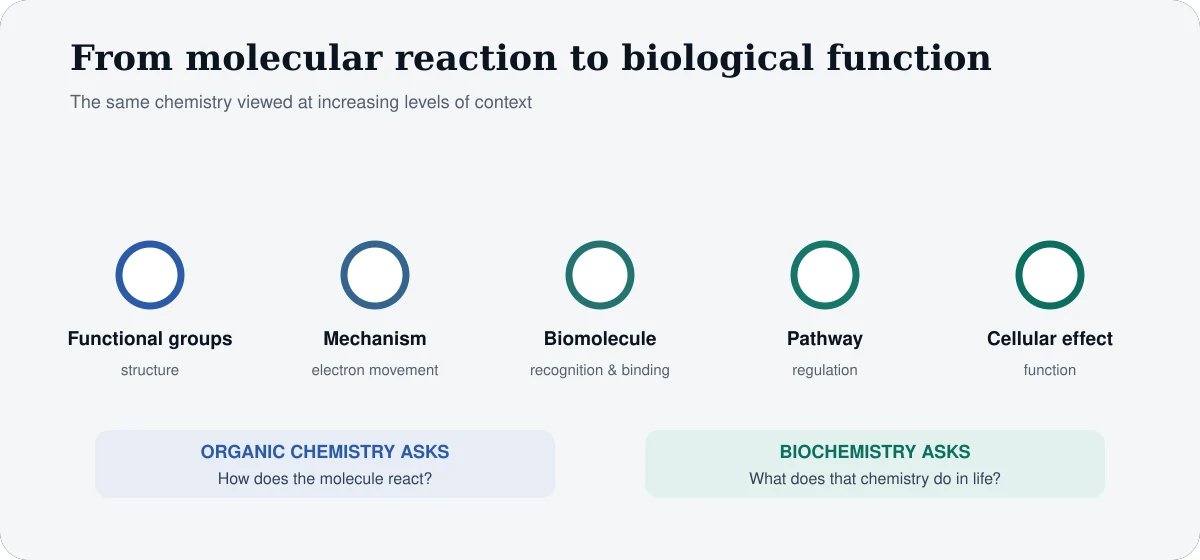
Follow one molecule through two scientific lenses
What functional groups and stereochemistry does the molecule have?
Structure determines reactivity. Organic chemistry trains you to interpret bonding, electron distribution, three-dimensional arrangement and functional groups.
Biochemistry connection: that same structure influences whether an enzyme or receptor can recognize the molecule.How the coursework differs
What organic chemistry asks you to learn
Introductory organic chemistry commonly develops structure and bonding, acidity and basicity, stereochemistry, reaction mechanisms, spectroscopy and the reactions of major functional groups. Advanced study may add multistep synthesis, retrosynthetic analysis, physical organic chemistry, organometallic chemistry or medicinal chemistry.
Within current ACS program guidance, organic chemistry is one of five chemistry foundation areas alongside analytical, biochemistry, inorganic and physical chemistry. That matters: a broad chemistry degree normally includes both organic chemistry and some biochemistry rather than forcing a complete separation.
What biochemistry asks you to learn
Biochemistry typically combines chemical principles with biology. Core topics include amino acids and proteins, enzymes, membranes, carbohydrates, lipids, metabolism, DNA/RNA, molecular recognition and regulation. Programs often require organic chemistry first because bonding, functional groups and mechanism concepts help explain biomolecular behavior.
ASBMB's undergraduate framework emphasizes energy transformation, macromolecular structure and function, information storage and flow, and quantitative discovery in biological contexts. Program titles and course sequences differ, so inspect the actual catalog.
Which is harder?
A student can memorize reaction names and still struggle to predict what electrons will do next. Another can recall every step of a metabolic pathway and still struggle to explain why an enzyme slows down. That is why neither subject is universally harder: organic chemistry often tests mechanism and spatial reasoning, while biochemistry asks you to connect those principles with structures, pathways, and regulation.
Organic chemistry may feel harder if you dislike…
- spatial reasoning and stereochemistry;
- tracking electron movement through mechanisms;
- predicting products from unfamiliar reactions;
- multistep synthesis problems; or
- learning reaction patterns without reducing them to memorization.
Biochemistry may feel harder if you dislike…
- integrating chemistry with cell biology;
- large molecular structures and pathways;
- enzyme kinetics and quantitative relationships;
- connecting molecular events across several levels; or
- distinguishing similar proteins, processes and regulation steps.
The useful question is not “Which subject is objectively harder?” Ask whether you prefer mechanism-centered problems or function-and-system-centered problems. Both still require conceptual understanding, careful terminology and quantitative reasoning.
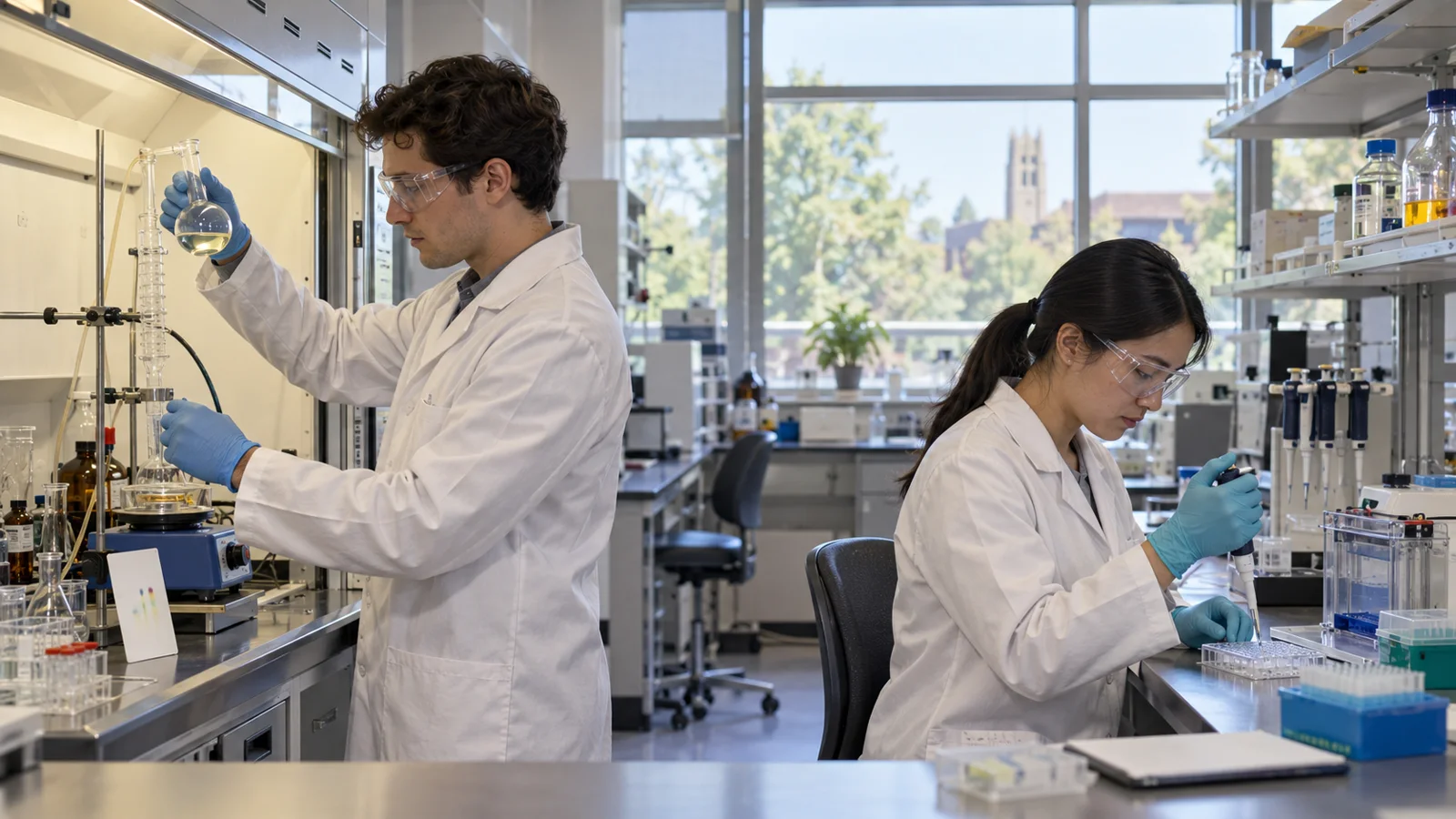
What happens in each laboratory?
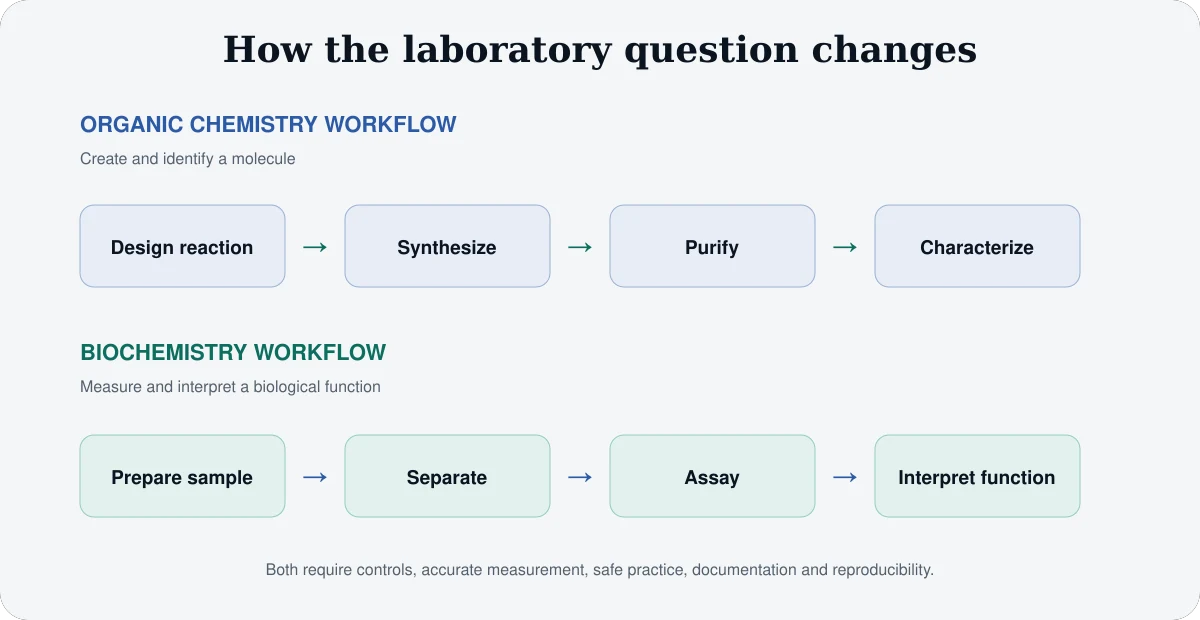
Organic chemistry workflow
Design → react → isolate → purify → characterize.
You may set up reactions, control temperature, perform extraction or chromatography, remove solvent, measure yield and use spectroscopy to establish identity and purity.
Biochemistry workflow
Prepare → separate → assay → quantify → interpret.
You may handle buffers and biological samples, purify proteins, run gels, measure enzyme activity, use spectrophotometry and connect results to biological function.
Career directions and overlap
“Organic chemist” and “biochemist” describe areas of expertise, but employer titles are inconsistent. Your degree, technical methods, research experience and graduate education influence the roles available.
Organic-heavy directions
Process chemistryMedicinal chemistrySynthetic chemistryFormulationMaterials & polymersShared territory
Drug discoveryChemical biologyAnalytical sciencePharmaceutical R&DBiochemistry-heavy directions
Protein scienceEnzyme researchMolecular assaysBiotechnologyCellular researchAdvanced independent research in either direction often requires graduate education. Bachelor's-level graduates may enter laboratory, quality, testing, manufacturing or research-support roles depending on the employer and techniques they can demonstrate.
Why there is no honest “organic chemistry salary” comparison
Salary headlines can make this look like a straightforward contest. It is not. The U.S. Bureau of Labor Statistics groups people by occupation, not by whether they preferred organic chemistry or biochemistry in college. Its Chemists category is not a stand-alone salary survey of organic chemists, and its Biochemists and Biophysicists category covers a different occupational population. The figures below are benchmarks, not a degree-to-degree pay comparison.
Those numbers should not be used to conclude that studying biochemistry automatically pays more. BLS lists a bachelor's degree as the typical entry-level education for chemists, while a doctoral or professional degree is typical for the biochemist/biophysicist occupation and a Ph.D. is generally needed for independent R&D. The populations are not educationally equivalent.
Which direction should you choose?
Choose organic chemistry depth if molecular construction, reaction mechanisms, synthesis and structural characterization are the questions you want to keep solving.
Choose biochemistry if proteins, enzymes, metabolism, molecular medicine and cellular regulation give those molecules the context you care about.
Choose the overlap if drug discovery, chemical biology or medicinal chemistry interests you. Compare faculty laboratories, research access and electives—not only the program title.
A three-document decision test
Before committing, open three documents for each institution: the four-year degree plan, the advanced-course list, and the faculty research pages. Look for the problems you would want to solve repeatedly, even when an experiment fails. Then compare the lab access, prerequisites, and costs. That is a more reliable decision than choosing whichever field sounds more impressive.
If you are making a major-level decision, also read Biochemistry vs Chemistry. That article compares two degree pathways; this page focuses on the organic-chemistry and biochemistry subject areas.
Frequently asked questions
Is biochemistry harder than organic chemistry?
Not universally. Organic chemistry emphasizes mechanisms, spatial reasoning and synthesis; biochemistry integrates chemistry with biological structures, pathways and regulation. Difficulty depends on your preparation and thinking style.
Is organic chemistry part of biochemistry?
Organic chemistry provides foundational ideas for understanding biomolecules, including functional groups, stereochemistry and reaction mechanisms. Biochemistry adds biological context, organization and regulation.
Do biochemistry majors take organic chemistry?
Commonly yes, although exact requirements vary. Check the current curriculum at each university rather than assuming every program has the same sequence.
Which is better for medical school?
Neither label automatically provides an admissions advantage. Students should verify the prerequisite courses of each target medical school and consider academic performance, admissions testing and relevant experience.
Can an organic chemist work in pharmaceuticals?
Yes. Organic and medicinal chemistry skills are relevant to synthesis, process development, drug discovery, analysis and related pharmaceutical work. Education requirements depend on the position.
Can a biochemist do organic synthesis?
Some can, especially with substantial synthesis coursework or research. However, positions centered on complex synthesis may prefer deeper organic-chemistry training and demonstrated laboratory experience.
Which field has more biology?
Biochemistry. It studies chemical processes in biological contexts and commonly includes molecular biology, genetics or cell biology. Organic chemistry generally remains centered on molecular structure and reactivity.
Should I memorize every organic reaction?
Successful study usually depends more on understanding electron movement, mechanism patterns, structure and conditions than on isolated memorization. Some facts still require recall, but conceptual organization makes them usable.
Sources and methodology
This guide separates course-level, degree-level and occupation-level comparisons. U.S. labor figures were checked September 22, 2026.
- American Chemical Society: Guidelines for Bachelor's Degree Programs
- ACS Approval Program: Foundation coursework areas
- ASBMB: Characteristics of an accredited BMB program
- U.S. BLS: Chemists and Materials Scientists
- U.S. BLS: Biochemists and Biophysicists
Occupation medians are not starting salaries, degree earnings or guaranteed outcomes. Course requirements and program names vary by university.