
Data scientist vs software engineer: the difference
Data scientists use data, statistics and modeling to investigate questions, test predictions and explain what the evidence supports. Software engineers design, build, test and maintain applications, services and systems that people or other software depend on.
Both careers require programming, debugging and collaboration. Data science usually puts more emphasis on statistical reasoning, model evaluation and uncertainty. Software engineering usually puts more emphasis on system behavior, maintainability, integration and reliability.
Before choosing a major or switching careers, look at the problems you would be responsible for solving. Data scientists sometimes build software; software engineers sometimes develop machine learning features. The job title tells you less than the day-to-day responsibilities.
Data scientist vs software engineer salary: who earns more?
The latest BLS figures show a higher U.S. median wage for software developers than for data scientists. That does not mean every software engineer earns more than every data scientist.
| Occupation measured | Median annual wage | What to remember |
|---|---|---|
| Data scientists | $120,230 | A national occupation benchmark across experience levels. |
| Software developers | $135,980 | A relevant benchmark for software engineering, not a figure for every employer title. |
The difference is $15,750 a year. These numbers represent the middle of each occupation’s pay distribution. They are not starting salaries, and they do not compare two people with the same employer, experience or location. Sources: BLS Data Scientists and BLS Software Developers.
Why salary websites can give different answers
Salary websites measure different things. Some report average wages, others report medians or compensation submitted by users. One estimate may include stock awards while another counts only base pay. Differences in city, seniority and employer can reverse a ranking without either figure necessarily being wrong.
For a useful comparison, match the date, location, level and responsibilities. Separate base pay, bonus and equity. Ask about benefits, office attendance and support duties. A company specific search such as “Google data scientist vs software engineer salary” still needs a matching level and compensation definition.
Before paying for a degree based on either median, estimate tuition, fees, living costs and income you would give up. Use the Choicelyt education ROI calculator with several plausible early career incomes. A national median is a poor substitute for a beginner offer in your local market.
What would you actually do? Follow one subscription product
Imagine a U.S. subscription service offering a free trial. The team wants more trial users to become paying customers. It is considering an optional reminder that links to the upgrade page. This is an original hypothetical example, not an employer case study.
The data scientist asks whether the idea is supported
They define the outcome: a paid upgrade within a stated period. They check whether the historical records are complete, decide what information would have been available before the reminder and test a simple prediction against a baseline.
They might find patterns in usage or test whether reminders improve upgrades. They explain uncertainty and whether the evidence supports a change. A credible answer could be that the current model adds too little value to use.
The software engineer makes the feature dependable
They build the reminder settings, check permissions and connect the message to the correct upgrade page. They prevent repeated messages, handle failures and test what happens when a user changes their preference.
They also make the feature observable: the team needs to know which messages were attempted, delivered or skipped. A reminder that ignores an opt out or opens a broken link has failed even if the prediction was good.
Prediction and improvement are different questions
A model might identify people already likely to upgrade. That does not prove a reminder causes more upgrades. You could spend time contacting people who would have paid anyway. A carefully designed comparison of reminder and no reminder groups can help investigate the intervention, with appropriate consent, outcome definitions and safeguards.
The data scientist checks whether the proposed intervention has evidence behind it. The software engineer makes sure the feature works, respects user choices and records what happened. Product staff weigh the tradeoffs. At a smaller company, one person may handle several of these tasks.
Data science vs software engineering responsibilities
O*NET’s Data Scientists profile includes evaluating models, communicating findings and identifying business questions. Its Software Developers profile covers software needs, design, testing and changes. Use these broad profiles to orient yourself, then inspect the actual job description.
| Question | Data scientist | Software engineer |
|---|---|---|
| What do you produce? | Analysis, experiments, predictions and recommendations. | Features, applications, services and maintained systems. |
| What is a recurring challenge? | Separating a real pattern from misleading evidence. | Making behavior correct when inputs, usage or dependencies change. |
| How do you test the work? | Compare with a baseline, use suitable evaluation data and explain uncertainty. | Check behavior, integration, permissions, performance and failure recovery. |
| What needs explaining? | What the result means, its limitations and the decision it supports. | How the system works, its tradeoffs and how to maintain it. |
| What can go wrong? | A misleading target, information leakage or an unhelpful metric. | A broken feature, unsafe access or a failure with no usable recovery. |
| What do both need? | Programming, debugging, documentation, collaboration and judgment. | |
Where machine learning engineering fits
Machine learning engineers frequently work where these roles meet. They may package a model, build the service that delivers predictions and monitor its performance after launch. Some positions are closer to software engineering; others involve substantial modeling. Read the responsibilities before assuming the title means one or the other.
A data engineer focuses more on supplying dependable data to these teams. See Data Engineer vs Data Scientist and Data Engineer vs Software Engineer if the infrastructure work appeals to you.
A 90% accurate model can still miss the point
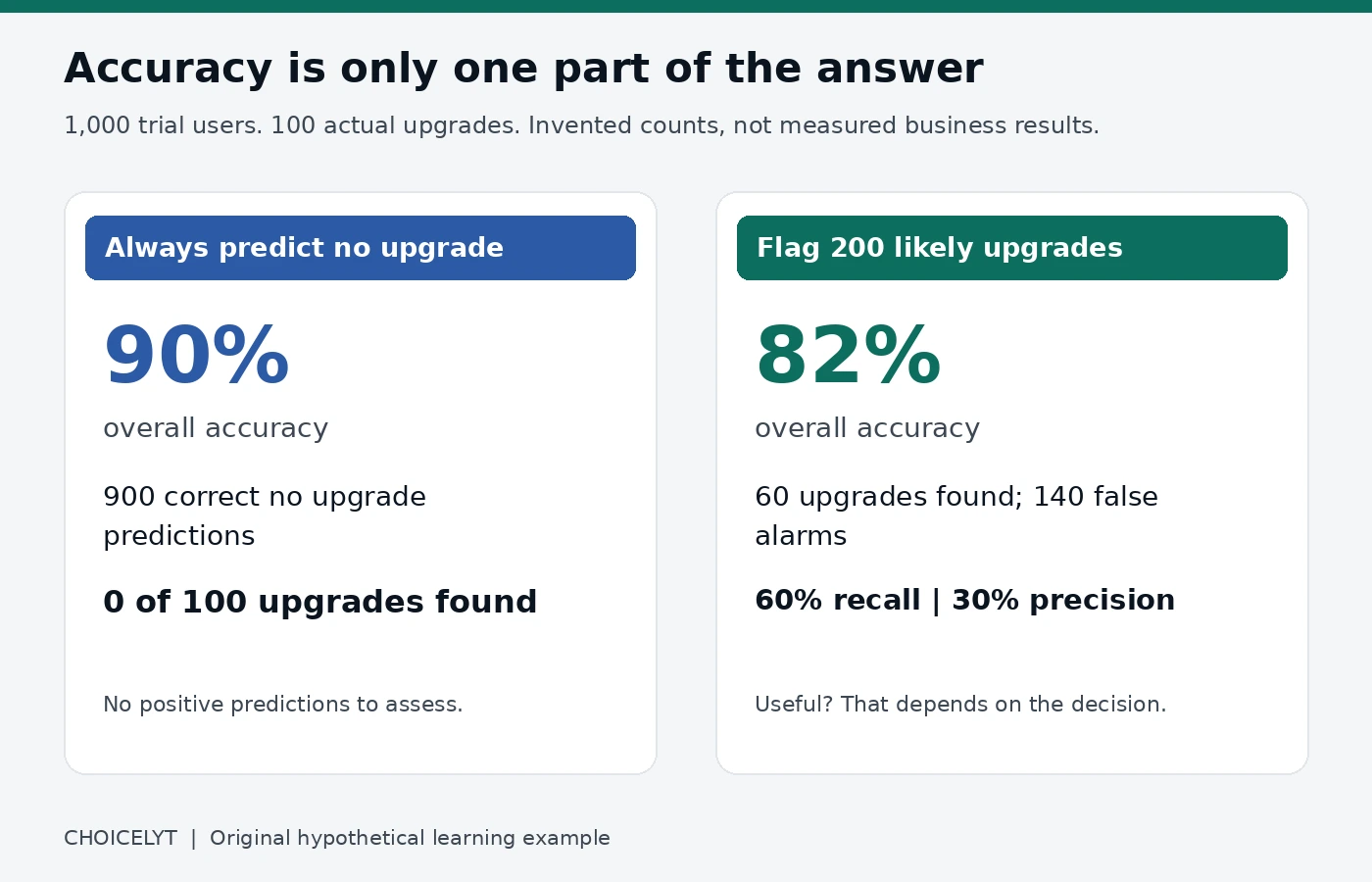
Suppose 100 of 1,000 trial users upgrade. A rule that predicts “no upgrade” for everyone is correct for 900 people. Its accuracy is 90%, but it identifies none of the people who upgrade.
Now suppose another model flags 200 people as likely to upgrade and correctly identifies 60 of the 100 actual upgrades. Its accuracy is lower, but it finds 60 people who actually upgrade. That may be valuable for some decisions and useless for others. The costs of false warnings, missed upgrades and the planned action all matter.
Try the numbers yourself
Keep 1,000 users, 100 actual upgrades and 200 positive predictions fixed. Change how many actual upgrades the model finds. This changes the hypothetical results, not a trained model or its decision threshold.
820 correct predictions out of 1,000.
60 actual upgrades among 200 flagged users.
60 of the 100 actual upgrades found.
140 flagged users do not upgrade; 40 actual upgrades are missed.
Accuracy = correct predictions ÷ all users. Precision = correctly flagged upgrades ÷ all flagged users. Recall = correctly flagged upgrades ÷ all actual upgrades. Rounded to one decimal where needed. These are learning measures, not evidence that sending a reminder changes behavior.
The scikit learn evaluation guide distinguishes prediction quality from decision making and explains multiple scoring measures. You do not need every metric memorized. You do need to ask what a seemingly impressive number leaves out.
This is a taste of data science reasoning. The software counterpart is equally demanding: does the reminder respect preferences, work repeatedly and fail safely? A useful product needs sound evidence and dependable behavior.
Coding, math and the skills worth learning
Does data science require less coding?
Not necessarily. A data scientist may write substantial code to prepare data, run analyses, evaluate models and reproduce results. Software engineers often work across larger maintained codebases, but the amount of code depends on the role. “I want to avoid coding” is not a strong reason to choose either.
Build data science foundations
- Python or R for analysis, and SQL for retrieving data.
- Probability, statistics and the meaning of uncertainty.
- Data preparation and clearly defined outcomes.
- Evaluation on information not used to fit the model.
- Charts and writing that explain a decision accurately.
Build software engineering foundations
- One programming language and organized program design.
- Data structures and methods for solving coding problems.
- Automated tests and practical debugging.
- Version control, review and clear documentation.
- Databases, permissions and failure handling for your chosen specialty.
Python is useful in both careers. A software role may instead center on Java, JavaScript, TypeScript, C++ or another language. Choose the kind of work first, then learn the languages that support it. A project you can explain and test says more than a résumé crowded with tools you barely used.
Which career needs more math?
Data science generally puts more routine emphasis on probability, statistics and model evaluation. You should be comfortable asking whether a result could be due to chance and whether a sample represents the people you care about. Linear algebra and calculus become more important in some modeling work.
Software engineering also needs mathematical reasoning. Graphics, scientific software, optimization and machine learning systems can be mathematically demanding. Many application roles put more daily emphasis on design, logic and testing. “Software has no math” is not a reliable distinction.
Berkeley’s data science major requirements include probability, modeling, computational depth and human contexts. ABET’s software engineering criteria include design, requirements, security and validation, as well as discrete mathematics, probability and statistics. These are curriculum examples and standards, not a universal hiring checklist.
Testing means different things in each role
A model can appear excellent because its inputs accidentally contain information available only after the outcome. That is information leakage. The scikit learn pitfalls guide explains why evaluation data must remain separate from training and preprocessing decisions.
A service can pass a happy path test but fail when a request arrives twice or a dependency is unavailable. Google’s service reliability guidance discusses measures such as response time, errors and availability. In plain terms: decide what users need, measure it and prepare for failures.
Degrees, first jobs and whether you need a master’s
BLS lists a bachelor’s degree as the typical entry education for both Data Scientists and Software Developers. Some data science employers prefer or require graduate study, especially for research-heavy or specialized modeling work. A master’s is not a universal requirement, and a certificate alone does not establish job readiness in either field.
A computer science degree can support either direction if you add the missing foundations. A statistics or data science program can offer stronger preparation in inference and experimentation, but you still need programming practice. A software engineering program can strengthen design and team development, while you may need extra statistical coursework to move toward data science.
Read the course list and project requirements, not just the degree name. The ACM Data Science Task Force provides computing curriculum guidance for the discipline. For broader major choices, read Computer Science vs Data Science and Software Engineering vs Computer Science.
Which is easier to enter?
Neither field has a universally easier entry route. A software portfolio lets employers test a working feature; a data science portfolio asks them to inspect your assumptions and analysis. In both cases, copying a tutorial offers weaker evidence than making and defending your own decisions.
If you already analyze data and understand a business domain, data science may build on your strengths. If you already build applications, software roles may require less retraining. Start from what you can demonstrate rather than a claim that one market is easy.
Compare a manageable sample of current U.S. postings in locations where you can work. Record the title, required experience, degree wording, recurring skills and salary range if disclosed. Keep beginner roles separate from senior roles and remove repeated listings. This personal check is more useful than counting every search result as an available first job.
Interview preparation should match the responsibility
For data science, practice explaining an experiment, choosing an evaluation measure, inspecting data with SQL and defending assumptions. For software work, practice coding, debugging, tests and design decisions relevant to the role. Ask the recruiter which stages are included. Neither field has one standard interview format.
One portfolio project, two different kinds of evidence
Use synthetic trial records to build a small subscription example. Keep the scope modest and make it easy to run locally. A demonstration dataset can teach the workflow; it cannot establish that a real subscription business would obtain the same results.
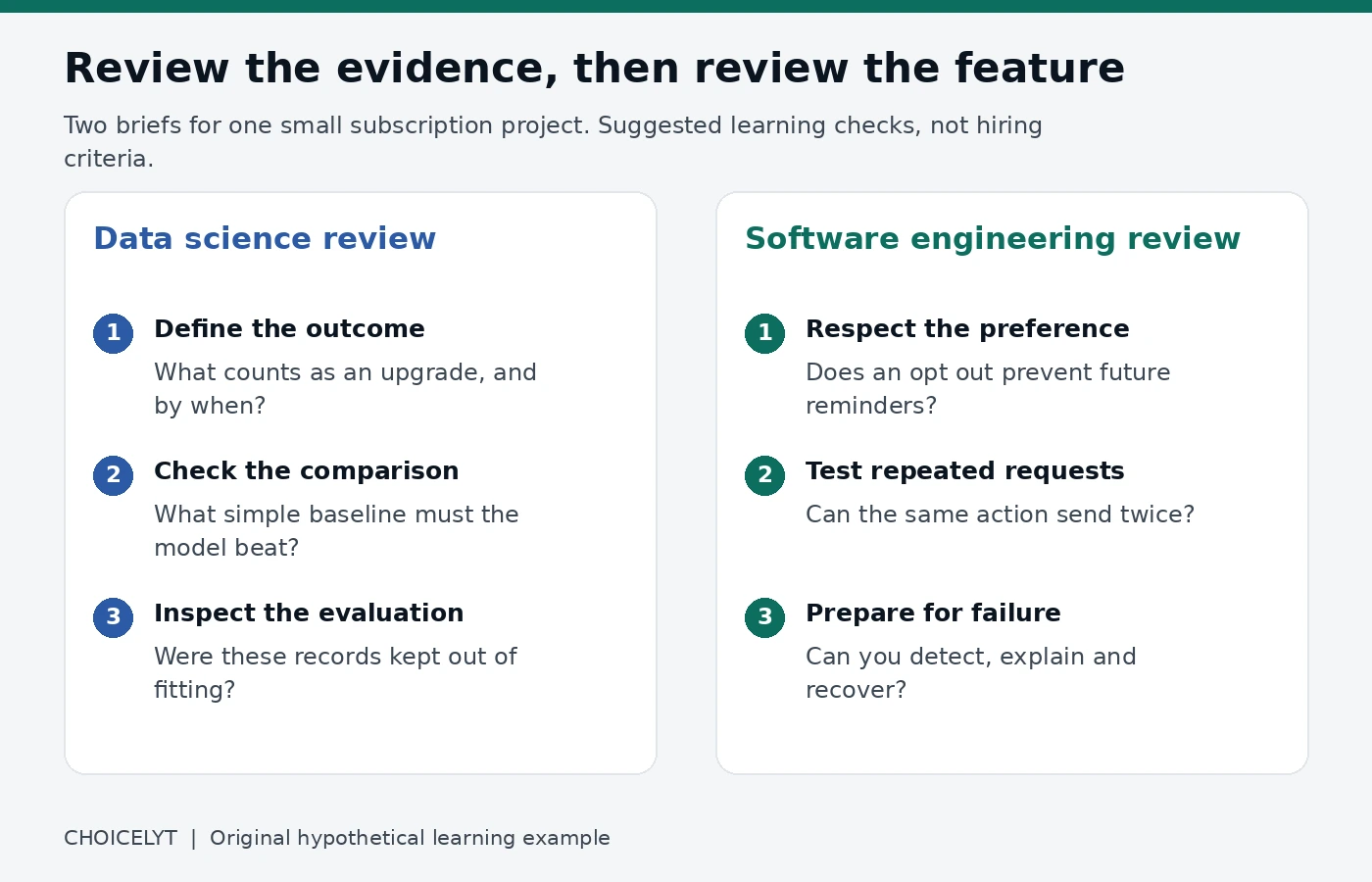
Data science deliverables
- A precise definition of a paid upgrade and its time window.
- A simple baseline and a reason for your evaluation measure.
- Separate fitting and evaluation records, with the separation explained.
- Examples of wrong predictions and what they reveal.
- A short conclusion including what the project cannot prove.
Software engineering deliverables
- A small reminder preference screen or service.
- Permission checks and tests for preference changes.
- A check that repeated requests do not send repeated reminders.
- Useful failure records and a recovery or retry plan.
- Instructions another person can follow to run and inspect it.
Then change one requirement. Suppose reminders must stop immediately after a user opts out. Explain how you would coordinate stored preferences, scheduled work and tests. On the data side, ask whether the new policy changes who receives reminders and how that affects interpretation of results.
Notice which part makes you want to keep working. Do you want to investigate why the result changed, improve the feature’s behavior or connect the two? That reaction is useful career evidence. It is not an aptitude test.
Can you switch between data science and software engineering?
Software engineer to data scientist
Your programming, debugging and testing experience can transfer. The gap is often statistical reasoning: choosing a meaningful target, designing comparisons, evaluating uncertain results and explaining limitations. Add a project where the quality of the conclusion matters as much as the quality of the code.
If you enjoy model deployment more than experiments, investigate machine learning engineering roles. Read their responsibilities carefully rather than assuming every such role is a route into research.
Data scientist to software engineer
Your coding and analytical skills can transfer. The gap may be maintaining larger software components, designing interfaces, automated testing, access controls and service operation. Turn a notebook into a small documented application that handles invalid inputs and failure conditions.
You do not need to become expert in every software specialty. Choose a target such as backend services, then demonstrate the foundations that target requires. A transition plan should identify specific missing work rather than restart your entire education by default.
AI, career demand and what the forecasts mean
Generative AI can draft code, explain an error and help explore a dataset. It can also produce a convincing answer that fails in practice. In either career, you need to understand the output well enough to test it and spot mistakes. Current BLS projections still show growth in both occupations, but those projections do not establish that every task or job title will be equally affected by automation.
Data science responsibilities to practice
Define the question, check data provenance, prevent leakage, select suitable comparisons and explain uncertainty. A generated chart or model summary does not verify those decisions.
Software responsibilities to practice
Define behavior, review permissions, test integration and handle failures. Generated code is not proof that the product is secure, maintainable or correct.
The NIST AI Risk Management Framework offers voluntary guidance for trustworthy AI design, use and evaluation. It supports a careful approach to AI systems; it does not predict which occupation is immune to automation.
U.S. job outlook: growth rate and market size are different
For 2025 through 2035, BLS projects about 35% growth for Data Scientists, from roughly 275,600 jobs to 371,000, with about 24,800 openings per year. For Software Developers, BLS projects about 10% growth, from roughly 1.72 million jobs to 1.89 million. BLS projects about 95,300 Software Developer openings per year on average. Software development starts from a much larger employment base, while data science has the faster growth rate.
These occupational forecasts are not promises about your application or a specific employer. Inspect local opportunities, the work you can demonstrate and the cost of filling your skill gaps. Neither forecast establishes that a career is safe from future change.
Which is better for you? Choose the work you want to own
You want to defend an answer
You enjoy asking why a result happened, checking assumptions and explaining what the data cannot tell you. You are willing to study statistics and sometimes conclude that an idea is not supported.
You want to build dependable behavior
You enjoy turning requirements into a working system, improving its structure and tracking down failures. You are willing to maintain the feature after the first demonstration.
If you are interested in both, try the two versions of the subscription project before paying for a degree or certificate. Then speak to people doing the jobs. You may learn more about your preferred work from one stubborn bug or unexpected model result than from a salary ranking.
Questions to ask a hiring team
- What will I own in the first few months? Ask for a specific analysis, feature or maintained system.
- Who reviews my decisions? Find out how statistical conclusions or software changes are checked.
- What happens when the work fails? Ask about urgent support, recovery and communication.
- How will success be measured? Look for meaningful outcomes and realistic expectations.
Common questions
Are data scientists and software engineers the same?
No. Their skills overlap, but Data Scientists usually focus more on evidence, statistical modeling and predictions, while Software Engineers focus more on building and maintaining software behavior and systems.
Who earns more, a data scientist or a software engineer?
The May 2025 BLS median is higher for Software Developers at $135,980 than for Data Scientists at $120,230. That does not determine an individual offer, and the occupations differ substantially in size and responsibilities.
Which career requires more coding?
Both can require substantial coding. Software engineering often involves larger maintained codebases and broader system integration. Data science uses code heavily for data preparation, experimentation, modeling and reproducible evaluation.
Which career requires more math?
Data science usually places more routine emphasis on probability, statistics and model evaluation. Software engineering can also become mathematically demanding in areas such as graphics, optimization, scientific computing and machine learning systems.
Can a software engineer become a data scientist?
Yes. Programming, testing and systems experience transfer well. The main added gaps are usually statistics, experimental reasoning, model evaluation and communication of uncertainty.
Can a data scientist become a software engineer?
Yes. Coding experience transfers, but the person may need stronger practice with system design, interfaces, automated testing, security, deployment and long-term maintenance.
Do I need a master’s degree for data science?
Not universally. BLS lists a bachelor’s degree as the typical entry education for Data Scientists, although some employers prefer or require graduate education for specialized roles.
Which career is safer from AI?
There is no reliable universal answer. AI can automate parts of coding, analysis and experimentation in both fields. The durable skills are defining the right problem, validating outputs, understanding failure modes and remaining accountable for results.
Sources and research method
Occupational facts use U.S. public data. Curriculum and technical references support specific explanations. Career fit recommendations, the subscription scenario and the numerical exercise are original editorial material. Their invented counts are not measured employer results. No hiring survey or independent labor market study was conducted.
- BLS: Data Scientists for wages, entry education and projections.
- BLS: Software Developers, Quality Assurance Analysts and Testers. This article uses developer pay and growth, not the combined group’s wage.
- O*NET: Data Scientists for occupational tasks.
- O*NET: 2025 employer software demand for Data Scientists.
- O*NET: Software Developers for occupational tasks.
- O*NET: 2025 employer software demand for Software Developers.
- UC Berkeley: Data Science upper division requirements as a U.S. curriculum example.
- ABET: 2026 to 2027 Engineering Program Criteria, Software and Similarly Named Engineering Programs.
- ACM: Data Science Task Force for computing curriculum guidance.
- scikit learn: Common pitfalls for information leakage and evaluation practices.
- scikit learn: Model evaluation for interpreting scoring measures.
- Google SRE: Service Level Objectives for meaningful service reliability measures.
- NIST: AI Risk Management Framework for voluntary AI risk guidance.
Sources checked October 2, 2026. Wage period: May 2025. Projection period: 2025 through 2035. Program requirements and hiring needs can change. Suggestions are general educational guidance.