
Short answer
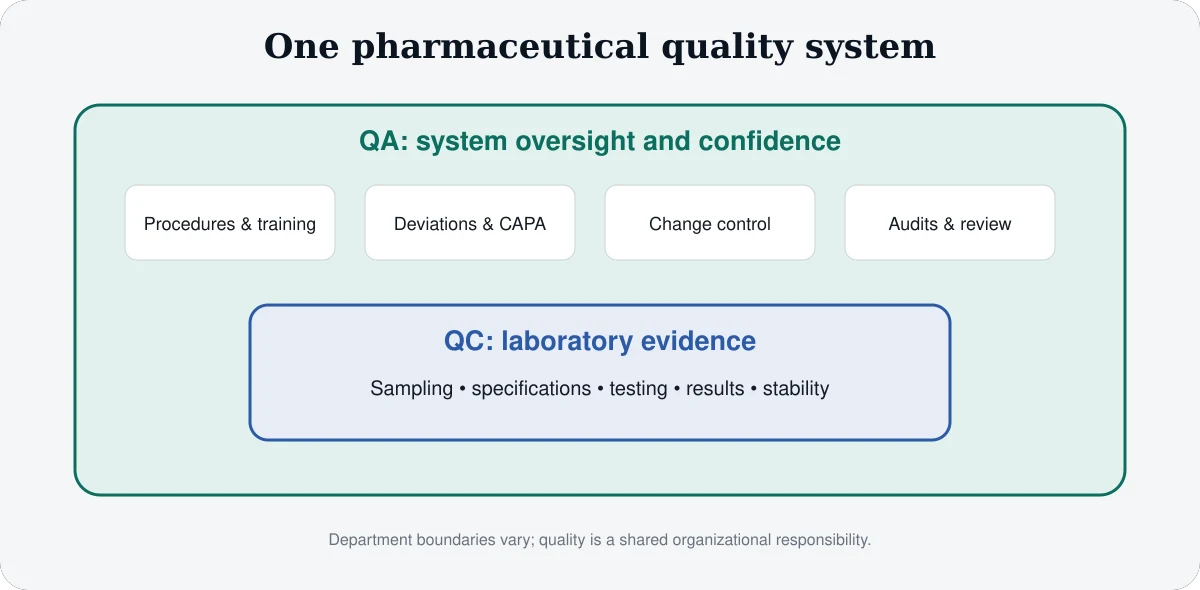
Pharmaceutical QA is system-focused: procedures, training, deviations, change control, CAPA, audits and review of records that demonstrate control. Pharmaceutical QC is laboratory-focused: sampling and testing components, in-process materials, finished products and stability samples against approved methods and specifications. Under U.S. drug CGMP rules, the legally defined quality control unit has broader approval and rejection authority than the everyday job title “QC analyst.”
The core difference
Imagine a batch of tablets waiting in a hold area on a Friday afternoon. In the lab, an analyst has just finished the assay, and the HPLC result sits comfortably inside the specification. Down the hall, a QA reviewer is reading the batch record and notices a line-clearance entry with no signature. The test result is fine. The paperwork raises a question. (This scenario is invented for illustration.)
Neither person can do the other’s job in that moment. The analyst produced evidence about the product. The reviewer is asking whether the evidence about the process holds together. That gap between “the sample passed” and “the system stayed in control” is the core of pharmaceutical quality assurance vs quality control.
Build confidence in the system
QA asks whether procedures, records, investigations, training and changes collectively show that the process remains controlled.
- Document and procedure control
- Training-system oversight
- Deviation and CAPA coordination
- Change-control review
- Audits and batch-record review
Generate product evidence
QC asks whether a representative sample meets scientifically sound, approved test methods and specifications.
- Sampling and sample management
- Standards and reagent preparation
- Chemical, physical or microbiological tests
- Instrument suitability and calibration support
- Results, trends and laboratory investigations
Interactive responsibility map
Select an activity to see which function normally leads and which supports. This is a practical editorial guide, not survey data or a universal organization chart.
QC performs approved laboratory tests; QA may oversee procedures, data governance and the wider quality system.
Where QA and QC act in a pharmaceutical batch
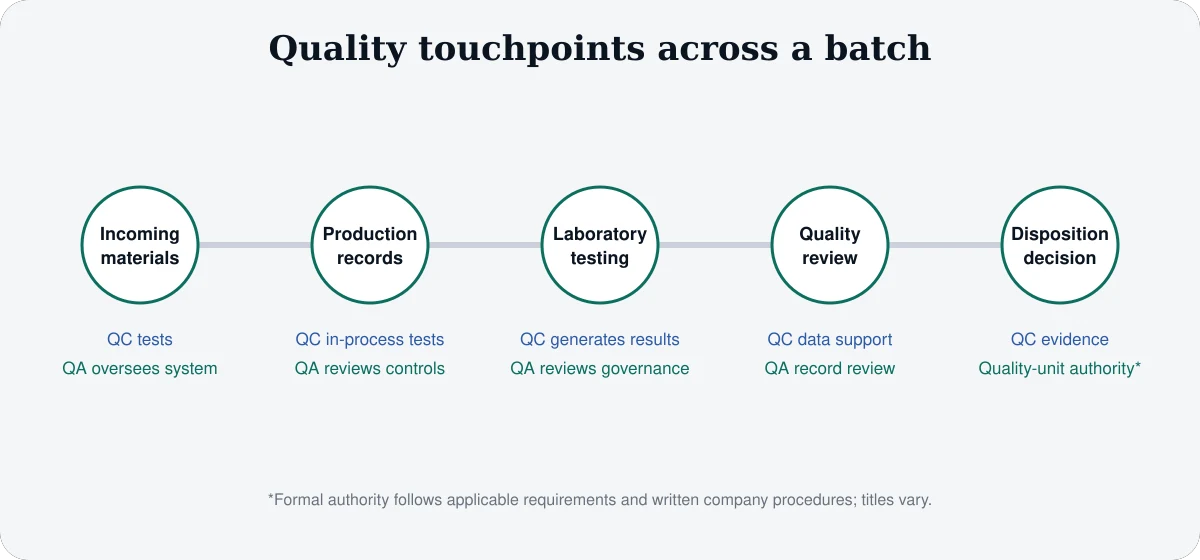
Choose a stage. The panel explains typical contributions without implying that every company divides responsibilities identically.
Incoming materials
QC: samples or tests components according to approved plans and specifications. QA: oversees approved procedures, supplier controls and the quality-system evidence supporting use.
What the daily work feels like
Pharmaceutical QA
- Review records, procedures and investigations
- Coordinate across production, QC, engineering and regulatory teams
- Assess whether evidence is complete and defensible
- Track CAPA, change controls and quality trends
- Prepare for or participate in audits
Work rhythm: meetings, review queues, risk decisions, writing and follow-up.
Pharmaceutical QC
- Prepare samples, standards and reagents
- Run HPLC, GC, spectroscopy or other approved tests
- Check system suitability and calculations
- Record results contemporaneously
- Escalate atypical or out-of-specification findings
Work rhythm: bench work, instrument sequences, turnaround targets and detailed records.
What U.S. pharmaceutical CGMP actually says
Terminology matters here, because “quality control” means two different things in U.S. drug manufacturing. In 21 CFR 211.22, the quality control unit is a regulatory function with the responsibility and authority to approve or reject components, containers, closures, in-process materials, packaging, labeling and drug products. It also has authority to review production records to assure that no errors have occurred, and to approve or reject procedures or specifications affecting identity, strength, quality and purity. The rule also covers drug products manufactured, processed, packed or held under contract by another company.
In plain English, the regulation names a function, not a department. Companies spread that function across teams called QA, QC or simply Quality, so the “quality control unit” in the rule is much broader than the day-to-day job of a laboratory QC analyst.
Under 21 CFR 211.160, laboratory controls must include scientifically sound and appropriate specifications, standards, sampling plans and test procedures. Those controls are drafted by the appropriate organizational unit and reviewed and approved by the quality control unit. Their performance must be documented at the time it happens, and any deviation from the written controls must be recorded and justified. FDA’s quality-systems guidance adds the bigger idea that quality should be built into the product rather than relying on testing alone.
Skills and education
QC laboratory roles commonly favor chemistry, biochemistry, microbiology, pharmaceutical science or related preparation. QA roles may accept similar scientific backgrounds plus experience in operations, documentation, validation, auditing or regulated quality systems. Requirements vary substantially by employer and responsibility level.
For chemistry graduates, QC can be a direct technical entry route. Movement into QA becomes more realistic when you understand deviations, CAPA, change control, document control, data integrity and how laboratory evidence connects to the wider manufacturing system.
Why there is no honest single QA-vs-QC salary answer
U.S. labor datasets do not map pharmaceutical QA and QC titles into two clean occupations. QC chemists may be classified as chemists; QC analysts may map to technician groups. QA specialists may map to compliance, quality or scientific occupations depending on duties. Comparing one broad occupation against another would create a false precision.
Use actual job postings and offers to compare base pay, shift differential, bonus, education requirement, exempt status, location and scope. The strongest national figure we can responsibly show here is the BLS median for chemists, $91,240 in May 2025. It is not a pharmaceutical QC salary, and it says nothing directly about pharmaceutical QA pay. Even within that one occupation, the lowest 10 percent earned under $58,460 and the highest 10 percent earned over $160,830, so the spread is wide before you split anything by function.
Which pharmaceutical quality role fits you?
QA may fit you if…
- you enjoy reviewing evidence across an entire process;
- you write clearly and ask difficult follow-up questions;
- you can make risk-based decisions without losing independence;
- you prefer systems, investigations and cross-functional work.
QC may fit you if…
- you enjoy laboratory instruments and sample preparation;
- you can follow methods precisely under time pressure;
- you notice small inconsistencies and document them;
- you want results directly connected to product decisions.
If you are still undecided, go back to the batch waiting in the hold area. Ask whether you would rather be the person producing the test result or the person asking whether the whole record supports releasing the batch. Then read a few real U.S. job postings for each role, because the daily work behind a title varies more by company than by department name. If you start in QC, the move toward QA becomes more realistic once you understand investigations, change control and documentation.
Frequently asked questions
What is the difference between pharmaceutical QA and QC?
QA oversees the quality system: procedures, training, deviations, change control, audits and record review. QC performs the laboratory testing that generates evidence about materials and products. In U.S. drug CGMP rules, the legally defined quality control unit is broader than either department title.
Is pharmaceutical QA higher than QC?
Not inherently. They are different functions with different career ladders. Seniority depends on the position, responsibility and organization.
Does QA perform laboratory testing?
Usually QC performs routine laboratory tests. QA may review systems, records, investigations and governance around testing, although structures vary.
Who releases a pharmaceutical batch?
Company procedures assign review and release responsibilities within applicable requirements. Under 21 CFR 211.22, the quality control unit has defined approval and rejection authority; department names vary.
Can a QC analyst move into QA?
Yes. Experience with investigations, deviations, CAPA, document control, audits and data integrity can support the transition.
Which role is better for a chemistry graduate?
QC often provides the more direct laboratory route. QA may suit graduates who prefer systems, documentation, investigations and cross-functional decisions.
Which role is more stressful?
QC often faces testing and production timelines; QA faces review queues, investigations, audit readiness and risk decisions. Workplace conditions matter more than the title alone.
Which role pays more?
No official national dataset cleanly isolates pharmaceutical QA and QC titles. Compare actual jobs by scope, level, location, industry and shift.
Is QA responsible for product quality?
Quality is a shared organizational responsibility. QA supports the system, QC provides testing evidence, and manufacturing and management also carry essential responsibilities.
Sources and methodology
This guide distinguishes everyday QA/QC job functions from the formal “quality control unit” defined in U.S. drug CGMP regulations.
- 21 CFR 211.22: Responsibilities of the quality control unit
- 21 CFR 211.160: Laboratory-control requirements
- FDA: Quality Systems Approach to Pharmaceutical CGMP Regulations
- O*NET OnLine: Quality Control Analysts
- U.S. BLS: Chemists and Materials Scientists
The text of 21 CFR 211.22 and 211.160 and the BLS chemist wage figures were re-checked on October 16, 2026. The FDA guidance and O*NET pages were last checked September 21, 2026. Regulations and company responsibilities should be verified for the relevant product and facility.