
Short answer
Choose computer science if you want broad access to computing theory, systems, AI, data, security and software development. Choose software engineering if you already know you want to build large, reliable software with requirements, architecture, testing, teamwork and long-term maintenance. Both degrees can lead to software-engineer jobs; your projects, internships and technical depth usually matter more than the label alone.
What is the difference between software engineering and computer science?
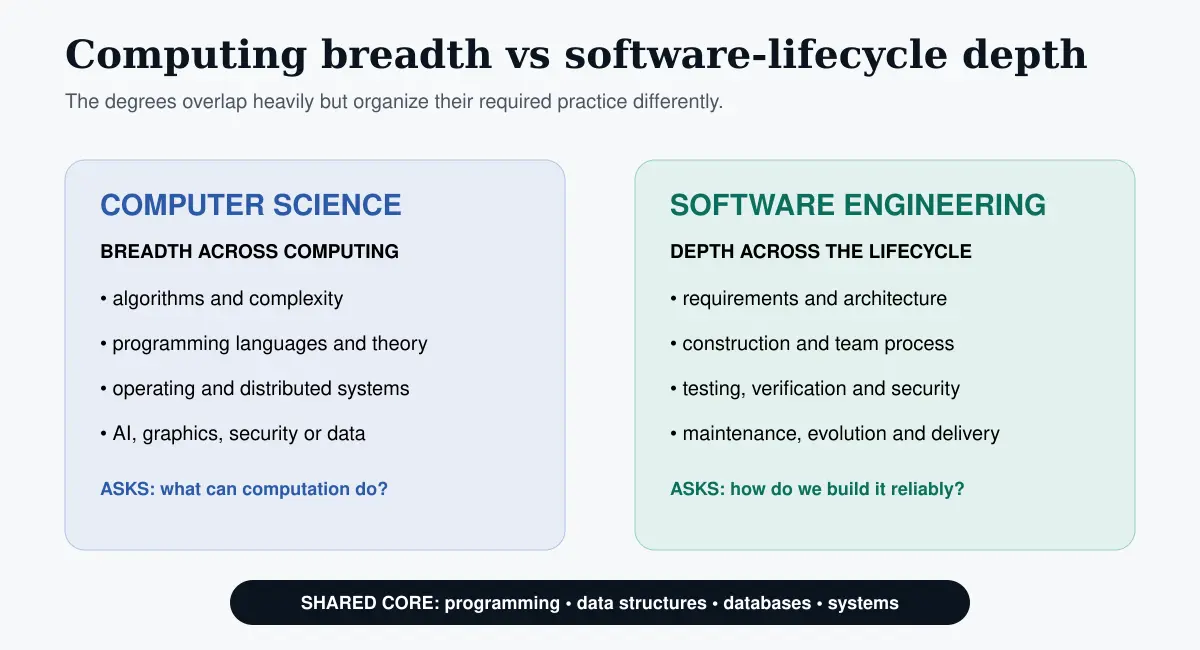
Computer science asks how computation works and how to use it to solve problems. Students study algorithms, data structures, programming languages, operating systems and computer architecture. Depending on the program, they can also go deeper into artificial intelligence, security, graphics or data science.
Software engineering focuses on building software that other people can depend on. Beyond writing code, students learn to interpret requirements, design architectures, test behavior, track changes, work in teams and maintain systems after release.
The boundary is not rigid. CS students build applications, and software engineering students still learn algorithms and computing fundamentals. Look at what the program makes every student do, rather than what appears only as an elective.
Breadth across computing vs depth across the software lifecycle
Computer-science questions
Which data structures and concurrency model will keep transactions fast and correct? How should distributed state, cryptography and database behavior work?
Software-engineering questions
What are the requirements? How will teams divide services, manage change, verify security, test failures, deploy safely and maintain the platform?
Software engineering vs computer science at a glance
| Factor | Computer science | Software engineering |
|---|---|---|
| Central focus | Computation, theory and computing systems | Reliable software development and evolution |
| Breadth | Usually broader across AI, systems, theory, graphics, data and security | Usually deeper across the software lifecycle |
| Programming | Central tool for exploring computing concepts | Central tool inside a larger engineering process |
| Mathematics | Often more theory, discrete math, calculus and probability | Discrete math, probability and statistics applied to engineering decisions |
| Teamwork | Varies; individual and team projects | Usually more required team-based development |
| Testing | Covered, but depth varies by program | Verification, validation and quality are central |
| Requirements | May appear in software-engineering electives | Usually required and connected to architecture |
| Career flexibility | Broad access across computing specializations | Strongly aligned with software-product careers |
| Best fit | You want breadth or may pursue AI, systems, data or research | You want software delivery, architecture, quality and team practice |
How the curricula differ
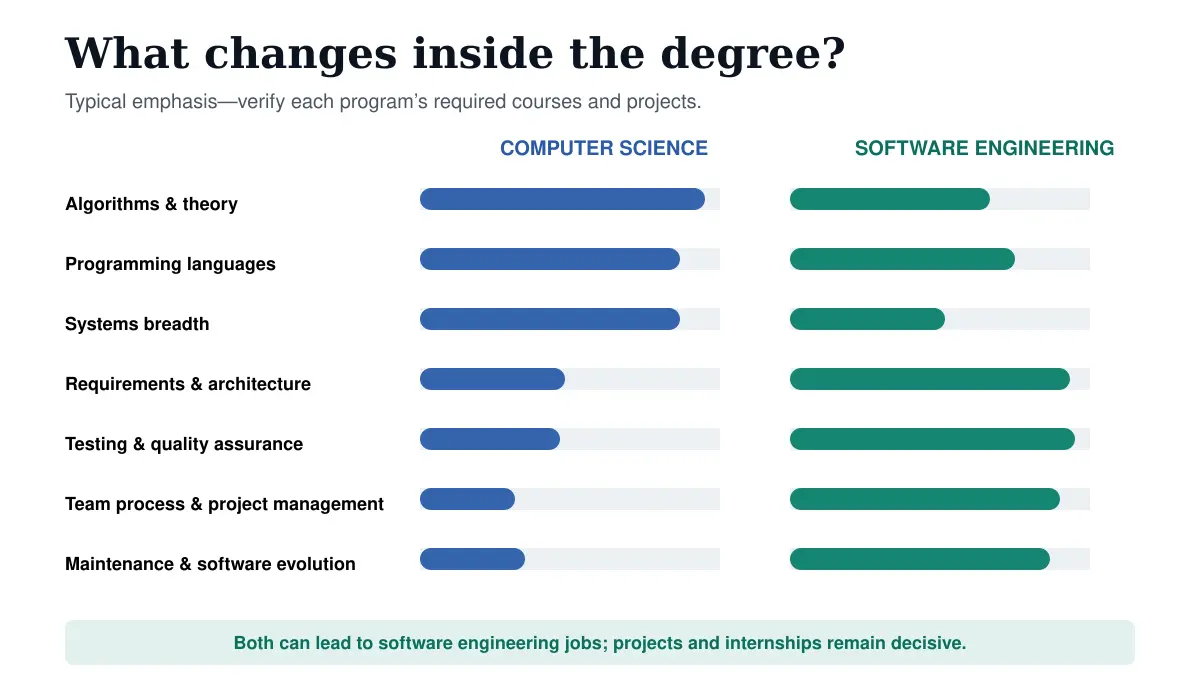
ABET provides a useful curriculum benchmark, but the two degrees may be accredited under different commissions. Under the 2026–2027 Computing Accreditation Commission criteria, a CS program needs at least 40 semester credit hours of computer science and 15 of mathematics and statistics. The Engineering Accreditation Commission criteria for software engineering emphasize software design and construction, requirements analysis, security, verification and validation, and processes for developing complex systems. Verify the exact program and commission rather than assuming an entire university is accredited.
Understand computation broadly
- programming and data structures;
- algorithm analysis and computational complexity;
- discrete mathematics and theory;
- computer architecture;
- operating and distributed systems;
- databases and networking; and
- AI, data, security or graphics electives.
Engineer dependable software
- programming and data structures;
- requirements engineering;
- software architecture and design;
- testing, verification and validation;
- security and quality assurance;
- configuration and project management; and
- maintenance, evolution and team capstone.
Which degree is harder?
The difficulty is different, not automatically greater in one degree. CS may feel demanding if theoretical math and abstract problems are difficult for you. Software engineering can be demanding when a project has changing requirements, multiple contributors and tests that must keep working after every change. Compare required courses and capstones before deciding.
A software engineer is a job—not proof of a software-engineering degree
A CS graduate who wants software engineering work should build evidence of testing, teamwork and delivery, not just coding assignments. A software engineering graduate aiming at AI or research may need additional math, theory and specialist projects. Neither pathway is closed, but some courses are easier to take during a degree than to add later.
Which degree is better for your target career?
| Your goal | Usually the better starting fit | What to verify before enrolling |
|---|---|---|
| General software developer or full-stack engineer | Either degree | Internships, substantial programming projects, databases, testing, version control and deployment. |
| AI, machine learning or data science | Computer science usually has the edge | Linear algebra, probability, statistics, machine learning, data systems and research opportunities. |
| Operating systems, compilers or computing research | Computer science | Theory, systems programming, architecture and access to undergraduate research; research-scientist roles commonly require graduate study. |
| Large product teams, architecture or technical delivery | Software engineering can have the edge | Requirements, architecture, team capstone, testing, configuration management and maintenance. |
| Software quality, testing or reliability | Software engineering often aligns more directly | Verification, validation, test automation, security, quality assurance and realistic team projects. |
| Cybersecurity | Either—specialization matters more | Secure coding, networks, operating systems, cryptography, security labs and internships. |
Which problem would you rather own?
Select the task you would most enjoy practicing. This is a reflection tool—not an admissions decision.
Make a system faster or more capable
You may enjoy data structures, performance tradeoffs and understanding why one technical approach works better than another.
Check next: theory depth, advanced systems electives and research opportunities.Career paths and crossover
Computer-science leaning
- software engineer;
- machine-learning engineer;
- data engineer;
- systems programmer;
- security engineer;
- computer scientist; and
- graduate research roles.
Shared careers
- application developer;
- backend or frontend engineer;
- full-stack developer;
- QA automation engineer;
- DevOps or platform engineer;
- cloud software engineer; and
- technical lead.
Software-engineering leaning
- software engineer;
- software architect;
- requirements engineer;
- test or quality engineer;
- release engineer;
- engineering project lead; and
- site-reliability engineer.
For either degree, a project that other people can use tells employers more than a list of programming languages. Show that you can read unfamiliar code, track changes, write tests, explain design choices and fix bugs after release. An internship or a sustained team project is especially useful evidence.
Computer science vs software engineering salary
Neither degree comes with a national salary. The Bureau of Labor Statistics tracks occupations, not pay by undergraduate major, so these numbers describe specific jobs across experience levels.
BLS projects overall employment of software developers, QA analysts and testers to grow 10% from 2025 to 2035, with about 106,100 openings per year.
U.S. median annual wage in May 2025. This is an occupation-wide median—not a starting salary or a guarantee for either degree.
For comparison, the May 2025 median was $104,300 for software quality assurance analysts and testers and $140,300 for computer and information research scientists. Research scientist roles typically require at least a master’s degree. These are national medians for people already working in those occupations, not expected first-job salaries. Geography, industry and experience can change an offer substantially.
Which degree is safer in the AI era?
Neither degree guarantees protection from changes in AI tools. Code generation can speed up drafts and routine implementation, but someone still needs to decide what the software should do, test whether it works, protect data and maintain the result.
- computing theory and fundamentals;
- systems and performance reasoning;
- AI and data foundations;
- ability to learn new abstractions.
- requirements and architecture;
- verification of generated code;
- team coordination and review;
- reliability, security and maintenance.
A sensible preparation is to combine computational fundamentals with practical verification. Try AI tools, but practice checking generated code, reproducing bugs and explaining tradeoffs without relying on the tool. No credible source can promise which degree will be safer from future automation.
How to choose between the degrees
- Audit the required curriculum. Count theory, systems, mathematics, requirements, architecture, testing and team-project credits.
- Inspect the capstone. A serious software-engineering program should require sustained teamwork and lifecycle evidence—not only a small app.
- Check accreditation. Search ABET for the exact program and commission; do not assume from the university name.
- Read target job descriptions. Identify repeated skills and compare them with required courses and electives.
- Evaluate breadth. If you may move toward AI, research, graphics or systems, confirm whether the SE program preserves enough CS depth.
- Build evidence before graduating. Complete internships and a maintained project with tests, documentation, issue tracking and deployment.
Frequently asked questions
Is software engineering better than computer science?
Neither degree is universally better. Both can lead to development work. Compare the required curriculum, capstone, internship access and the particular job you want.
Can a computer-science graduate become a software engineer?
Yes. BLS says software developers typically need a bachelor’s degree in computer and information technology or a related field; it does not require a degree specifically titled software engineering. CS students should add team projects, testing, version control, deployment and internships.
Can a software-engineering graduate work in AI or data science?
Yes, but advanced mathematics, statistics, machine learning and data experience may need to be added through electives, projects or graduate study.
Which degree has more math?
Computer science often has more theoretical mathematics. Software engineering still uses discrete mathematics, probability and statistics.
Do software engineers need an engineering license?
Most U.S. software-development jobs do not require professional-engineer licensure. Requirements can differ in regulated or safety-critical contexts.
Do the degrees lead to different salaries?
Not automatically. BLS reports pay by occupation, not by undergraduate major. In May 2025, the U.S. median was $135,980 for software developers and $104,300 for software QA analysts and testers. These are occupation-wide medians, not graduate starting salaries.
Sources and research method
This comparison uses current accreditation criteria, computing curriculum guidance and federal occupational projections. Competitor pages informed question coverage, but their wording and salary shortcuts were not reused.