Short answer
Biochemistry usually provides deeper training in molecular chemistry, proteins, enzymes, metabolism and biochemical measurement. Biotechnology is usually more application-oriented, combining biology with genetic engineering, cell culture, bioprocessing, product development, manufacturing, quality or regulation.
Neither degree is universally better. Many biotechnology roles depend on biochemistry, and many biochemistry graduates work in biotechnology companies. Compare the required chemistry, laboratory hours, research access, internships and actual graduate outcomes before choosing.
Picture two first-year students at the same lab bench. This is an invented example, used only to make the idea concrete. One cannot stop asking why an enzyme loses activity when the temperature rises. The other keeps asking how you would keep that enzyme working in a 500-liter tank. Same textbook, same instructor, two different instincts. The first leans biochemistry. The second leans biotechnology. Most people carry a bit of both, which is why this guide focuses on typical emphasis and not on a hard line.
What is the difference between biotechnology and biochemistry?
Biochemistry is a molecular science. It asks how proteins fold, how enzymes accelerate reactions, how cells obtain and use energy, how biomolecules interact and how chemical changes contribute to health or disease.
Biotechnology is an application-oriented field. The National Library of Medicine describes it around the use of organisms, cells or cell-derived components to develop products, while the Biotechnology Innovation Organization summarizes it as technology based on biology. Its scope can include medicines, diagnostics, fermentation, agricultural technology, industrial enzymes, environmental systems and manufacturing processes.
The boundary is not a wall. A biochemist may develop an enzyme assay for a biotechnology company. A biotechnology graduate may need enzyme kinetics, protein chemistry and metabolism to optimize a production system. The most useful distinction is one of typical emphasis: biochemistry asks more often how a molecular system works, while biotechnology asks more often how biological knowledge can be turned into a usable process, product or platform.
Biotechnology vs biochemistry at a glance
| Factor | Biochemistry | Biotechnology |
|---|---|---|
| Central question | How do biological molecules and chemical reactions work? | How can biological systems be used, modified or scaled to solve a problem? |
| Academic center | Chemistry connected to biology | Applied biology connected to technology, processing and industry |
| Common subjects | Organic chemistry, proteins, enzymes, metabolism, thermodynamics and molecular biology | Genetics, cell culture, microbiology, bioprocessing, bioinformatics, quality and regulation |
| Typical laboratory emphasis | Purification, assays, chromatography, spectroscopy and molecular measurement | Cell culture, recombinant systems, fermentation, scale-up, process monitoring and product testing |
| Common outputs | Mechanistic understanding, analytical data and research findings | Processes, prototypes, diagnostics, biologics, engineered organisms or commercial products |
| Best fit | Students who enjoy molecular explanations and chemistry | Students who enjoy applied biology, development and multidisciplinary projects |
Where each field sits in the science-to-product pipeline
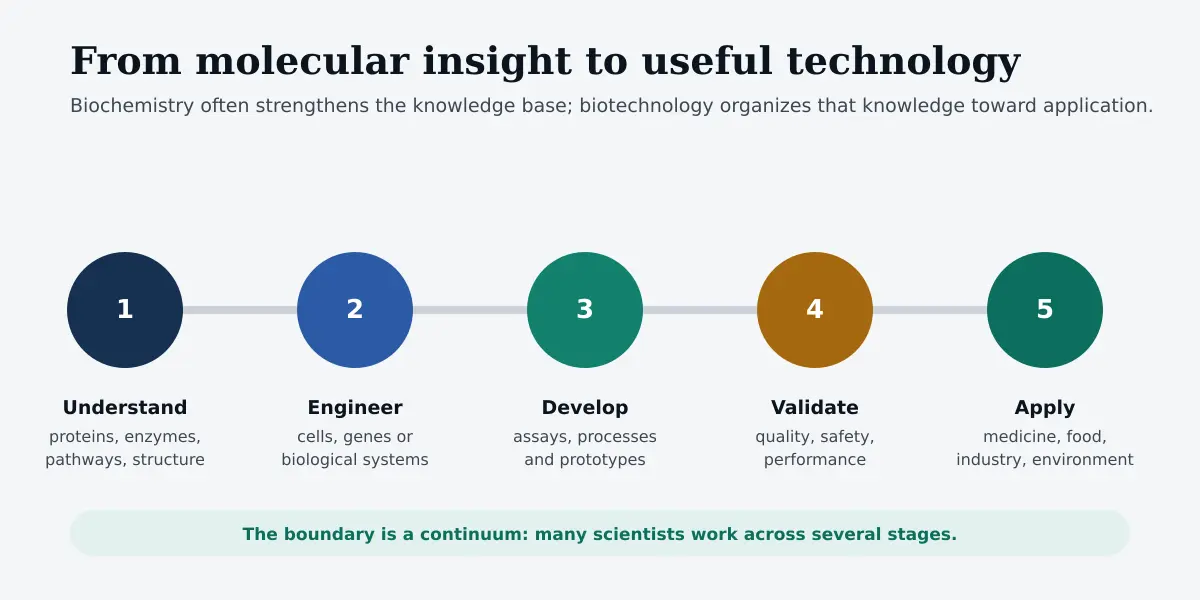
Biochemistry can clarify which molecule matters, how strongly it binds, why an enzyme loses activity or which pathway controls a response. Biotechnology can then connect that evidence with engineering, production, validation and delivery. A biotechnology project may fail without sound biochemistry; biochemical knowledge may remain fundamental research without an application pathway.
How the degree coursework differs
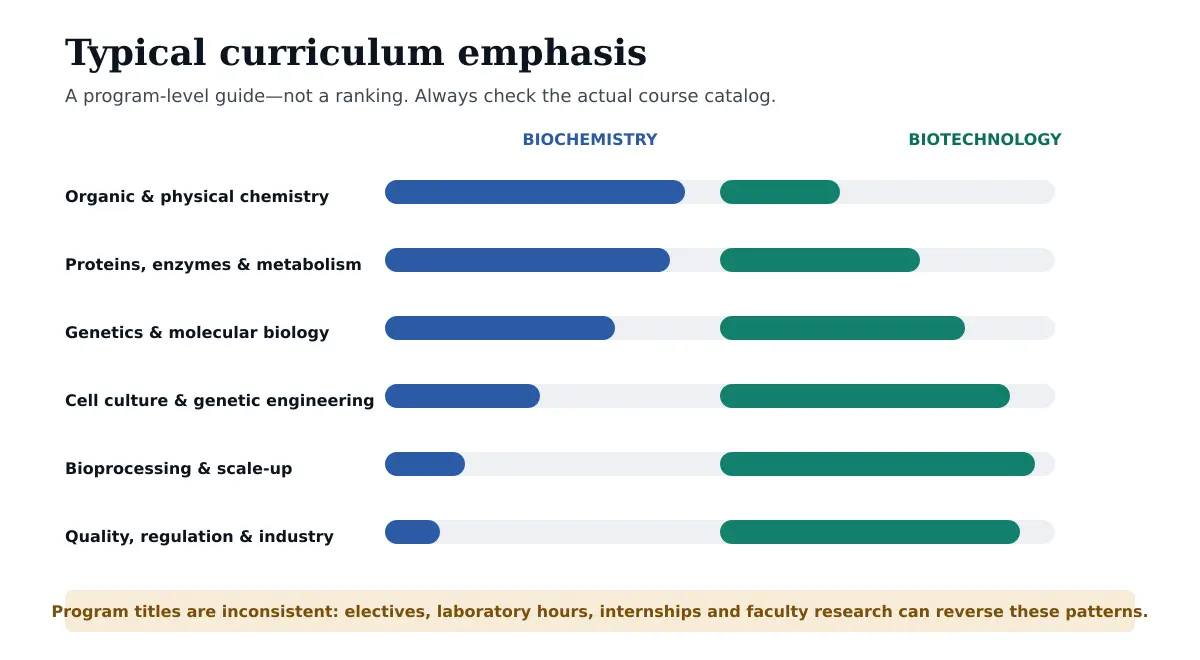
Deeper molecular explanation
- general and organic chemistry;
- analytical or physical chemistry;
- protein structure and function;
- enzyme kinetics;
- metabolism and bioenergetics;
- molecular biology; and
- quantitative biochemical laboratory work.
Broader applied development
- molecular and cell biology;
- genetics and genetic engineering;
- microbiology and cell culture;
- bioinformatics or data analysis;
- fermentation and bioprocessing;
- quality and regulatory concepts; and
- product or process development.
ASBMB's current accreditation framework gives a concrete benchmark for strong biochemistry and molecular biology programs. It emphasizes four core concepts: energy transformation, macromolecular structure and function, biological information flow, and discovery through objective measurement, quantitative analysis and clear communication. Accredited programs are also expected to provide 400 or more contact hours of direct laboratory experience across STEM, with at least one research or inquiry-based experience recommended. Biotechnology programs may build on the same molecular foundation while adding production systems, process control, entrepreneurship, regulatory science or manufacturing.
Laboratory work: bench science versus development systems
Purify a protein, measure enzyme activity, determine binding behavior, examine stability or quantify metabolites.
Use controls, electrophoresis, PCR, immunoassays, quantitative analysis and reproducible documentation.
Engineer a host, grow cells, optimize yield, monitor a process, test a prototype or prepare for scale-up and validation.
Employers rarely hire on degree title alone. Practical competence can include aseptic technique, sample preparation, documentation, experimental design, statistics, data integrity and familiarity with the instruments or production environment used by the organization. For biochemistry-heavy roles, chromatography, spectroscopy, electrophoresis and assay work may matter. For biotechnology-heavy roles, cell culture, fermentation, process monitoring, GMP documentation and validation may matter more.
Which type of problem sounds most satisfying?
Select the work you would most like to do. This is a reflection tool, not an aptitude test.
Explain why a molecule behaves as it does
You may enjoy protein structure, chemical interactions, enzyme mechanisms, metabolism and carefully controlled molecular experiments.
Still verify: chemistry depth, upper-level laboratories and undergraduate research.Career paths after biotechnology or biochemistry
Both degrees can lead into biotechnology and pharmaceutical organizations, research laboratories, diagnostics, food and agriculture, environmental work and graduate education. The difference is usually visible in the role requirements, not only the company sector.
Biochemistry-leaning roles
- biochemistry research assistant;
- protein or enzyme assay associate;
- analytical laboratory associate;
- metabolism or biomarker research;
- formulation or stability support; and
- graduate research in molecular sciences.
Overlapping roles
- biological or laboratory technician;
- research associate;
- quality control analyst;
- assay-development associate;
- diagnostics laboratory roles; and
- pharmaceutical or biotech R&D support.
Biotechnology-leaning roles
- cell-culture or bioprocess associate;
- fermentation technician;
- manufacturing science support;
- quality assurance or validation;
- regulatory operations; and
- biotechnology product-development support.
Titles differ across employers. Search job descriptions for techniques such as protein purification, HPLC, PCR, cell culture, upstream or downstream processing, GMP documentation, validation and statistical analysis. That skills-based search is more reliable than searching only for “biochemist” or “biotechnologist.” Also separate bachelor’s-level associate or technician roles from independent scientist positions that may require graduate study.
Graduate study: where the two paths often separate
Level of degree changes the picture more than the major name does. BLS says biochemists and biophysicists need a Ph.D. to work in independent research and development positions, and that most Ph.D. holders begin in temporary postdoctoral positions. Bachelor's and master's graduates qualify for some entry-level positions, but many of those roles sit closer to the technician and associate level. For biological technicians, BLS lists a bachelor's degree in biology or a related field as the typical entry education and stresses that students need laboratory experience, which internships can supply.
In practice, if your goal is to lead independent research in either field, plan for graduate study. If your goal is to start working with a bachelor's degree, look closely at how many hands-on laboratory hours and internship routes each program offers, because those are what employers see first.
Biotechnology vs biochemistry salary: why there is no single answer
A degree is not an occupation, and “biotechnology” is an industry-spanning field rather than one standardized job. BLS does not publish one national salary called “biotechnologist.” A direct degree-versus-degree salary claim would therefore be misleading.
May 2025 U.S. median. BLS counted about 35,200 jobs in 2025 and projects 12% growth to 39,500 jobs by 2035, with about 2,900 openings per year. Independent R&D generally requires a Ph.D., although bachelor’s and master’s graduates qualify for some entry-level positions.
May 2025 U.S. median. BLS counted about 74,400 jobs in 2025 and projects 7% growth to 79,900 jobs by 2035, with about 9,400 openings per year. A bachelor’s degree is the typical entry education.
These figures are occupational reference points, not predicted starting salaries for either major. The Biochemists and Biophysicists occupation is especially important to interpret carefully because it contains many advanced research roles. Bachelor’s graduates entering biotech or laboratory work may instead compete for technician, associate, quality, manufacturing or research-support positions with different pay structures.
Which degree should you choose?
- Compare required chemistry. If organic, analytical and physical chemistry appeal to you, biochemistry may provide the stronger fit.
- Check the biotechnology track. Look for cell culture, genetic engineering, fermentation, bioprocessing, quality and regulatory courses, not just a modern-sounding title.
- Inspect laboratory hours. Identify which instruments, organisms, assays and production systems students actually use.
- Study faculty projects. Protein mechanisms, metabolism and structural work may lean biochemical; process development, engineered cells and applied platforms may lean biotechnology.
- Read ten real job descriptions. Mark repeated skills and compare them with each program's required courses, internships and research opportunities.
Back to the two students at the bench. The one asking why and the one asking how to scale it were never rivals; a project needs both. Choose the question you would still enjoy chasing in year three, after the novelty has worn off, and let the program you pick back that up with real laboratory hours and real internships.
Frequently asked questions
Is biotechnology the same as biochemistry?
No. Biochemistry studies chemical processes and molecular mechanisms in living systems. Biotechnology applies biological knowledge, cells or biomolecules to develop products, processes and technologies.
Which degree has more chemistry?
Biochemistry usually requires deeper chemistry, especially organic chemistry, protein chemistry, enzyme kinetics, metabolism and molecular measurement. Individual curricula still vary.
Is biotechnology easier than biochemistry?
Neither is reliably easier. Biochemistry usually carries heavier chemistry, while biotechnology spreads across more subjects at once, such as genetics, cell culture and process work. Difficulty depends on your strengths and on the specific program, so compare the required courses instead of the degree names.
Which degree is more applied?
Biotechnology is usually more explicitly application-oriented, especially when the program includes genetic engineering, cell culture, bioprocessing, manufacturing, quality or regulation.
Can a biochemistry graduate work in biotechnology?
Yes. Biotechnology companies employ biochemistry graduates in protein science, assays, analytical development, quality control, formulation, diagnostics and research support.
Can a biotechnology graduate become a biochemist?
Possibly, but chemistry depth and research preparation matter. Chemistry-intensive or independent biochemistry research may require additional coursework or graduate education.
Which degree is better for pharmaceutical careers?
Both can lead to pharmaceutical work. Biochemistry often aligns with molecular research, analytical work and assays, while biotechnology often aligns with biologics, cell culture, bioprocessing, manufacturing and validation.
Do I need a Ph.D. to work as a biochemist?
For independent research and development positions, yes. BLS says biochemists and biophysicists need a Ph.D. for those roles. Bachelor's and master's graduates qualify for some entry-level positions, often in laboratory or research-support work.
How many laboratory hours should a good program include?
ASBMB's accreditation standard for biochemistry and molecular biology programs asks for 400 or more contact hours of hands-on laboratory experience across STEM areas, and recommends at least one research or inquiry-based experience. That is a useful benchmark when you compare programs, though not every program follows it.
Do biotechnology and biochemistry require graduate school?
Not for every role. Bachelor’s graduates can enter technician, associate, quality, manufacturing and research-support positions. Independent research and many scientist-level roles commonly require graduate education.
Sources and methodology
This comparison separates degree emphasis, scientific discipline, laboratory preparation, industry applications and occupation-level data. Sources were rechecked October 17, 2026. BLS wage figures are May 2025 data, and BLS projections cover 2025 to 2035.
- ASBMB: Characteristics of an accredited BMB program
- ASBMB: Accreditation and laboratory-experience standards
- NCBI: Biotechnology collection definition
- Biotechnology Innovation Organization: What is biotechnology?
- U.S. BLS: Biochemists and Biophysicists
- U.S. BLS: Biological Technicians
Curricula and job requirements vary. Salary medians describe occupations, not degrees, and are not guaranteed starting salaries.