
Short answer
Biological chemistry and biochemistry are often effectively the same field. Both study chemical processes in living systems. The name “biological chemistry” may signal a chemistry-centered or interdisciplinary program, while “biochemistry” may sit in a chemistry, biology or joint department. That is a tendency—not a rule. Compare required courses, laboratories, research and accreditation before deciding.
The names overlap more than they differ
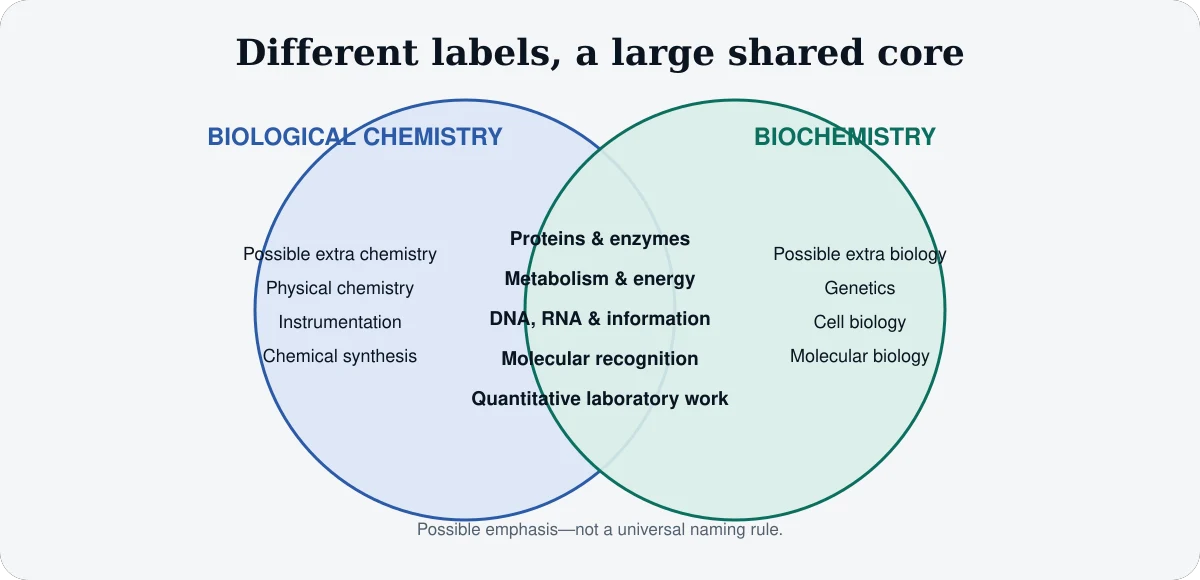
Picture two course catalogs side by side. Both feature proteins, enzymes, nucleic acids, metabolism and molecular recognition. At first glance, the degrees seem identical. Look more closely, though, and one may emphasize chemical instrumentation while the other gives more space to genetics and cell biology. The actual course requirements reveal that difference, not the words on the diploma.
A program housed in a chemistry department may require more physical chemistry, analytical chemistry or advanced instruments. Meanwhile, one based in biology may emphasize genetics, cell biology or molecular biology. Joint departments can combine these approaches. Rather than treating any one pattern as a rule, check the official catalog.
What does the curriculum actually emphasize?
Select the strongest feature you see in a program's required courses.
Chemistry-centered molecular bioscience
Extra physical, analytical or inorganic chemistry can create a more chemistry-intensive route—even if the degree title is “biochemistry.”
Verify: advanced laboratory requirements, instrumental analysis and chemistry prerequisites.What should appear in either curriculum?
ASBMB's outcomes-based framework for biochemistry and molecular biology emphasizes energy in biological systems, macromolecular structure and function, information storage and flow, and quantitative discovery. A strong program under either name should develop scientific measurement, data interpretation, communication and laboratory safety alongside molecular content.
ACS-approved chemistry programs provide another useful reference point. Their breadth spans analytical, biochemistry, inorganic, organic and physical chemistry, with in-depth coursework and substantial laboratory experience. A biological chemistry degree connected to an ACS-approved chemistry program may therefore retain more of that chemical breadth—but verify the exact certified pathway.
Real universities prove the title is not standardized
The naming differences become clearer when you look at real universities. The University of Chicago offers a BS in Biological Chemistry for students interested in interdisciplinary biochemical and biophysical sciences. Harvard uses a different name, Chemical and Physical Biology, for a concentration that applies quantitative, physical and chemical approaches to biological questions. Neither example means one title is superior; instead, each points you toward the program requirements.
These examples do not establish a national naming rule. They show why students should compare learning outcomes and requirements instead of assuming that one phrase has a universal definition.
Do the names lead to different careers?
Usually not by themselves. Employers care about the completed degree, laboratory skills, research experience and job requirements. Graduates may pursue biotechnology, pharmaceutical research, analytical laboratories, quality control, diagnostics, food science, environmental work or research support.

Independent research roles often require graduate education. BLS groups workers into occupations such as biochemists and biophysicists; it does not publish separate national salary categories for graduates named “biological chemistry” versus “biochemistry.” Therefore, a credible comparison should not invent a pay difference between the two degree names.
Graduate school, medical school and professional routes
For graduate study, research preparation and faculty recommendations may matter more than whether the diploma says biological chemistry or biochemistry. Examine advanced coursework, undergraduate research, quantitative preparation and the techniques used in laboratories.
For medical or other professional school, neither name automatically creates an advantage. Confirm prerequisites at every target institution. A scientifically strong program can still omit a specific admissions requirement, while another may include it naturally.
Use this five-part program test
- Required courses: count advanced chemistry, biology, mathematics and laboratory courses.
- Laboratory depth: identify hands-on hours, instruments, assays and independent projects.
- Research access: review faculty laboratories and whether undergraduates can participate.
- External signals: check the exact program or pathway for ASBMB accreditation or relevant ACS approval—not merely the university name.
- Graduate outcomes: ask where recent students worked or studied next, while remembering outcomes are not guarantees.
Frequently asked questions
Is biological chemistry the same as biochemistry?
Often they describe substantially the same field, but degree requirements vary. Compare each institution's catalog and program outcomes.
Is biological chemistry harder than biochemistry?
The name does not determine difficulty. A chemistry-heavy curriculum may require more physical or analytical chemistry; another program may require more biology and molecular detail.
Which degree is better for biotechnology?
Either can prepare students for biotechnology. Relevant laboratory techniques, research, internships and the employer's requirements are more informative than the title alone.
Which is better for medical school?
Neither automatically. Complete every target school's prerequisites and consider academic performance, admissions testing and relevant experience.
Is chemical biology the same as biological chemistry?
They overlap, but chemical biology often emphasizes applying chemical tools to understand or manipulate biology. Institutions use the terms differently.
Will employers understand a biological chemistry degree?
Generally yes, but job applications may require you to explain relevant coursework and techniques. Use the official degree title and show the skills that match the role.
Should I choose an ASBMB-accredited program?
ASBMB accreditation is a useful independent, outcomes-based quality signal, but it is not the only factor. Compare curriculum, faculty, infrastructure, research and affordability.
Sources and methodology
This guide compares program naming and curriculum rather than claiming a universal distinction. Sources were checked September 22, 2026.
- ASBMB undergraduate accreditation
- ASBMB accredited-program characteristics
- ACS bachelor's degree program guidelines
- University of Chicago Biological Chemistry catalog
- Harvard Chemical and Physical Biology concentration
Program requirements can change. Verify the current official catalog before enrolling.