
Data engineer vs software engineer: the short answer
Data engineers build and operate systems that integrate, transform, store and deliver dependable data. Software engineers design, build and maintain software applications, services and systems. The disciplines overlap because data engineering uses software engineering practices, but the primary output is different.
Data engineering concentrates on pipelines, data models, warehouses, and the quality of records other people rely on. Software engineering spans a wider range of applications and systems. When something changes or fails, which problem would you want to solve?
The titles can blur in real teams. A backend engineer working with databases and events may do work that resembles data engineering. A data engineer may write a service used by several teams. Instead of trusting the job title, ask what the position produces, who depends on that work, and who gets called when it fails.
One booking product, two kinds of engineering work
Picture a community class in the United States. Someone books the last seat online and receives a confirmation. Behind the scenes, the organizer expects the next morning’s report to reflect every booking and cancellation. These events seem simple until two people rely on the same information for different reasons. This is a hypothetical teaching example, not a real employer case study.
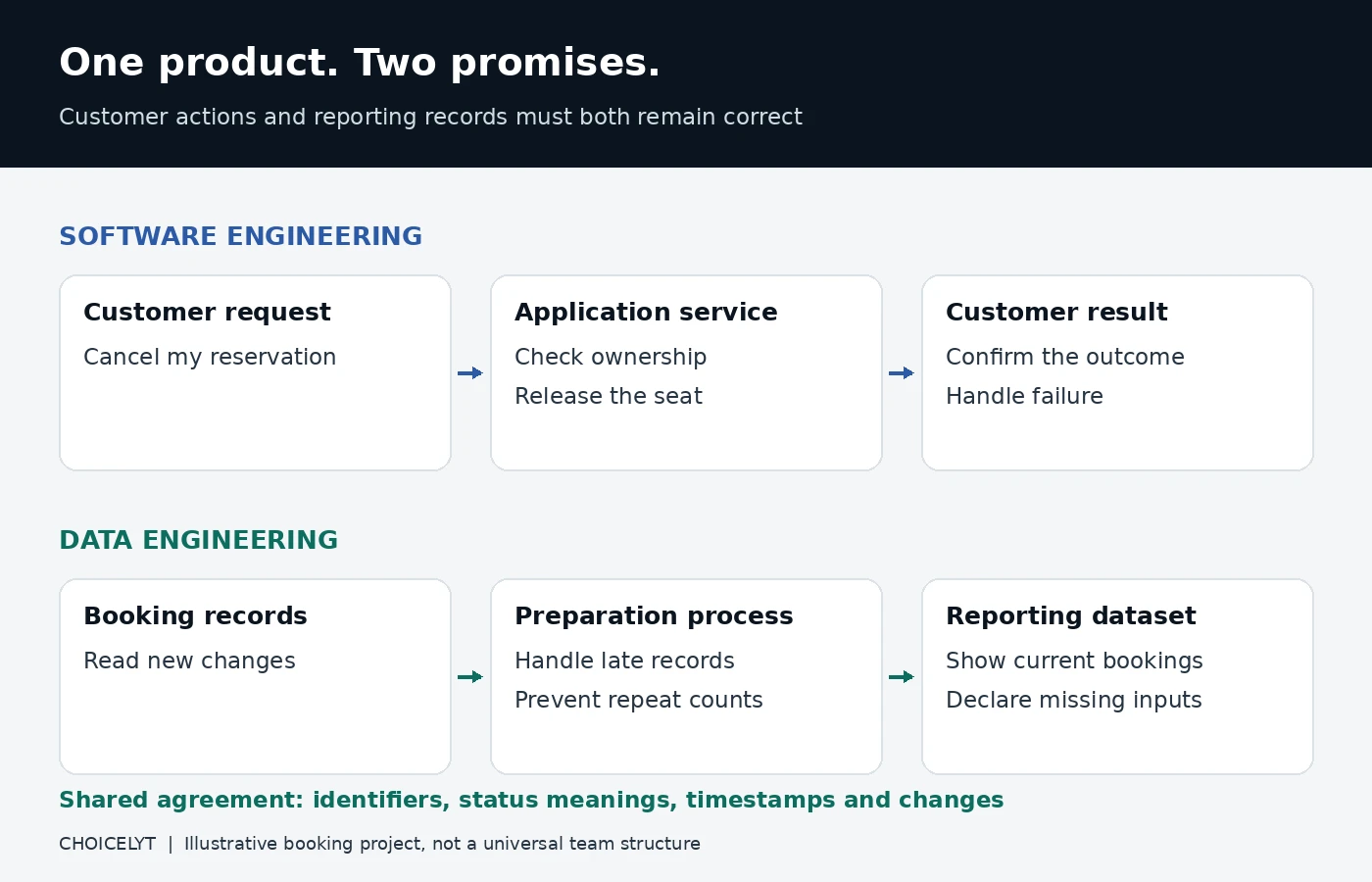
Now a customer wants to cancel without calling the organizer. The website must release the seat, and the attendance report must show that cancellation. Both tasks involve code. What makes them different is the promise each engineer must prove they kept.
The software engineer owns the cancellation behavior
The engineer checks that a customer can cancel only their own reservation, that the seat becomes available correctly and that two simultaneous requests cannot leave inconsistent results. They design the response when the request fails and test the new behavior.
Success means the product performs the promised action safely. The user interface is one part of that promise; the underlying service and permissions are just as important.
The data engineer owns the reusable cancellation data
The engineer checks that cancellation records reach the reporting dataset, that repeated processing does not count an event twice and that late records can be incorporated. They document the meaning of the status field and alert users if a refresh is incomplete.
Success means other teams can use the dataset with known assumptions about completeness, timing and correctness.
A working app can still produce a wrong report
The customer sees “Cancellation successful.” The report still counts their seat. From the user’s perspective, the feature worked. From the organizer’s perspective, the data did not. The reverse can happen too: a correct report tells you little about whether the app lets a customer cancel. Neither team can judge the whole product by its own tests alone.
The shared discussion should cover identifiers, event meaning, timestamps and changes to fields. If a status changes from “canceled” to “cancelled,” an unnoticed reporting rule could stop recognizing it. A change that looks small inside an application may matter to every downstream dataset.
Data engineering vs software engineering responsibilities
Microsoft Learn describes data engineers as integrating, transforming and consolidating structured and unstructured data into forms suitable for analytics, while helping design and support reliable pipelines and data stores. O*NET’s Data Warehousing Specialists profile similarly includes sourcing, loading, transformation, extraction, data-quality verification, source-to-warehouse mapping and troubleshooting. The BLS software development guide covers analyzing user needs, designing software, testing, maintenance and documentation.
| Factor | Data engineer | Software engineer |
|---|---|---|
| Primary output | Reliable datasets, pipelines and data services. | Applications, services, features or computing systems. |
| Typical users | Analysts, scientists, applications and other data consumers. | Customers, staff, developers or other systems. |
| Common questions | Are the records complete, current and safe to reuse? | Does the system behave correctly, securely and efficiently? |
| Database emphasis | Preparation, analytical table design and recurring processing. | Storage that supports application behavior and services. |
| Quality evidence | Checks for missing records, repeated events and input changes. | Tests for behavior, permissions, integration and failure handling. |
| Recurring pressure | Failed refreshes, changing sources, processing cost and recovery. | Broken features, releases, performance problems and service recovery. |
| Common foundation | Programming, version control, testing, databases, debugging and clear documentation. | |
If a career description reduces data engineering to cleaning spreadsheets or software engineering to building websites, it leaves most of the work out. Both careers depend on systems, testing, and maintenance. The meaningful difference is the problem you would return to, day after day.
Data engineer vs backend software engineer: where the boundary blurs
Think about what happens after someone presses “Reserve.” A backend engineer may check availability, save the booking, and return a confirmation through an API, a defined way for software components to exchange requests and responses.
Those bookings become a history that staff want to examine. A data engineer may combine records from the app with other sources and prepare a reporting table that can be refreshed safely. The application database is designed to support actions as they occur; the analytical dataset is designed to help people understand many actions together.
The distinction becomes less clear when a backend team publishes event streams or a data team builds a service that supplies information directly to an app. For such roles, compare the deliverable, expected response time, data volume and operational duties. A label cannot explain all four.
Database engineer, data platform engineer and big data engineer
Database engineering may concentrate on database design, performance or availability. Data platform engineering may focus on shared infrastructure that lets several teams create and operate pipelines. A big data role usually signals larger or more complex processing requirements, but it does not specify a universal toolset or career level.
Ask the employer which systems the position owns, how failures are handled and what a successful first project looks like. These titles can describe substantial overlap, and their meanings differ across organizations.
Which career needs more coding?
Both need meaningful programming ability. Software engineering covers a broad range of languages and application types. Data engineering often combines substantial SQL with a language such as Python and skills for operating recurring processes. The amount of code depends on the project, not a reliable ranking between careers.
What to learn for data engineering
Start with SQL, database fundamentals, and one programming language. Work with tables until you can explain exactly what one row represents. Try a join that accidentally duplicates bookings, then fix it. Handle dates carefully. After that, add tests, error handling, version control, and a process you can run again without changing the result incorrectly.
Then learn one environment for scheduling, storage and deployment. A scheduler starts work and manages dependencies; a warehouse stores data for analytical use. Learn these functions before trying to memorize every product name. A small pipeline that another person can inspect and rerun is stronger evidence than a diagram containing many cloud logos.
What to learn for software engineering
Choose one language and build something small enough to understand completely. Let a user make a reservation. Then make the application reject invalid input, enforce permissions, and handle changed records. Write tests and use version control. When it breaks, trace the failure rather than hiding it with another patch.
For web and backend work, practice HTTP, APIs and databases. For mobile, embedded or systems roles, the relevant foundations differ. Choose the specialty before buying a course that claims to cover every software career.
Does data engineering require more math?
Neither career has a universal math requirement. Both need logical reasoning, careful measurement and comfort with constraints. Specialized graphics, scientific software or machine learning can require substantial mathematics. Everyday data pipeline work is usually more about correctness, organization and systems behavior than developing statistical models.
Do not confuse data engineering with data science. A data scientist may build experiments or predictive models. For that distinction, see Data Engineer vs Data Scientist.
Data engineer vs software engineer salary in the U.S.
There is no clean federal salary series that compares every job titled Data Engineer with every job titled Software Engineer. Software Engineer maps reasonably well to the BLS Software Developers occupation. Data Engineer is less standardized and can overlap data warehousing, database architecture, data platform and software-development work. The related figures below are useful context, not a title-to-title salary ranking.
| Occupation | Median pay | Limit of the comparison |
|---|---|---|
| Software developers | $135,980 | A useful software development benchmark, not a starting offer. The lowest 10 percent earned under $82,460 and the highest 10 percent over $214,670. |
| Database architects | $139,500 | O*NET uses Database Architect wage data for Data Warehousing Specialists, but this is still not a universal data engineer salary. |
| Database administrators | $104,620 | A separate occupation with database operating responsibilities. |
Those wage figures include workers at different career stages. They cannot tell you what your first offer will be or which title pays more in every company. Seniority, location, industry, and stock compensation can change the picture. Compare actual roles before drawing a conclusion.
How to compare actual offers
- Match seniority. Compare beginner with beginner and senior with senior.
- Separate compensation components. Record base salary, bonus and equity separately.
- Match location and working rules. Note whether remote pay changes by location and whether office attendance is required.
- Include support duties. Ask about on-call rotations, urgent recovery and the expectations outside normal hours.
- Read the scope. A shared data platform and a small internal application can carry different responsibilities despite similar titles.
The same caution applies to company-specific searches. A salary reported for one level at Google, Meta or Amazon does not represent the whole company or the national market. Check the date, level, location and whether the figure is base pay or total compensation.
Career growth and job market
BLS counted about 1.72 million software developer jobs in 2025 and projects about 1.89 million in 2035, a 10% increase, or roughly 174,700 added jobs. BLS also projects about 106,100 openings per year on average over the decade. That figure covers software developers, quality assurance analysts and testers together, so treat it as an upper bound for developers alone.
For the related Database Architects occupation, BLS counted about 69,500 jobs in 2025 and projects about 76,000 in 2035, a 9% increase. That is useful context for data infrastructure work, but it is not a national forecast for every job advertised as Data Engineer. The neighboring Database Administrators occupation looks different: BLS projects 0% change from 2025 to 2035 (75,000 jobs in 2025 and 74,900 in 2035). The contrast is a reminder that data-related titles do not all move together.
For an entry decision, inspect current U.S. postings you could realistically apply for. Count required experience, recurring skills and evidence of supervision. Long-term occupational growth does not establish that beginner hiring is easy in a particular year or city.
Which career is easier to enter?
An application is easy to show someone: they can click a button and see what happens. A well-designed data pipeline is less visible, but proving that it can survive a broken input or repeated run is impressive evidence too. Neither demonstration means the corresponding job is automatically easier to get.
If you already build software, data engineering may be a focused specialization. If you already work in reporting and SQL, it may be a transition that builds on your data knowledge. If you are entirely new, start with shared fundamentals before committing to an expensive specialist program.
Degrees, certificates and learning choices
Computer science, software engineering, information systems and related computing programs can provide useful foundations. BLS lists a bachelor’s degree as the typical entry education for Software Developers. Data-engineering postings vary more, so compare actual requirements and look for coursework or project evidence in programming, databases, data modeling, systems and testing rather than assuming one degree title is required.
Certificates can organize learning around a platform. Evaluate whether a course includes code review, practical debugging and work you must defend independently. A finished certificate is not equivalent to experience maintaining a production service or pipeline.
Compare education costs and income forgone through the Choicelyt ROI calculator. Use realistic early-career assumptions rather than the median of a senior-leaning occupation. If you are choosing between programs, see Software Engineering vs Computer Science.
A practical project that tests both careers
Build the reservation example locally with synthetic records. Use a simple database and a small interface or API. Avoid real customer information. The project should be small enough that you can inspect every important result manually.
Software work to demonstrate
- Create, view and cancel a reservation.
- Check that one user cannot alter another user’s record.
- Handle an unavailable session and invalid input.
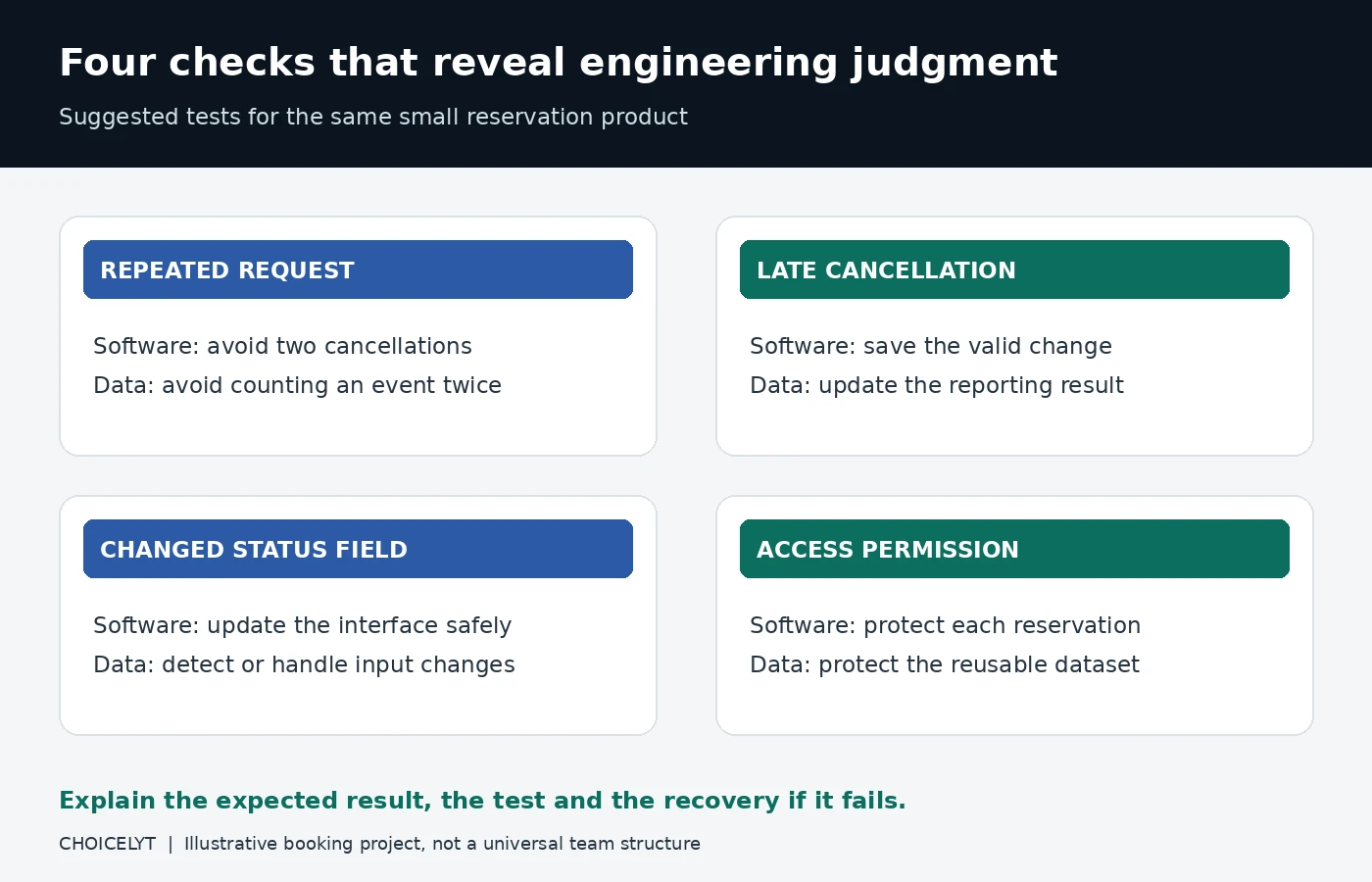
- Test repeated requests and explain the outcome.
- Write instructions so another person can run the app.
Data work to demonstrate
- Prepare a daily bookings and cancellations dataset.
- Document identifiers, statuses and timestamps.
- Make repeated processing safe.
- Handle a late cancellation and a changed input field.
- Show checks, execution logs and recovery instructions.
You do not need a story about millions of users. Show the exact problem you solved, the failure you introduced, and the test that caught it. Explain what your project cannot handle yet. That kind of clarity tells a reviewer more than an inflated claim.
What to explain in an interview
For software work, explain behavior, permissions, component boundaries and failure handling. For data work, explain record meaning, completeness, repeated processing and recovery. In both cases, show a test that caught a mistake and describe why you changed the design.
A tutorial gives you somewhere to start. The learning begins when you change the requirements, break something on purpose, and explain how you repaired it. A polished screenshot means little if you cannot explain the decisions behind it.
Can a software engineer become a data engineer?
Yes. Software engineers already have foundations in programming, testing, version control, and systems thinking. What they may need to add is deeper analytical SQL, warehouse design, data preparation, scheduling, and an understanding of what analysts and other users expect from reliable datasets.
Start by turning a small application’s records into a maintained dataset. Document what each row represents, handle changes and prove another run is safe. Then learn the environment used by target teams. Simply moving records once does not demonstrate ongoing reliability.
Can a data engineer become a software engineer?
Yes. Data engineers already use many software practices. The additional work depends on the target specialty. A backend transition may require deeper practice with service interfaces, request handling and application behavior. A frontend transition also requires interface, browser and accessibility skills.
Build something a user can interact with, test its permissions and explain how components work together. Avoid treating every software position as interchangeable. The learning gap for a mobile role differs from the gap for backend development.
Career progression without a forced ladder
A data engineer can deepen technical responsibility, move toward platform or architecture work, or manage a team. A software engineer can deepen a specialty, lead larger systems or move into management. These are possible directions, not guaranteed promotion sequences. Ask how an employer recognizes technical contributions before assuming management is the only way to advance.
Which career is better positioned for AI?
An AI feature needs more than a model. Someone must deliver trustworthy data to it, and someone must build the application that uses its predictions. Data engineers often contribute to the first responsibility; software engineers often contribute to the second. Machine learning engineers may work across both.
AI assistance can draft scripts, queries, tests and code explanations. That capability does not determine which career will have more jobs. BLS currently says continued software development for AI, IoT, robotics and other automation applications is one factor supporting demand for software developers. For data infrastructure, BLS says database architects will remain important as organizations adopt AI and require sound database design, transition, backup and security. The practical responsibility in both careers remains validating generated work against the real system and its users.
In the booking example, generated code might correctly implement cancellation but forget a reporting field. It might create a pipeline that works once but duplicates records on another run. Review behavior, permissions, data meaning and recovery rather than accepting successful execution as proof.
Use AI according to the organization’s data and code policies. Keep the ability to explain the work without the assistant. The recommendation to strengthen validation is editorial guidance, not a quantified forecast about replacement or job security.
Which responsibility would you rather practice?
Choose your next small experiment
Select a task. The result suggests a learning exercise, not an aptitude score or a guaranteed career outcome.
Test your preference through work
Notice which responsibility you want to improve even after the first version works.
Software engineering may fit better if application behavior and broad computing options hold your interest. Data engineering may fit better if dependable records, transformations and data delivery hold your interest. If both appeal, backend and data-platform responsibilities are useful areas to explore because their boundaries often overlap.
Your first job is a starting point, not a permanent label. Look for responsibilities you understand, people who will review your work, and challenges you can grow into. A modest title with good mentoring may teach you more than an impressive one that leaves you to figure everything out alone.
Frequently asked questions
Is a data engineer a software engineer?
Data engineering uses software engineering practices, but it is specialized around data movement, transformation, storage, quality and delivery. Team structures and titles vary by employer.
Who earns more, a data engineer or a software engineer?
Federal data do not support a clean national title-to-title comparison. BLS provides a clear Software Developer median, while data-engineering work can map to several occupations. Compare the same level, location, scope and compensation components.
Is data engineering harder than software engineering?
Neither is inherently harder. Data engineering adds challenges around data quality, changing sources and recovery from failed refreshes. Software engineering adds challenges around application behavior, scale, security and user interaction. The difficulty depends on the specialty and the team.
Which role uses more coding?
Both can involve substantial coding. Software engineering spans many languages and product types, while data engineering often combines SQL with Python or another language plus recurring data-processing and infrastructure work.
Can a software engineer switch to data engineering?
Yes. Programming, testing, version control and systems reasoning transfer well. Add stronger SQL, data modeling, pipeline orchestration, data-quality checks and warehouse concepts.
Can a data engineer become a software developer?
Yes. The additional skills depend on the target software specialty. Backend roles may require deeper practice with APIs, request handling, application behavior and service reliability.
What is the difference between a data engineer and a backend engineer?
A backend engineer usually owns application services and behavior. A data engineer usually owns data movement, preparation and delivery. Databases, event streams and internal services can create substantial overlap.
Does data engineering require machine learning?
Not necessarily. Data engineers often build the data systems used by analytics and machine-learning teams without developing models themselves.
Will AI replace data engineers or software engineers?
AI can automate parts of coding, querying, testing and documentation. Current BLS projections still show growth for Software Developers and Database Architects. Engineers remain responsible for system behavior, data quality, security and recovery.
Sources and research method
Official U.S. occupational data and role documentation support the role, skill and salary discussion. Related occupations are labeled explicitly because there is no single federal Data Engineer occupation covering every employer title. The booking project, tests and learning recommendations are original editorial material. No employer survey or measured hiring experiment was conducted.
- Microsoft Learn: Data Engineer career path
- O*NET OnLine: Data Warehousing Specialists, updated 2026
- O*NET OnLine: 2025 employer software demand for Data Warehousing Specialists
- O*NET OnLine: 2025 employer software demand for Database Architects
- O*NET OnLine: Software Developers, updated 2026
- O*NET OnLine: 2025 employer software demand for Software Developers
- BLS: Software Developers, Quality Assurance Analysts and Testers
- BLS: Database Administrators and Architects
Updated October 16, 2026. BLS wage, employment and projection figures and the O*NET 2025 posting percentages were re-checked against the linked pages on that date (BLS pages last modified August 27, 2026). The Microsoft Learn description and the O*NET occupation profile text were last reviewed October 1, 2026. Pay refers to May 2025 and projections to 2025 through 2035. Check current local postings and program requirements before making an education decision.