
Short answer
Choose R&D if you enjoy open-ended experiments, iteration, troubleshooting and creating new products, formulations or methods. Choose QC if you prefer defined procedures, measurable specifications, traceable records and direct responsibility for material or product decisions. Neither is automatically better, easier or higher-paying, and the job titles overlap more than most people expect.
R&D vs QC at a glance
Picture two chemists in the same building on a Monday morning, each with an HPLC running. The first is studying a chromatogram from a new formulation that turned cloudy in storage. She does not know why yet, so she is already sketching the next three experiments. The second is checking last week’s production batch against an approved limit. His result lands just inside it, and his job is to make sure it is recorded exactly, reviewed properly and escalated if anything about the run looks off. (These two chemists are invented for illustration.)
The distinction is not the equipment. One job asks what could work. The other asks whether this material conforms. In a smaller lab, the same person may do both.
| Factor | Research & Development | Quality Control |
|---|---|---|
| Main objective | Create or improve products, formulations, materials, processes or methods | Verify raw materials, in-process samples and finished products against specifications |
| Work style | Exploratory, iterative and often project-based | Procedure-driven, repeatable and often schedule- or batch-based |
| Acceptable outcome | Useful learning, a better design or evidence that an approach does not work | A valid, documented result that supports conformance or escalation |
| Method flexibility | More room to modify variables within the project plan | Normally follows controlled methods; deviations require authorization and documentation |
| Typical pressure | Technical uncertainty, milestones and innovation timelines | Accuracy, turnaround time, production needs and data integrity |
| Common output | Prototype, formulation, method, technical report or scale-up recommendation | Pass/fail result, certificate data, trend, deviation or investigation input |
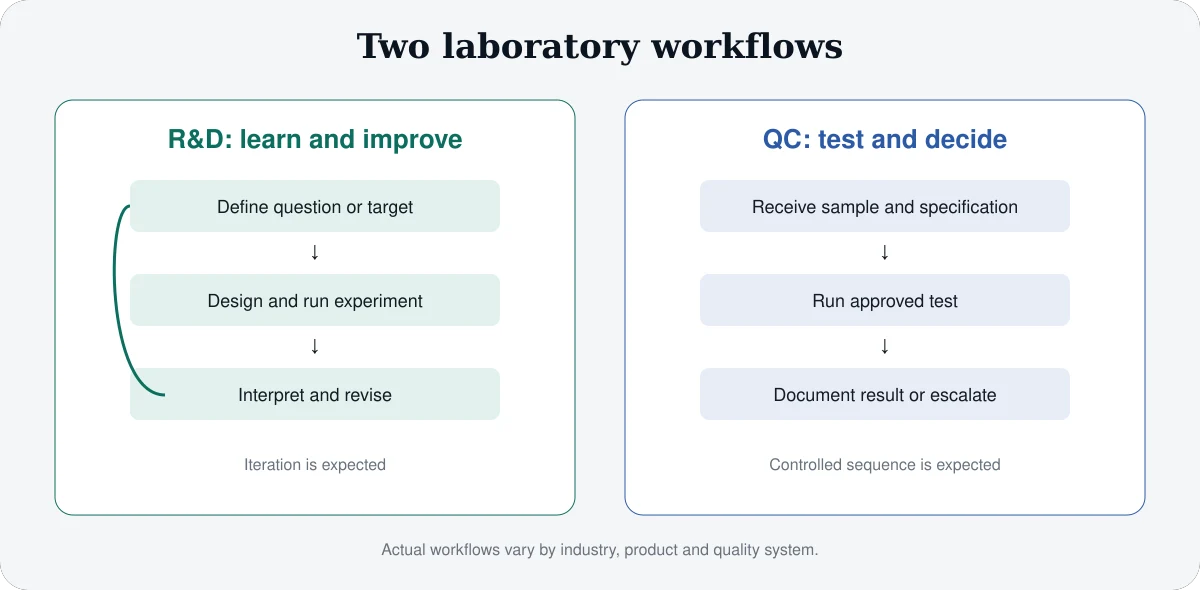
How the workflow differs
R&D workflow
An R&D project begins with a question that may not have a known answer. A chemist selects variables, runs experiments, compares outcomes and decides what to try next. An unsuccessful experiment can still be useful when it rules out a formulation or exposes a problem worth studying.
QC workflow
QC starts with a sample, a specified test and acceptance criteria. The analyst checks instrument readiness, prepares standards and samples, runs the method, reviews the original data and records a result. If something is unexpected, the laboratory follows its investigation procedure rather than repeatedly testing until it gets a passing value.
Typical daily responsibilities
R&D chemistry
- Plan experiments and select variables
- Develop formulations, materials or analytical methods
- Interpret unexpected outcomes
- Characterize prototypes or candidate products
- Write technical reports and present recommendations
- Collaborate with engineering, manufacturing or regulatory teams
Quality control chemistry
- Receive or collect representative samples
- Prepare reagents, standards and test solutions
- Run approved chemical and instrumental tests
- Verify calculations and acceptance criteria
- Maintain traceable laboratory records
- Escalate deviations, atypical trends or invalid systems
O*NET’s Chemists profile covers both directions: it describes chemical analyses for quality or process control and work that develops new products or knowledge. Reported titles include R&D Chemist, Research Chemist and QC Chemist. This overlap is why a national title-to-title salary comparison is unreliable.
Which role is more stressful?
Neither job is automatically less stressful. In R&D, the difficult part may be spending weeks on experiments that fail to meet a target. In QC, a delayed or questionable result may hold up production. The consequences differ, and so do the time pressures.
Before accepting either job, ask about workload, staffing, deadlines, shift schedules and how the team responds when an experiment or test goes wrong. Those details tell you more about day-to-day pressure than the department name.
Does QC involve more documentation?
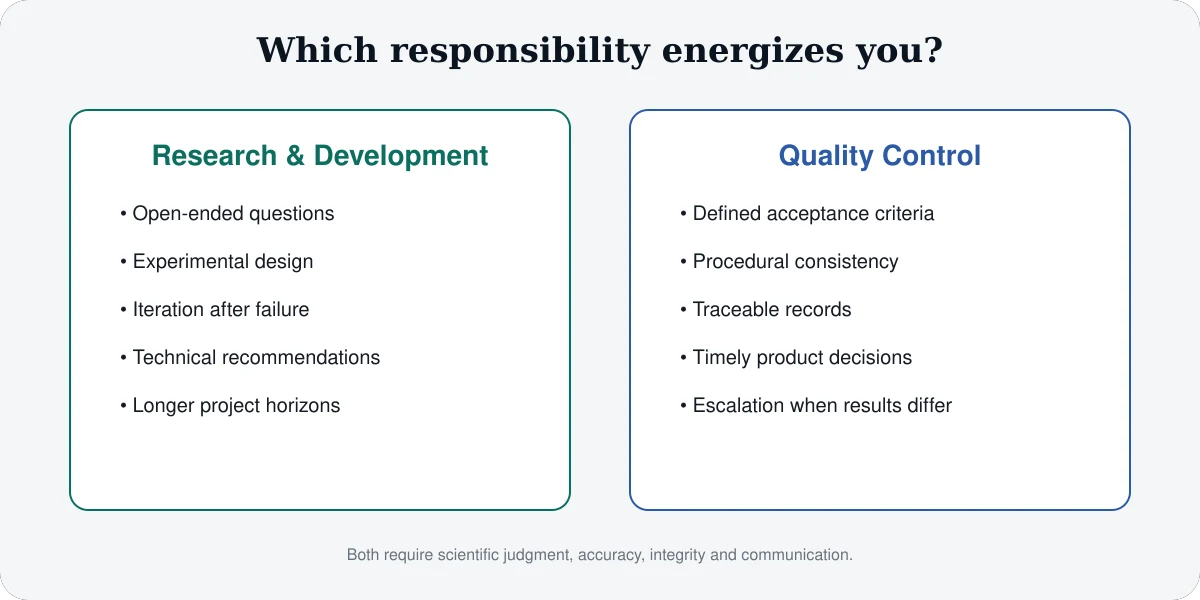
Both jobs require good records, but they are used differently. R&D notebooks help colleagues understand what was tried, why it was changed and whether results can be reproduced. QC records show which sample was tested, which approved method was followed, and how a reported result supports a quality decision.
That distinction matters during troubleshooting. A development chemist can often revise an experimental method within an approved project plan and record the change. A QC chemist generally needs authorization before departing from a controlled procedure. Neither can discard inconvenient results.
Education and skills
For chemists and materials scientists, the U.S. Bureau of Labor Statistics lists a bachelor’s degree as the typical entry-level education. Some research jobs require a master’s degree or Ph.D., particularly when the chemist designs and directs specialized research. QC openings span bachelor’s-level chemist jobs and technician roles with different requirements, so check the actual posting.
| Skill area | R&D emphasis | QC emphasis |
|---|---|---|
| Experimental design | Central to selecting variables and learning efficiently | Useful for investigations and method evaluation |
| Analytical instruments | Characterization, development and troubleshooting | System suitability, approved testing and reliable execution |
| Statistics | Comparing formulations, models and method performance | Precision, trends, capability and result review |
| Writing | Protocols, notebooks, reports and recommendations | Controlled worksheets, logs, deviations and investigation evidence |
| Decision style | Choose the next experiment under uncertainty | Apply criteria consistently and escalate correctly |
Salary and outlook: what official data can and cannot show
There is no separate national BLS wage series for “R&D chemist” and “QC chemist.” O*NET lists both titles within Chemists (19-2031.00). BLS reports a $91,240 median annual wage for chemists in May 2025 and projects 6% growth from 2025 to 2035. Those statistics cover chemists across industries and experience levels; they do not prove that the two departments pay the same.
Some QC analyst positions fall into technician classifications rather than the chemist occupation. Mixing technician pay with research-chemist pay would create a misleading comparison. To compare offers, match the degree requirement, seniority, location, industry, responsibilities and shift pattern first.
2025 national median for the occupation containing reported R&D Chemist and QC Chemist titles. The lowest 10 percent earned under $58,460 and the highest 10 percent earned over $160,830.
Projected U.S. employment growth from 2025 to 2035, compared with 3% for all occupations. BLS expects chemist jobs to rise from 84,900 to 90,300.
Which career fits you?
R&D may fit you if…
- you enjoy questions without a known answer;
- failed experiments motivate your next idea;
- you like changing variables and designing tests;
- you are comfortable defending technical recommendations; and
- you may pursue specialized or graduate education.
QC may fit you if…
- you value precision, repeatability and clear criteria;
- you can follow procedures without becoming careless;
- you take traceability and data integrity seriously;
- you can escalate problems despite schedule pressure; and
- you want close connection to operations and product decisions.
If you are still unsure, go back to the two chemists on that Monday morning. Ask which one you would rather be by Friday: the one chasing an answer nobody has yet, or the one making sure the answer on the record is right. Then read a few real job postings to see which description sounds like your week.
Can you move from QC to R&D, or back?
Moving between QC and R&D is possible, but shared instrument experience alone may not be enough. If you are in QC and want development work, seek opportunities to design experiments, troubleshoot methods, evaluate variables, interpret results and contribute to validation or transfer projects. Keep examples of decisions you made, not just a list of tests you ran.
If you work in R&D and want to enter QC, demonstrate that you can follow approved procedures, maintain traceable records, recognize atypical results and work within specifications. Method validation and investigation work can help bridge either move.
Frequently asked questions
Is R&D better than QC?
Neither is universally better. Look at the work itself: experimental uncertainty and product development versus controlled testing, investigations and conformance decisions.
Is QC easier than R&D?
Not necessarily. QC demands dependable results under deadlines; R&D demands experimental judgment when the answer is unknown. The specific employer matters.
Does R&D require a Ph.D.?
Not always. BLS says some research positions require a master's degree or Ph.D. Requirements depend on independence, specialization and employer.
Can a fresh chemistry graduate enter R&D?
Some entry-level research assistant, associate scientist and development roles accept bachelor's graduates, especially with internships or undergraduate research. Other positions require advanced education.
Can QC experience lead to R&D?
Yes, particularly when you gain method validation, troubleshooting, investigation, data-analysis and project experience.
Which role pays more?
Federal pay data do not isolate the titles. Ask for the salary band for the exact job, and compare offers with similar seniority, location and responsibilities.
Do R&D and QC use the same instruments?
Often yes. The difference is purpose: development and characterization versus approved specification testing.
Is QC the same as QA?
No. QC tests materials and products; QA oversees the wider quality system. See QA vs QC.
Sources and methodology
This comparison treats R&D and QC as work functions, not universally standardized occupations. Salary claims are limited to the official occupation that contains both reported chemist titles.
- O*NET OnLine: Chemists (updated 2026)
- O*NET OnLine: Quality Control Analysts
- U.S. BLS: Chemists and Materials Scientists
- U.S. BLS: Chemical Technicians
U.S. wage and outlook figures were re-checked against the BLS Occupational Outlook Handbook on October 16, 2026 (page last modified August 27, 2026). O*NET classifications were last checked October 11, 2026. Actual qualifications and responsibilities vary by employer.