
Machine learning engineer vs data scientist: the short answer
Data scientists investigate whether data supports a useful conclusion, experiment or prediction. Machine learning engineers build and operate the software systems that make models usable, repeatable and dependable in production.
Both roles can train models and write substantial code. Data science usually puts more emphasis on statistical reasoning, experimentation and model evaluation. ML engineering usually puts more emphasis on software design, deployment, monitoring, latency, reliability and recovery.
Which problem would you be more interested in solving: proving that a recommendation is useful, or making sure an application can serve that recommendation reliably? Both require model knowledge. The distinction helps you decide which skills to develop first.
The division changes with team size. At a startup, a data scientist might train, deploy and monitor a model. In a larger organization, an ML engineer might spend substantial time improving model quality. An actual job description tells you more than the title alone.
| Question | Data scientist | Machine learning engineer |
|---|---|---|
| What do you deliver? | An analysis, experiment or evaluated model that supports a decision. | A working prediction system, with tests and a way to maintain it. |
| What fills your day? | Investigating data, checking assumptions, testing approaches and explaining results. | Developing code, connecting systems, measuring response times and diagnosing failures. |
| What counts as success? | The evidence answers the question and the result is useful. | Predictions remain useful, available and affordable to run. |
| What is the math emphasis? | Statistics, uncertainty, experiments and model evaluation. | Model behavior plus the mathematics needed for the specialty. |
| What do both need? | Programming, data preparation, model knowledge, collaboration and clear explanations. | |
The BLS Data Scientists profile includes collecting and analyzing data, creating and validating models, visualizing results and making recommendations. Google Cloud’s ML engineer role description includes building, evaluating, productionizing and optimizing AI solutions. That overlap is why “scientists create, engineers deploy” is an incomplete rule.
One product, two different kinds of responsibility
Imagine an online retailer trying to improve the products it recommends to shoppers. This is an illustrative exercise, not a case study of a real employer.
The data scientist’s questions
Do recommendations help shoppers find useful products? Does a model improve on simply showing popular items? Are results worse for new customers? A promising test score is only a starting point. The scientist checks what was measured and whether the evidence supports a product decision.
The ML engineer’s questions
Can the site obtain the right inputs and return suggestions quickly? What happens when a customer has no history? Can the team release an update safely and restore the previous version? The engineer turns the proposal into dependable application behavior.
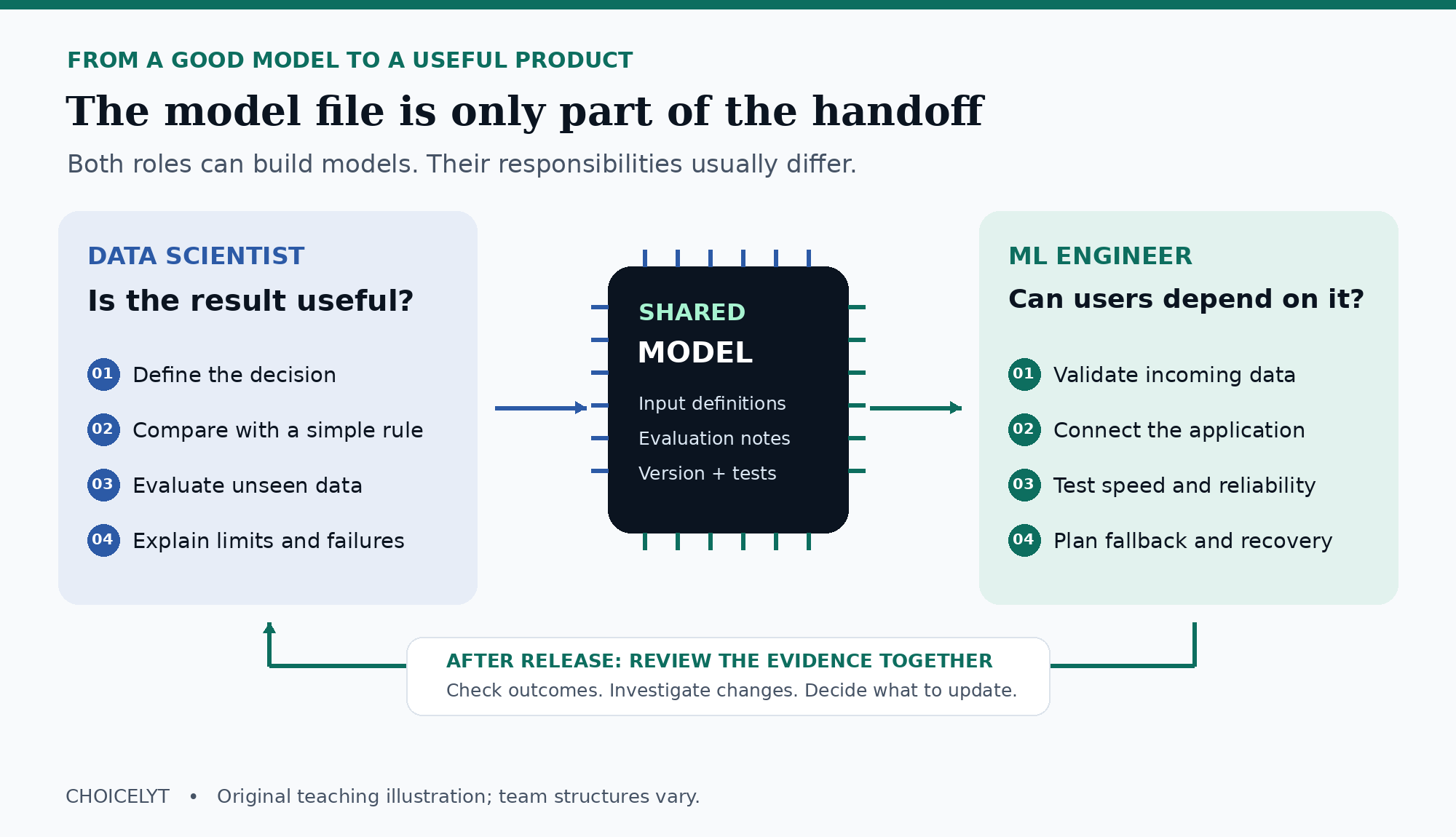
What happens when it breaks?
The website may load normally while its recommendations become useless. A data field can disappear, results can arrive too slowly, or shopper behavior can change. Select an example to see why the first investigation may involve both teams.
Open the incident desk
Select a situation to see what each person would investigate.
The customer history field is missing
ML engineer: Trace the data connection, check input validation and use an agreed fallback while the fault is resolved.
Data scientist: Check how much the missing information changes prediction quality and whether a simpler approach remains useful.
Shared decision: Define acceptable behavior for new customers and document it before the next release.
Google Cloud’s MLOps guidance treats evaluation, deployment and monitoring as connected work. MLOps means the practices used to operate and update machine learning systems. It is a responsibility area, not another model type.
Machine learning engineer vs data scientist salary in the U.S.
Neither title guarantees higher pay. A fair comparison matches location, experience and what the salary figure measures. Starting-pay benchmarks, occupation-wide medians and total compensation are not interchangeable.
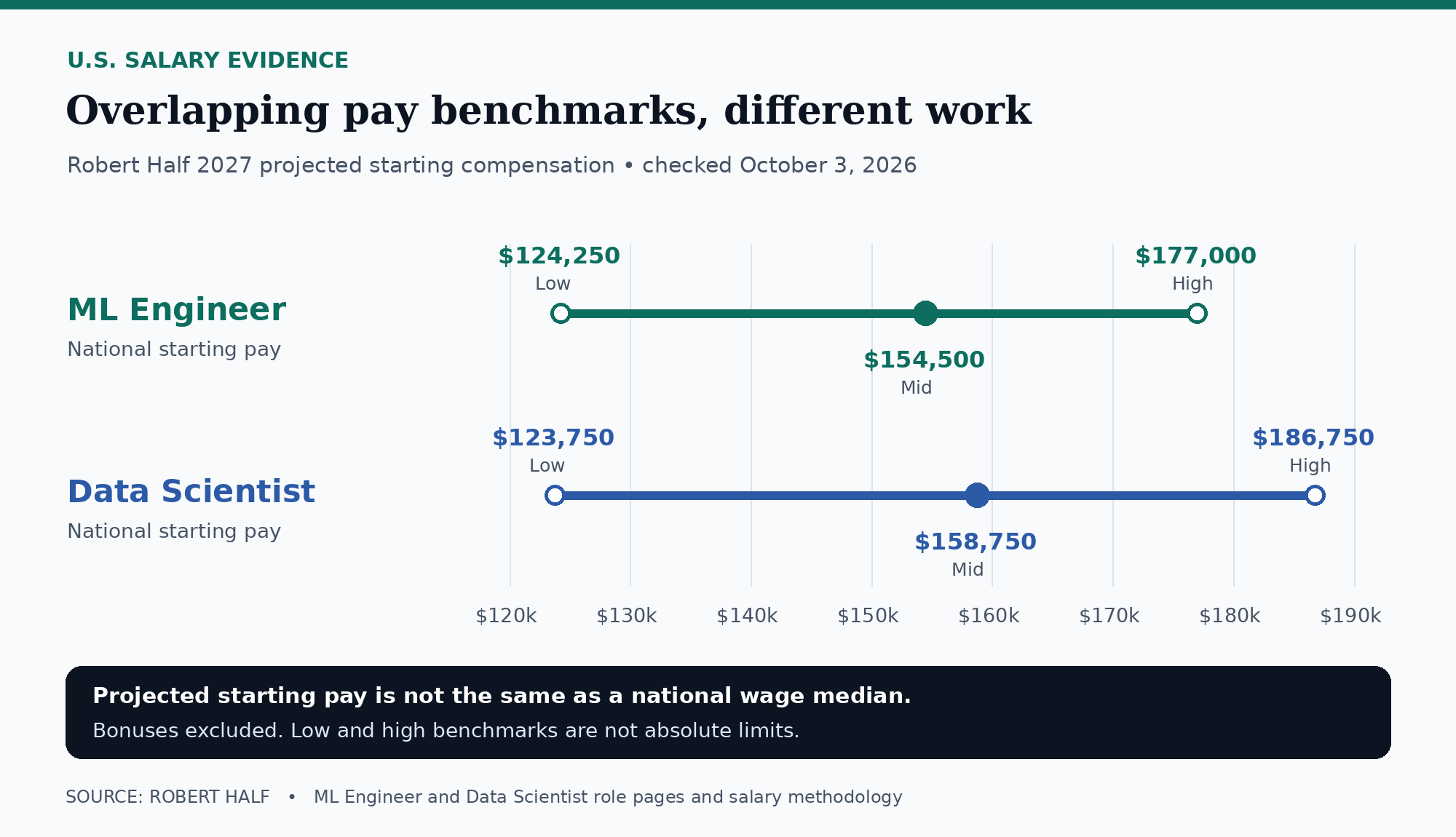
The current Robert Half ML Engineer page and Data Scientist page publish these national benchmarks for their 2027 projections, checked October 3, 2026:
| Role | Low benchmark | Mid benchmark | High benchmark |
|---|---|---|---|
| ML Engineer | $124,250 | $154,500 | $177,000 |
| Data Scientist | $123,750 | $158,750 | $186,750 |
The Robert Half numbers are national starting-pay benchmarks, not guarantees, legal minimums or national wage medians. Its methodology excludes bonuses from starting compensation. The low and high columns describe experience and skill profiles, not the bottom and top of every possible offer. ML Engineer and AI Engineer are listed as different roles.
What does federal job data say?
BLS reports a $120,230 median annual wage for Data Scientists in May 2025. It counted about 275,600 Data Scientist jobs in 2025 and projects about 371,000 in 2035, with roughly 24,800 openings per year on average over the decade. Those figures describe the Data Scientist occupation. BLS does not provide a separate national ML Engineer occupation series, so federal data cannot establish an ML Engineer pay premium or growth rate.
When you compare actual offers, record base salary, bonus terms, stock vesting, benefits, location policy and any on-call responsibilities. Match seniority as closely as possible: a senior production engineer and an entry-level data scientist are not a meaningful pay comparison.
Skills, degrees and getting your first role
What should you learn first?
Begin with Python, SQL, statistics and one project you can explain without a tutorial. SQL is useful for accessing and checking data; Python supports analysis and application code. You can learn a cloud platform later, once you understand the work your project needs to perform.
For data science
Practice asking a precise question, preparing data, choosing a simple comparison and evaluating results. Learn probability, sampling and how experiments can distinguish a real effect from noise. Write a short explanation of what the evidence does and does not show.
For ML engineering
Add organized software design, automated tests and version control. Build a small prediction service, meaning a program another application can call. Learn input validation, logging and release recovery before adding more infrastructure.
Both paths require an understanding of model evaluation. The scikit learn common pitfalls guide explains data leakage, which occurs when training or evaluation uses information that would not be available during real prediction. It also explains why preparation steps must be fitted and applied consistently.
Do you need a master’s degree?
BLS lists a bachelor’s degree as the typical entry education for Data Scientists, while noting that some employers require or prefer graduate study. There is no universal graduate-degree rule for ML engineering. Research-heavy model-development roles may ask for advanced study, while production-focused ML engineering roles may weigh software engineering, deployment and systems evidence more heavily.
Before paying for another degree, review ten current U.S. postings at your intended level. Record required education, accepted equivalent experience and evidence of actual duties. Compare the tuition and earnings you would give up using the education ROI page. A certificate can organize learning, but it does not replace the work a job asks you to demonstrate.
Which is easier to enter?
A software developer already familiar with APIs, testing and deployment may have a shorter route into production ML work. Someone experienced in statistics, research or analysis may be closer to the evaluation side of data science. Neither route is automatic, and many ML engineer openings expect prior production experience. For a first job, look beyond the headline title to the actual junior responsibilities.
Build one project with two kinds of proof
Choose a modest problem and a public dataset you are permitted to use. Explain what the prediction would change, then compare your model with a simple baseline. If the dataset is only an exercise, do not describe the result as proven commercial impact.
- Show the decision. Explain who would use the prediction, what action it supports and the cost of mistakes.
- Show the evidence. Separate development data from evaluation data. Report results against the simple rule, inspect failures and describe limitations.
- Show the running system. Provide a small service or app, test missing and invalid inputs, and make setup reproducible.
- Show recovery. Record model and code versions. Explain how to detect a problem, use a fallback and restore a previous version.
For a data science application, put the question, evaluation method and limitations first. For an ML engineering application, demonstrate the running service, tests, monitoring and recovery process. Include the model-evaluation evidence in both cases: a reliable service that makes unhelpful predictions is not a success.
Which career fits you, and can you switch?
You enjoy asking why a result changed, finding misleading evidence and explaining a decision even when the answer is uncertain.
You enjoy debugging, integrating components and making a model dependable under real constraints.
A data scientist moving into ML engineering should show they can structure code, test a service, deploy it and recover from failures. An ML engineer moving toward data science should demonstrate experimental design, statistical interpretation and clear communication of uncertainty. A focused crossover project may be more useful than automatically enrolling in another full degree.
Useful interview questions include: “What did the last person in this role actually deliver? Who signs off on model evaluation? Who responds when the service fails? What will I own in the first three months?” Specific answers reveal whether the job is mostly exploratory, production-focused or genuinely hybrid.
Will AI make either career unnecessary?
AI tools can draft code, summarize experiments and suggest infrastructure changes. They can also produce plausible but incorrect answers. In either career, someone must check data provenance, evaluation methods, security, dependencies and failure behavior. Faster output only helps if the team can verify it.
A chatbot that generates a plausible result has not established that the result is correct. NIST’s voluntary AI Risk Management Framework addresses trustworthiness throughout design, development, use and evaluation. For either career, practice checking generated work rather than accepting it because it looks polished.
Questions readers ask before choosing
What is the main difference between a machine learning engineer and a data scientist?
Data Scientists usually focus more on questions, experiments, statistical reasoning and model evaluation. Machine Learning Engineers usually focus more on turning models into dependable software systems and operating them under real constraints.
Who earns more, an ML engineer or a data scientist?
There is no universal winner. Robert Half’s 2027 projected U.S. starting-compensation ranges overlap substantially. Compare the same location, level, pay definition and responsibilities rather than treating one title as automatically higher paid.
Does ML engineering require more coding?
ML engineering often places more daily emphasis on maintained software, services, tests, deployment and infrastructure. Data Scientists can also write substantial code for preparation, experimentation, modeling and reproducible evaluation.
Which role requires more math?
Data science usually places more routine emphasis on probability, statistics, experiments and uncertainty. ML engineers still need enough mathematical and model knowledge to understand the systems they deploy, and specialized roles can be mathematically demanding.
Can a data scientist become an ML engineer?
Yes. Strengthen software structure, automated testing, APIs, deployment, monitoring, versioning, cloud systems and recovery. Show that a model can run repeatedly and safely outside a notebook.
Can a software engineer become an ML engineer?
Yes. Software engineering is a strong foundation for production-focused ML work. Add model evaluation, data preparation, experiment tracking and enough statistics to understand prediction behavior and failure modes.
Do I need a master’s degree for machine learning engineering?
Not universally. Requirements vary widely. Research-heavy roles may prefer graduate study, while production-focused roles may place more weight on software, systems and deployed ML evidence.
Will AI replace machine learning engineers or data scientists?
AI can automate parts of coding, analysis, experimentation and documentation. People still need to define useful problems, verify data and model behavior, operate systems, manage risk and remain accountable for the result.
Sources and research notes
Sources checked October 3, 2026. Salary measures and their dates are identified separately. ML Engineer has no dedicated BLS occupation series, so adjacent software evidence is labeled rather than presented as a federal ML Engineer benchmark. The store example and incident desk are original teaching illustrations, not employer case studies. Read Choicelyt’s methodology or report a correction.
- BLS: Data Scientists for duties, education, May 2025 wages and 2025 to 2035 projections.
- O*NET: Data Scientists, updated 2026 for occupational tasks and technology context.
- O*NET: 2025 employer software demand for Data Scientists.
- O*NET: Software Developers, updated 2026 as adjacent software-engineering context for production ML work.
- O*NET: 2025 employer software demand for Software Developers.
- Robert Half: ML Engineer and Data Scientist for 2027 projected starting compensation; salary methodology for definitions and limits.
- Google Cloud: ML engineer role and MLOps guidance for model operation, evaluation and monitoring.
- scikit learn: Common pitfalls for leakage and consistent data preparation.
- NIST: AI Risk Management Framework for voluntary trustworthiness guidance.