
Data analyst vs data scientist in one minute
Data analysts turn trusted data into measures, explanations and recommendations for decisions. Data scientists add deeper responsibility for statistical modeling, prediction, validation and model behavior over time.
Data analysis tends to center on questions such as what changed, where it changed and what action the evidence supports. Data science more often adds questions such as whether an outcome can be predicted, whether a model beats a simple baseline and how its errors should be monitored.
A data scientist is not simply a senior data analyst, and a data analyst is not a lesser version of a scientist. The titles overlap, so compare the expected work products, statistics depth, coding depth and production responsibility.
The real difference is production responsibility
Many career guides say analysts explain the past while scientists predict the future. Real teams are messier. Analysts forecast sales, evaluate experiments and build statistical models. Scientists also clean data, create charts and explain historical behavior. Time direction does not draw a reliable boundary.
A better question is: Does the team need an analysis that informs a decision, or a tested system that will score new cases repeatedly?
Data analyst responsibility
Produce trusted evidence for a question. That may be a metric definition, query, dashboard, experiment readout, investigation or recommendation. The result is usually reviewed by people before action.
Data scientist responsibility
Develop a repeatable way to estimate, classify, rank or predict. That includes choosing a target, comparing a simple baseline with more complex models, validating errors and planning how performance will be monitored.
One customer problem, two valid jobs
Imagine a U.S. subscription company (an invented scenario, used only to make the split concrete) notices that monthly customer cancellations increased. Leadership wants to protect revenue without sending expensive offers to everyone.
The data analyst finds the decision that can be made now
The analyst first defines cancellation consistently. They confirm whether the increase is real or caused by a reporting change. They compare customer groups, signup months, products, prices, support contacts and renewal dates. They may discover that cancellations rose mainly among customers whose introductory discount ended after a delayed service issue.
The analyst delivers a concise explanation, a chart that shows where the change occurred, a list of evidence limits and a recommendation. The company might improve the renewal message and test proactive support for the affected group.
The data scientist tests whether risk can be estimated before cancellation
The scientist asks whether a model can identify customers likely to cancel early enough for a useful intervention. They define the prediction date, ensure no future information leaks into training, build a simple baseline, compare models and study false alarms versus missed cancellations.
A model is only useful if its score improves a decision. The scientist must help choose a threshold, document who will act on the score, check whether results differ across important groups and design monitoring for performance changes after launch.
The analyst can create value without a predictive model. The scientist should not build one until the target, decision and baseline are clear. Good science begins with a decision worth improving, not with a fashionable tool.
Data analyst vs data scientist comparison
| Question | Data analyst | Data scientist |
|---|---|---|
| Primary goal | Turn trusted data into an explanation, measure or recommendation | Build and validate a model that estimates or predicts outcomes |
| Typical questions | What changed? Where? How large is it? What supports action? | Can we estimate this before it happens? How accurate and useful is the estimate? |
| Common outputs | SQL analysis, dashboard, experiment readout, metric definition, decision memo | Training dataset, baseline, model, validation report, scoring logic, monitoring plan |
| Core tools | SQL, spreadsheets, BI tools, statistics, sometimes Python or R | SQL, Python or R, statistics, machine learning libraries, version control, cloud tools |
| Math depth | Descriptive statistics, inference and experimentation vary by role | Probability, statistics, optimization and model evaluation usually go deeper |
| Coding depth | SQL is often central; programming varies widely | Reproducible programming is usually central |
| Main risk | A wrong metric, bad join or weak comparison misleads the decision | Leakage, poor validation or unstable behavior creates confident wrong scores |
| Entry path | Often more accessible with strong SQL, data quality and communication evidence | Usually expects deeper statistics, programming and model validation evidence |
| Best fit | You enjoy investigation, business context and explaining evidence | You enjoy prediction, experimentation, uncertainty and technical depth |
What each role actually produces
Tools do not define a profession. Two people can both use Python and still own different work. The work product reveals who the output is for, how it will be used and what can go wrong.
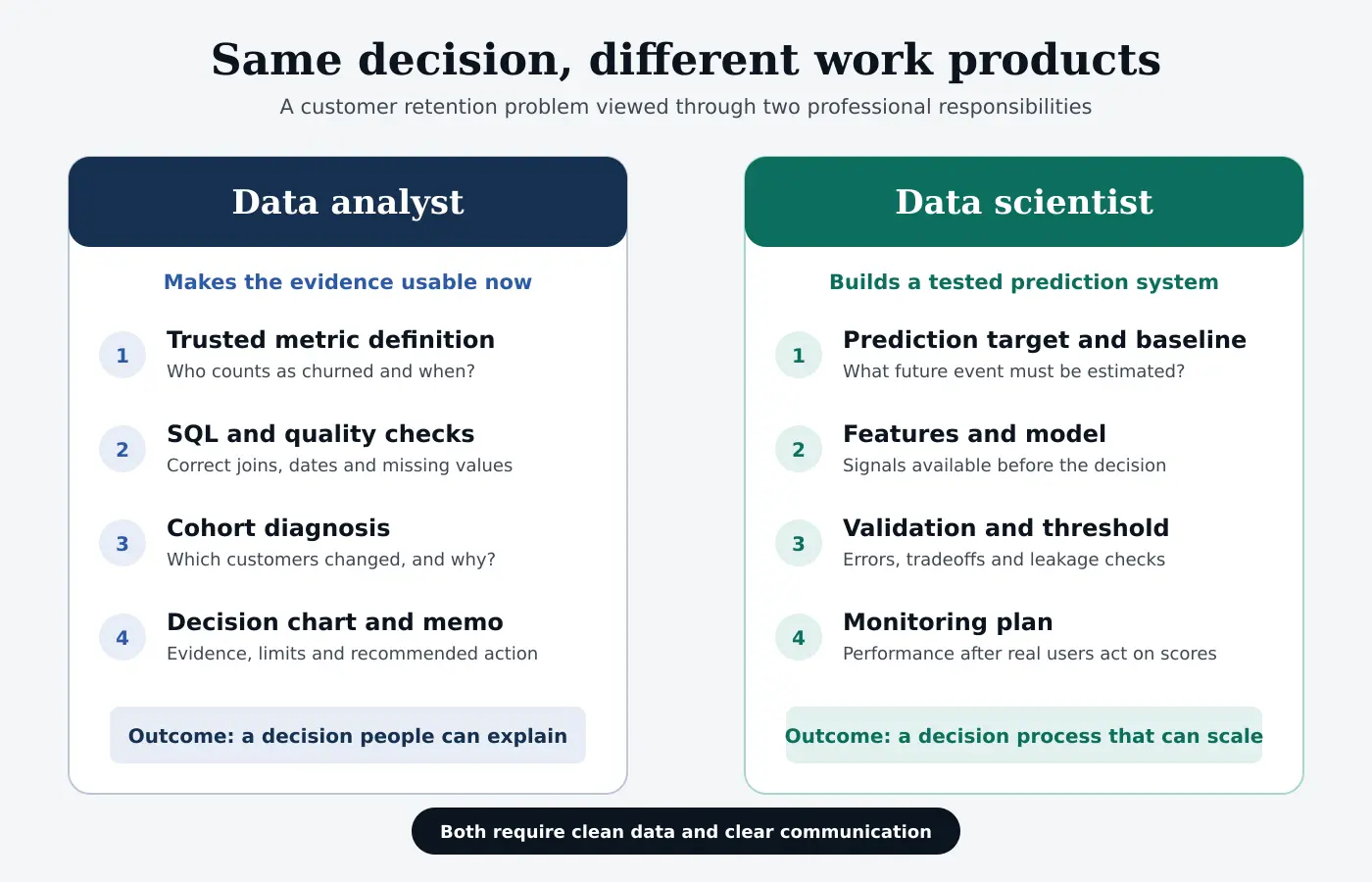
A credible analyst package
- a written metric definition;
- a reproducible query with quality checks;
- a comparison that accounts for seasonality or group differences;
- a chart designed around one decision;
- a recommendation with assumptions and limitations.
A credible scientist package
- a clearly timed prediction target;
- a simple baseline to beat;
- training and test data kept separate;
- error analysis tied to real costs;
- a deployment handoff and monitoring plan.
The baseline test before machine learning
Before building a complex model, test a simple rule, average, ranking or basic statistical model. If the simple approach produces nearly the same business result, extra complexity may create maintenance cost without enough value. A strong data scientist can explain when not to use machine learning.
What a realistic workday feels like
Analyst: Why did the weekly retention metric move after the pricing change?
Scientist: Has the risk model changed since the pricing change altered customer behavior?
Analyst: checks definitions, joins product and billing data, compares cohorts and investigates alternative explanations.
Scientist: rebuilds features, evaluates performance across time, studies errors and compares the current model with a baseline.
Analyst: meets marketing or operations to confirm context and turn findings into a testable action.
Scientist: works with product, engineering and risk partners to decide how a score will be used safely.
Analyst: a clear answer with evidence, uncertainty and next action.
Scientist: a validated model change with error tradeoffs and monitoring requirements.
Skills and tools employers are really buying
Microsoft describes data analysts as professionals who profile, clean and transform data, build useful data models and turn raw information into meaningful insights for stakeholders. The U.S. Bureau of Labor Statistics describes data scientists as workers who collect and analyze data, create and validate models, visualize results and make recommendations. O*NET also lists testing and reformulating models, comparing them with performance measures and communicating results among data scientist tasks.
Data analyst skill stack
- SQL: joins, grouping, time logic, windows and validation checks.
- Data quality: missing values, duplicate records, changing definitions and inconsistent categories.
- Statistics: fair comparisons, uncertainty, sampling and experiment interpretation.
- Visualization: charts that make a decision easier, not merely more colorful.
- Domain knowledge: understanding how the business process creates the data.
- Communication: concise findings, limitations and recommended action.
Data scientist skill stack
- Programming: reproducible Python or R workflows, tests and version control.
- Statistics: probability, inference, experiments and assumptions.
- Modeling: baselines, feature design, fitting, tuning and comparison.
- Validation: leakage checks, calibration, error costs and stability across groups and time.
- Data systems: enough pipeline and cloud knowledge to collaborate on production use.
- Communication: explaining model limits and operational tradeoffs without hiding behind technical language.
Both roles need SQL, curiosity, skepticism and communication. The difference is depth and purpose. An analyst may use Python to automate a recurring report. A scientist may use it to create a versioned training and evaluation workflow that must be rerun safely.
Degrees, certificates and entry routes
Data analysts enter from analytics, information systems, statistics, economics, business, computer science and many domain degrees. O*NET places Business Intelligence Analysts in Job Zone Four, where bachelor’s-level preparation is common, but that is not a universal requirement for every analyst job. Strong programs should build databases, SQL, statistics, data cleaning, visualization and applied project skills. A certificate can organize learning, but it is not proof that you can handle unclear, imperfect data.
For data scientists, the BLS lists a bachelor’s degree as typical entry education in mathematics, statistics, computer science or a related field. It also notes that some employers require or prefer a master’s or doctoral degree. Graduate education may be valuable for research-heavy roles, specialized modeling or a career change that needs structured depth, but it is not automatically required for every job.
Best analyst portfolio evidence
Show one business question from raw data to recommendation. Include the data dictionary, quality checks, SQL, choice of comparison, final chart and a short explanation of what the evidence cannot prove.
Best scientist portfolio evidence
Show a prediction problem with a simple baseline, a clean evaluation split, model comparison, error analysis and a monitoring plan. A polished score alone is weak evidence.
Before paying for a degree or bootcamp, compare tuition, fees, software, housing, commute and time away from work using the Choicelyt education ROI calculator.
Data analyst vs data scientist salary in the United States
The cleanest federal number belongs to Data Scientists. BLS reports a $120,230 median annual wage in May 2025. It counted about 275,600 jobs in 2025 and projects about 371,000 jobs in 2035, a 35% increase, with about 24,800 openings per year on average over the decade. These are occupation-wide figures, not entry salaries.
There is no single dedicated BLS “Data Analyst” occupation that captures every employer using that title. Analyst jobs may map to business intelligence, operations research, market research, finance, healthcare, product analytics and other occupations. That makes one national Data Analyst salary figure look more precise than the evidence allows.
May 2025 U.S. median wage. BLS occupation code 15-2051, with 35% projected growth.
May 2025 U.S. median. BLS projects 12% growth from 2025 to 2035. Useful context for some quantitative decision roles, not all data analysts.
May 2025 U.S. median. BLS projects 7% growth and about 82,000 openings per year through 2035. Relevant to some customer and market analysis, not a universal analyst benchmark.
How hiring tests differ
The interview usually reveals the true job more clearly than the title.
Typical data analyst case
You receive customer, subscription and support tables. The interviewer asks why retention fell. A strong response defines the measure, checks grain and joins, compares reasonable groups, asks about product changes and explains what can be concluded.
Expect SQL, spreadsheet or BI work, chart critique, metric questions and business communication. Some roles add statistics, experimentation or Python.
Typical data scientist case
You are asked to predict cancellation before renewal. A strong response clarifies the prediction time, available features, intervention and cost of different errors. It proposes a baseline, avoids future information, selects useful evaluation measures and explains monitoring.
Expect programming, probability, statistics, modeling, validation, product judgment and discussion of deployment tradeoffs.
Use one dataset to try both jobs
For the first hour, act as the analyst. Define retention, check data quality, find the group driving the change and write a recommendation. For the second hour, act as the scientist. Define a future cancellation target, create a simple baseline, describe an evaluation split and list harmful errors.
Notice which work you want to improve after time ends. That is more useful than choosing by title prestige.
Can a data analyst become a data scientist?
Yes, and the transition is often logical because strong analysts already understand messy data, metrics, stakeholders and business context. The gap is not a list of extra software. It is increased responsibility for statistical reasoning, prediction, validation and model behavior after release.
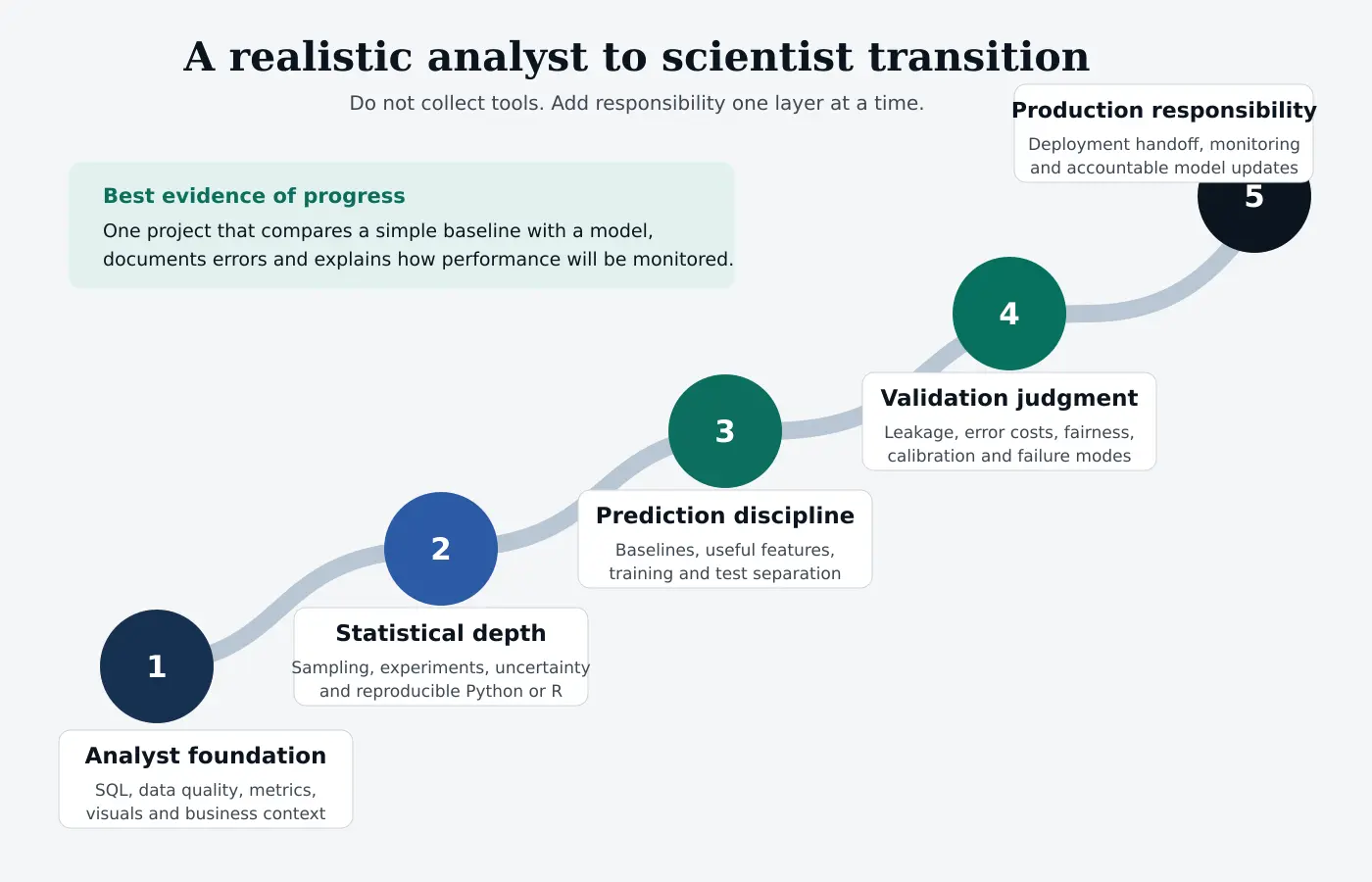
- Strengthen the analyst foundation. Write reliable SQL, document metrics, validate data and communicate decisions clearly.
- Make the work reproducible. Move repeatable analysis into clean Python or R code, version it and test important steps.
- Learn statistics deeply enough to challenge a result. Study sampling, uncertainty, experiments, regression and the assumptions behind common methods.
- Build predictions against a baseline. Start with a simple approach. Separate training from evaluation and explain why the chosen measure matches the decision.
- Study failure, not only accuracy. Examine leakage, false alarms, missed cases, calibration, fairness and changes over time.
- Show production judgment. Explain where features come from, how scores will be used, what will be monitored and when the model should be stopped or updated.
How AI changes both careers
AI can draft SQL, generate Python, suggest charts, summarize results and produce a first model quickly. That reduces the value of typing routine code without understanding it. It increases the value of defining the right question, checking the data and deciding whether the output is safe to use.
What remains human in analysis
Metric meaning, data provenance, valid comparison, business context, causal limits and the judgment to say “the evidence does not support that claim.”
What remains human in data science
Target design, leakage prevention, baseline choice, error costs, validation, fairness, deployment responsibility and monitoring when behavior changes.
BLS still projects strong Data Scientist growth through 2035 while describing demand tied to organizations using data-driven technologies and analytical methods. That does not guarantee an easy job search or establish that every analyst or scientist role is protected from automation. The durable skills emphasized throughout this article are validation, sound definitions, reproducibility and domain understanding.
Does this task need analysis or a model?
Select a task. The result explains the likely owner and why.
Choose a task above
Titles overlap. This tool classifies the responsibility, not the person.
Which career should you choose?
- Choose the daily work, not the title. Read at least thirty current U.S. postings and mark the expected outputs, coding depth, statistics and meeting load.
- Test both jobs on one problem. Complete the two-hour exercise above. Keep the work you would be proud to discuss in an interview.
- Check your tolerance for uncertainty. Analysts often face unclear business questions and imperfect measures. Scientists add model uncertainty and responsibility for automated or repeated decisions.
- Choose a domain. Healthcare, finance, retail, manufacturing and government reward people who understand how the data is created and what mistakes cost.
- Price the education path honestly. A higher salary ceiling does not justify every graduate program. Calculate the full cost and realistic time to employment.
Back to the subscription company with the rising cancellations. The analyst gave leadership something to do by Friday, and the scientist gave them a way to catch the next wave early. The company needed both, and you will do your best work in the seat whose problem you would still be curious about in month six.
A practical final check: data analysis can be a more direct entry route when you can already demonstrate SQL, data quality and decision communication. Data science usually asks for deeper statistics, programming and model-validation evidence. Neither path is permanent; strong shared foundations make later movement easier.
Frequently asked questions
What is the main difference between a data analyst and a data scientist?
A data analyst turns trusted data into measures, explanations and recommendations for decisions. A data scientist adds deeper responsibility for statistical modeling, prediction, validation and monitoring.
Which role requires more coding?
Data scientists usually need deeper reproducible programming because they build training, validation and monitoring workflows. Data analysts often use SQL heavily and may also use Python or R, but coding depth varies more across analyst roles.
Who earns more, a data analyst or a data scientist?
There is no clean federal title-to-title comparison. BLS reports a May 2025 median of $120,230 for Data Scientists, while Data Analyst titles can map to several different occupations. Compare similar seniority, location, duties and compensation components.
Can a data analyst become a data scientist?
Yes. The transition usually adds stronger programming, probability, statistics, experiment design, predictive modeling, validation, error analysis and monitoring to an analyst foundation.
Do data scientists need a master’s degree?
Not universally. BLS lists a bachelor’s degree as the typical entry education for Data Scientists, while noting that some employers require or prefer graduate education.
Can a data scientist work as a data analyst?
Often, but strong modeling skills do not automatically create strong analyst judgment. The role still requires metric definitions, business context, visualization and concise decision communication.
Which career uses more math?
Data science usually requires greater depth in probability, statistics, optimization and model evaluation. Data analysts also need statistics, especially in experimentation and inference roles, but the required depth varies more widely.
Will AI replace data analysts or data scientists?
AI can accelerate queries, code, charts and model experiments. People still need to define valid metrics, verify data, prevent leakage, evaluate models, explain uncertainty and remain accountable for decisions.
Sources and research method
This guide uses current U.S. government occupational data, O*NET employer-demand data and an official data analyst role definition. Salary figures are tied to named occupations and are not presented as promised starting pay or as universal figures for employer titles that map to multiple occupations.
- U.S. Bureau of Labor Statistics, Data Scientists
- U.S. Bureau of Labor Statistics, Operations Research Analysts
- U.S. Bureau of Labor Statistics, Market Research Analysts
- O*NET OnLine, Data Scientists, updated 2026
- O*NET OnLine, 2025 employer software demand for Data Scientists
- O*NET OnLine, Business Intelligence Analysts, updated 2026
- O*NET OnLine, 2025 employer software demand for Business Intelligence Analysts
- Microsoft Learn, Data Analyst career path
Last source review: October 18, 2026. Figures checked against BLS and O*NET pages on that date. Job titles, salaries, tools and hiring practices change. Verify current local postings before choosing.