
Computer science vs cyber security: the short answer
Choose computer science if you want the broadest computing foundation and enjoy building software, studying systems, solving abstract problems or keeping options open across software, data, AI, cloud, research and security engineering.
Choose cybersecurity if protecting systems is already the center of your interest and you prefer network defense, security operations, incident response, digital forensics, identity, cyber risk or governance. The degree should still include programming, operating systems, networking and repeated hands-on labs.
If you are undecided, a computer science major with substantial security electives may leave more doors open. If you already know you enjoy investigating threats and defending infrastructure, a hands-on cybersecurity program could be the more focused choice. Compare syllabi and labs before deciding.
Cybersecurity is the standard one-word form used by U.S. agencies and professional bodies. This guide also uses “cyber security” naturally because students frequently search that spelling; both refer to the same field here.
What is the difference between computer science and cybersecurity?
You will often hear that computer scientists build technology and cybersecurity specialists defend it. That is a useful starting point, but it breaks down quickly at work. A developer must understand security flaws, while a security engineer may spend hours reading and writing code. Application security, cloud security and DevSecOps sit squarely between the two.
| Decision factor | Computer science | Cyber security |
|---|---|---|
| Primary responsibility | Create, understand and improve computing systems. | Preserve confidentiality, integrity, availability and safe operations under risk. |
| Core questions | How should the software or system work? Is it correct, efficient and maintainable? | What can fail or be abused? How will we prevent, detect, contain and recover? |
| Typical coursework | Programming, data structures, algorithms, theory, architecture, operating systems, databases and networks. | Network and system security, secure software, incident response, digital forensics, identity, risk, privacy and governance. |
| Programming depth | Usually deeper and broader across multiple software contexts. | Varies significantly; substantial for security engineering, automation, malware analysis and research. |
| Mathematics | Usually more required mathematics, including discrete math, probability and statistics, with calculus-level rigor in ABET criteria. | ABET calls for discrete mathematics and statistics; cryptography and research paths may require considerably more. |
| Work rhythm | Planned design and development mixed with debugging and production failures. | Preventive work mixed with alerts, investigations, audits, changing threats and occasional on-call incidents. |
| Career flexibility | Broad across computing, including many security roles. | Deeply aligned with security roles but usually less direct for general software and theoretical computing careers. |
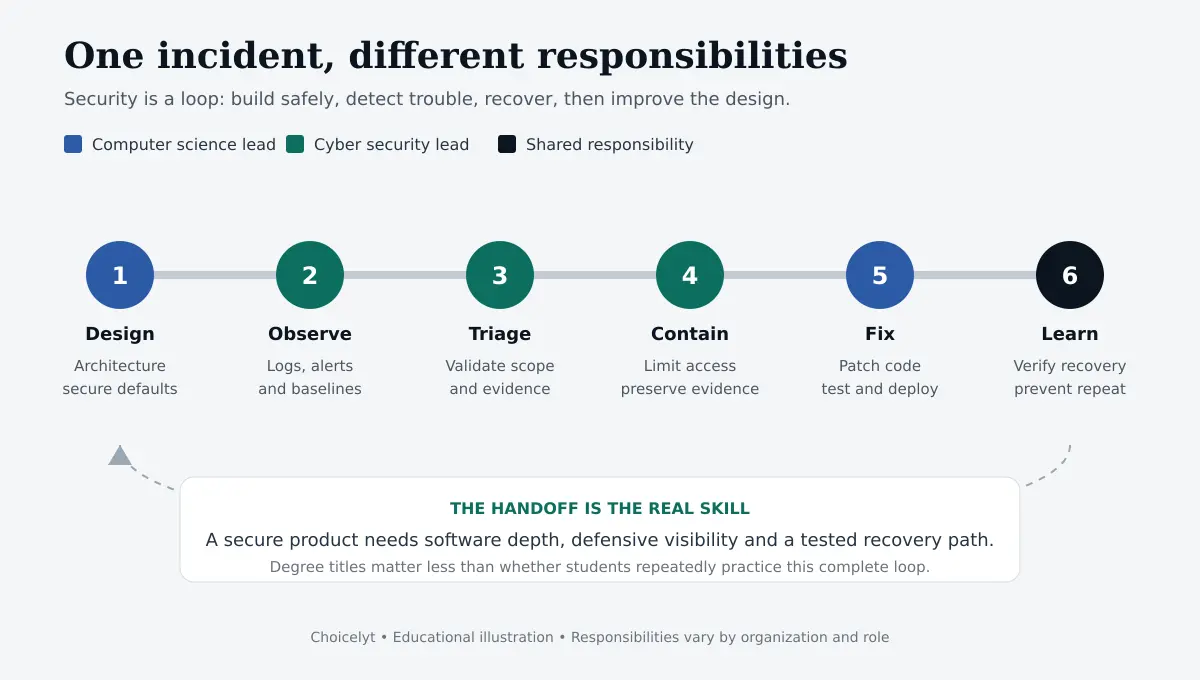
A real security incident shows how the fields collaborate
Consider an online service that starts recording suspicious account logins after an authentication update. The team cannot assume an attack has happened. It might be stolen credentials, a bug in the update, faulty monitoring or a combination. Developers and security staff have to investigate the same evidence from different angles.
One incident, two centers of responsibility
Understand and repair the product
- trace the authentication flow and recent code changes;
- reproduce the failure safely;
- identify the software or architectural weakness;
- write and test the fix;
- deploy without creating a second outage.
Establish scope and control risk
- validate alerts and preserve relevant evidence;
- determine affected accounts and systems;
- contain exposure without destroying evidence;
- coordinate response and recovery;
- document control failures and lessons learned.
Shared work: threat modeling, secure design, logging requirements, validation after the fix and preventing recurrence. Mature teams do not throw the problem over a wall.
Computer science degree vs cyber security degree coursework
The ABET 2026–2027 computing criteria offer a useful U.S. reference because they describe required educational coverage instead of relying on marketing language.
Broad computing depth
ABET calls for at least 40 semester credit hours of computer science covering software development, programming languages, algorithms and complexity, and computing theory. Students also encounter architecture, information management, networking, operating systems, parallel and distributed computing, multiple levels of abstraction and a major project.
The criteria require at least 15 semester credit hours of mathematics and statistics, including discrete mathematics, probability and statistics, with rigor equivalent to at least introductory calculus.
Security across eight layers
ABET calls for at least 45 semester credit hours of computing and cybersecurity. Programs address confidentiality, integrity, availability, risk, adversarial thinking and systems thinking.
Coverage spans data, software, components, connections, systems, people, organizations and society, followed by advanced security depth. At least six semester credit hours of mathematics must include discrete mathematics and statistics.
What a strong cybersecurity program should prove
- Computing foundations: programming, networks, operating systems, databases and system administration—not only tool demonstrations.
- Safe, authorized labs: isolated environments with written scope, ethical rules and evidence handling.
- Defensive operations: monitoring, alert triage, incident response, recovery and documentation.
- Secure development: threat modeling, code review, software security, testing and DevSecOps.
- Human and organizational risk: privacy, governance, awareness, policy and third-party risk.
- An integrative capstone: a realistic problem requiring analysis, communication and technical implementation.
- Career evidence: internships, cyber competitions, research, employer projects and transparent graduate outcomes.
The NSA’s National Centers of Academic Excellence in Cybersecurity designation can help you identify programs with recognized cybersecurity education standards. But it does not replace a close look at accreditation, labs, faculty, internship access, total cost or graduate outcomes.
Which degree is harder?
Computer science may feel harder when…
- you dislike sustained programming practice;
- abstraction and discrete mathematics feel unrewarding;
- debugging large systems drains you;
- you want immediate tools before learning foundations.
Cybersecurity may feel harder when…
- you dislike networking and operating-system details;
- you want one correct answer despite incomplete evidence;
- continuous learning and changing threats exhaust you;
- high-consequence incidents and documentation feel stressful.
Does cybersecurity require coding?
Yes in some paths, less in others. Application security, security engineering, automation, malware analysis and vulnerability research need strong programming. Security operations, audit and governance may involve less product development, but scripting, data handling and the ability to understand software behavior remain valuable. A degree promising a technical cyber career while avoiding both coding and systems knowledge deserves careful scrutiny.
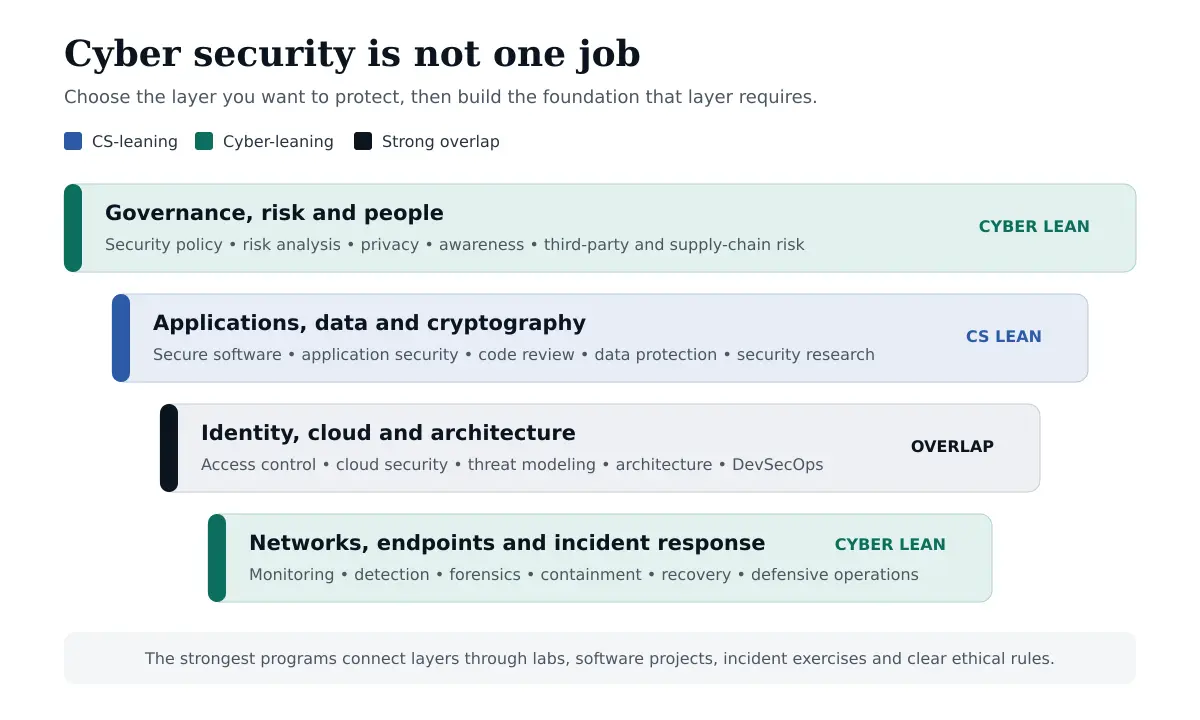
Cybersecurity is a collection of roles—not one job
Cybersecurity is not one occupation. NIST’s NICE Framework breaks the field into work roles, tasks, knowledge and skills so students and employers can compare actual responsibilities. Its April 2026 update added a cybersecurity supply-chain risk management role and refreshed cryptography and DevSecOps competency areas.
| Target career | Usually the stronger starting fit | What you still need |
|---|---|---|
| Software developer | Computer science | Secure coding, threat modeling, dependency management and security testing. |
| Application or product security | CS plus focused security depth | Web and software security, code review, risk communication and realistic secure-development projects. |
| SOC or defensive-security analyst | Cybersecurity | Networking, operating systems, log analysis, cloud fundamentals, triage and clear escalation writing. |
| Incident response or digital forensics | Cybersecurity | Evidence handling, timelines, operating-system artifacts, communication and repeated exercises. |
| Cloud security or DevSecOps | Either—a hybrid profile wins | Cloud architecture, identity, automation, software delivery, monitoring and shared-responsibility models. |
| Cyber risk, compliance or governance | Cybersecurity often aligns directly | Business processes, privacy, standards, audit evidence and the ability to translate controls into operational reality. |
| Security architecture | Usually either, after experience | This is rarely an immediate graduate role; broad systems knowledge and prior implementation experience matter. |
| Cryptography or security research | Computer science and mathematics | Advanced mathematics, theory and often graduate education. |
| Authorized penetration testing | Either, depending on technical depth | Networks, operating systems, web technology, reporting, legal scope and practice only in authorized environments. |
Which responsibility would you rather own?
Select the difficult task you would still find meaningful after the novelty disappears. This is a reflection tool—not a prediction of ability.
Build the dependable service
You may prefer software design, architecture, testing and turning requirements into a maintainable system.
Check next: programming depth, data structures, systems courses and substantial team projects.The entry-level cybersecurity reality
Cybersecurity demand is real, but “a talent shortage” does not mean every graduate immediately becomes a security engineer. The U.S. Bureau of Labor Statistics says information security analysts typically need a bachelor’s degree in a computer-related field and related work experience. Many analysts previously worked in an IT department, often in network or systems administration.
People who understand the systems being protected, can distinguish a meaningful signal from noise and communicate clearly during risk and uncertainty.
Internships, authorized labs, documented defensive projects, networking and Linux competence, clear reports, software or IT experience and role-relevant credentials.
Junior SOC work, IT support, network operations, system administration, software development, audit support, vulnerability management or structured apprenticeships—depending on the employer.
A degree title, a list of security tools, an unsupervised “hacking” claim or a senior certification studied without the experience it is designed to represent.
Myth: Cybersecurity is mostly ethical hacking.
Reality: defensive operations, identity, secure development, governance, recovery, privacy and communication represent large parts of the field.
Myth: Certifications replace fundamentals.
Reality: credentials can organize learning or satisfy an employer requirement, but they do not replace systems knowledge, labs, projects or judgment.
Myth: CISSP is an entry-level target.
Reality: ISC2 requires five years of cumulative full-time experience in at least two domains; an eligible degree or approved credential may waive up to one year.
A safe try-before-you-enroll challenge
Spend one session building and testing a small local application. Spend another in a legal training lab reviewing logs, permissions and a simulated incident. Document what happened, what evidence supports your conclusion and what should change. Notice whether you are more energized by creating the system, investigating its behavior or connecting both.
Rule: practice only on systems you own or environments that explicitly authorize security testing.
Computer science vs cyber security salary and outlook
Degrees do not have one salary. Computer science graduates enter many occupations, and cybersecurity graduates do too. The responsible comparison uses occupations, education requirements, experience and location.
May 2025 U.S. median pay. BLS projects 10% growth from 2025 to 2035.
May 2025 U.S. median pay. BLS projects 21% growth and about 14,100 openings per year.
May 2025 U.S. median pay. BLS projects 22% growth; the occupation typically requires at least a master’s degree.
These are occupation-wide medians across experience levels—not starting salaries and not outcomes guaranteed by either degree. Software-development opportunities form a much larger labor category: BLS projects roughly 106,100 annual openings for the combined software developer, quality-assurance analyst and tester group, compared with 14,100 for information security analysts.
CyberSeek’s 2025 update reported 514,359 U.S. job listings involving cybersecurity skills over a 12-month window. Those listings signal employer demand, but they should not be read as 514,359 unique, unfilled, entry-level cybersecurity jobs. Listings and BLS projected annual openings measure different things.
How AI changes computer science and cybersecurity
AI can speed up routine coding, alert summaries, log searches and documentation. But a confident-looking answer can still miss an attack, misread a log or introduce a vulnerability. In security work, being able to check the tool’s reasoning matters as much as knowing how to use it.
Computer science after AI
- less value in unexamined boilerplate;
- more value in architecture, testing and verification;
- continued need to understand dependencies and failure modes;
- growing need to build secure AI-enabled products.
Cybersecurity after AI
- faster alert enrichment and repetitive analysis;
- new risks around AI systems, data and supply chains;
- greater need to validate automated conclusions;
- continued accountability for containment, recovery and risk acceptance.
The April 2026 NICE Framework update added a cybersecurity supply-chain risk management work role and refreshed cryptography and DevSecOps competencies. Neither major is immune to automation. The stronger preparation is to understand systems well enough to review AI output and explain security decisions.
How to choose between computer science and cyber security
- Choose a responsibility, not a trend. Decide whether you prefer building systems, protecting operations, investigating evidence or managing risk.
- Audit required courses. Count programming, data structures, operating systems, networking, security labs, mathematics, secure development, incident response and governance.
- Read twenty target job descriptions. Separate junior roles from jobs asking for several years of experience. Record repeated responsibilities and foundations.
- Inspect experiential learning. Look for supervised labs, internships, competitions, research, realistic incidents and substantial software projects.
- Check external signals carefully. Confirm institutional accreditation, program accreditation where applicable, NSA CAE status, faculty experience and transparent outcomes.
- Test both work styles safely. Complete one software project and one authorized defensive-security exercise before committing.
- Compare total cost. Use Choicelyt’s education ROI calculator to include tuition, housing, commuting, financing and time away from work.
Bottom line: computer science is usually the safer broad undergraduate choice for students who remain uncertain or want security engineering and application security. Choose a dedicated cybersecurity degree when its curriculum is technically rigorous, its labs are substantial and your interest clearly lies in protection, response or cyber risk. The best degree is the one that gives you both a foundation and credible evidence of practice.
Frequently asked questions
Which is better, computer science or cyber security?
Computer science is usually the better broad foundation for software, systems, AI, data and security engineering. A dedicated cybersecurity degree is usually more direct for security operations, incident response, digital forensics and cyber risk, provided it includes strong computing foundations and hands-on labs.
Can you work in cybersecurity with a computer science degree?
Yes. CS graduates can add network, operating-system, cloud, secure-development and defensive-security experience. Computer science is especially relevant to application security, product security, security engineering and research.
Can a cybersecurity graduate become a software engineer?
Yes, but the graduate may need additional depth in data structures, software architecture, testing, operating systems and substantial application projects if those areas were limited in the cybersecurity curriculum.
Does cyber security require coding?
The amount varies. Security engineering, application security, automation, malware analysis and research require substantial programming. Security operations and governance may use less application development, but scripting and technical literacy remain valuable.
Which degree is harder, computer science or cybersecurity?
Neither is universally harder. CS usually demands more programming depth, abstraction and mathematical theory. Cybersecurity demands systems and network knowledge, adversarial thinking, careful evidence handling and continuous learning across technical and organizational risk.
Which pays more, computer science or cyber security?
Degrees do not have one salary. BLS reported May 2025 medians of $135,980 for software developers and $129,180 for information security analysts. Those occupation-wide medians are not starting salaries or guaranteed graduate outcomes.
Is cybersecurity an entry-level career?
Some junior pathways exist, but many security jobs are not truly entry level. BLS says information security analysts typically need a bachelor’s degree and related work experience. Internships, labs and prior IT or development experience can be important bridges.
Is a cybersecurity degree worth it?
It can be when the program has strong computing foundations, authorized labs, internships, secure-development coverage, incident exercises and reasonable total cost. The title alone is not enough.
Should I study computer science and minor in cybersecurity?
That is often a strong option for students who want broad software and systems depth plus structured security coursework. Verify that the minor includes technical labs and that your schedule leaves room for internships and substantial projects.
Will AI replace cybersecurity or computer science jobs?
AI will automate portions of coding, alert review, documentation and analysis. It also creates new software risks and security work. Employers still need people who can verify outputs, design secure systems, investigate evidence, manage risk and remain accountable.
Sources and research method
This article prioritizes current U.S. curriculum standards, federal workforce frameworks and occupation-level labor data. Competitor articles were reviewed to identify recurring questions and weaknesses; their wording, unsupported “future-proof” claims and outdated salary figures were not reused.
- ABET — Criteria for Accrediting Computing Programs, 2026–2027
- NIST — NICE Framework Resource Center
- NIST — NICE Framework Components v2.2.0
- NSA — National Centers of Academic Excellence in Cybersecurity
- U.S. BLS — Information Security Analysts
- U.S. BLS — Software Developers, Quality Assurance Analysts and Testers
- U.S. BLS — Computer and Information Research Scientists
- NIST — 2025 CyberSeek job-listing update
- ISC2 — CISSP experience requirements
Last source review: September 24, 2026. Programs, certifications and labor data change; verify the linked source and each college catalog before making a decision.