
Business analyst vs data analyst in one minute
A business analyst identifies needs, studies processes, brings stakeholders into agreement, defines requirements and evaluates whether a proposed change will create value. A data analyst gathers, cleans and examines data, then explains patterns, uncertainty and implications.
The business analyst usually asks, “What problem are we solving, who is affected and what must the solution do?” The data analyst usually asks, “What does the evidence show, how reliable is it and what action does it support?” In smaller organizations, one person may do parts of both jobs.
The real difference is the uncertainty each role removes
Many comparison pages reduce this choice to communication versus coding. That is too simple. Both roles communicate, both may use data and both need analytical thinking. The more useful distinction is the type of uncertainty they are expected to remove.
Business analyst uncertainty
The organization may not agree on the problem, the current process, the people affected, the required behavior or the value of a solution. The business analyst creates clarity around change.
Core question: What should change, and how will we know the solution is acceptable?
Data analyst uncertainty
The organization may have competing explanations, incomplete records or no reliable measure of what happened. The data analyst creates clarity around evidence.
Core question: What does the available data support, and what remains uncertain?
The International Institute of Business Analysis defines business analysis as enabling change by defining needs and recommending solutions that deliver value to stakeholders. That definition matters because a business analyst is not simply a person who makes business reports. Data may support the work, but the role centers on needs, change, solutions, context and value.
Here is a simplified scenario drawn from the kind of quality work Husnain has done, included to make the split concrete and not as a case study. A batch of metal castings keeps failing inspection. One person has to work out what the process is supposed to guarantee, who signs off at each step and what a passing casting must look like. Another has to look at the test records, find out whether the failures cluster by shift, furnace or supplier, and say how sure anyone can be. The first is doing business analysis. The second is doing data analysis. The fix needed both.
One checkout problem, two professional lenses
Customers are abandoning an online checkout
A retailer knows that completed orders have fallen, but the team disagrees about the cause. Marketing blames price. Customer service blames confusing delivery choices. Engineering suspects a payment error. Leadership wants a fix within six weeks.
Business analyst contribution
- interviews customer service, marketing, finance and engineering;
- maps the checkout process and the points where ownership changes;
- separates assumptions from confirmed needs;
- defines what the improved checkout must allow customers to do;
- documents business rules, exceptions and acceptance criteria;
- helps compare solution options and their operational impact.
The output is a shared definition of the problem and a solution that stakeholders can build, test and accept.
Data analyst contribution
- checks whether checkout events are captured consistently;
- builds a funnel from cart to payment confirmation;
- compares device, browser, payment method, location and customer type;
- finds a sharp decline after a mobile payment update;
- tests whether the pattern started at the same time as the release;
- estimates affected orders and defines how improvement will be measured.
The output is evidence about where the failure occurs, its likely size and what result should be monitored after the fix.
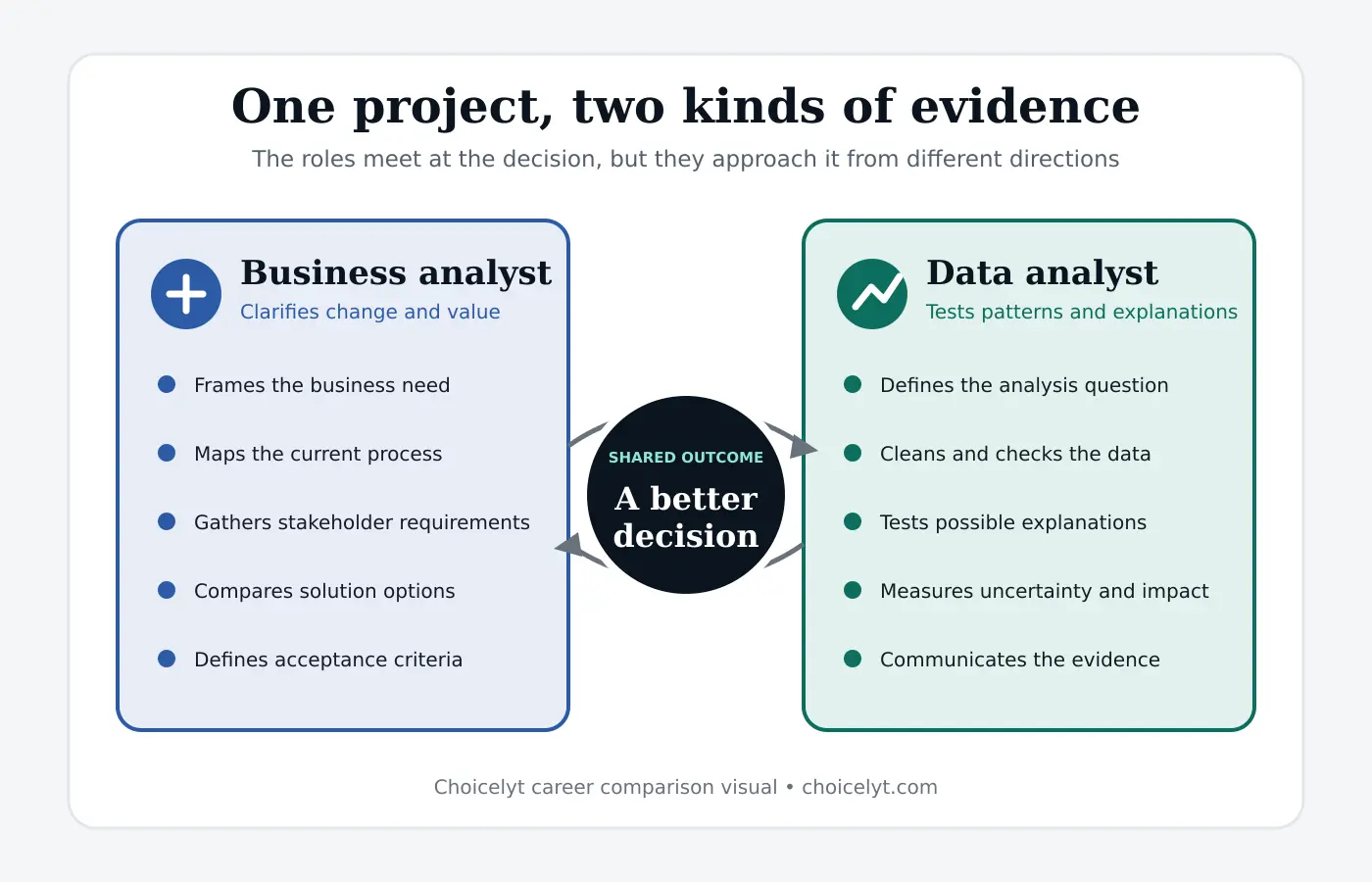
Business analyst vs data analyst side by side
| Decision factor | Business analyst | Data analyst |
|---|---|---|
| Main purpose | Clarify needs and help an organization implement valuable change. | Turn data into trustworthy evidence for a decision. |
| Typical starting point | A process problem, new system, stakeholder request or proposed change. | A question, pattern, performance change or claim that needs evidence. |
| People interaction | Usually frequent workshops, interviews, negotiation and clarification. | Frequent collaboration, but often more uninterrupted analysis time. |
| Common outputs | Process maps, requirements, business rules, user stories, option analysis and acceptance criteria. | Queries, cleaned datasets, reports, charts, statistical analysis and recommendations. |
| Technical emphasis | Process, systems, requirements, documentation and solution evaluation. | SQL, data quality, spreadsheets, visualization, statistics and sometimes Python or R. |
| Success looks like | The right problem is addressed and the change works for its stakeholders. | The evidence is reliable, correctly interpreted and useful for action. |
| Common mistake | Documenting a requested feature without challenging the underlying need. | Producing a convincing chart without checking data quality or business context. |
| Strong fit signal | You enjoy clarifying disagreement and improving how work happens. | You enjoy investigating patterns and proving or rejecting explanations. |
What each role is expected to produce
Tools change quickly. Deliverables reveal the role more reliably. When reading a posting, look for the objects the person will create, maintain and defend.
Business analyst deliverables
- current and future process maps;
- stakeholder and impact analysis;
- business requirements and rules;
- user stories and acceptance criteria;
- gap, cost and option analysis;
- decision records and change support;
- traceability from need to tested solution.
Data analyst deliverables
- clean and documented analysis datasets;
- reproducible SQL queries or analysis code;
- charts, dashboards and written findings;
- segment, trend and exception analysis;
- quality checks and metric definitions;
- forecast or experiment summaries;
- recommendations with limitations.
The strongest collaboration happens when the business analyst prevents the team from solving the wrong problem and the data analyst prevents the team from acting on weak evidence.
What a realistic workday can feel like
Business analyst: prepares a workshop about checkout exceptions. Data analyst: checks whether the event data refreshed correctly before sharing findings.
Business analyst: facilitates a discussion between teams that use different definitions. Data analyst: compares mobile and desktop behavior and investigates an unexpected difference.
Business analyst: updates business rules and acceptance criteria. Data analyst: reviews a query, validates totals and writes a short explanation of the result.
Both: meet with the product owner. They connect the evidence to the proposed change and agree on how success will be measured.
Real schedules vary. A consultant may spend more time with clients. A data analyst on a reporting team may attend many meetings. A business analyst in a technical product team may work closely with databases and system interfaces.
Skills and tools without the stereotypes
Business analyst foundation
- elicitation: ask questions that uncover needs, rules and exceptions;
- process thinking: see delays, handoffs and failure points;
- requirements: describe needed behavior clearly enough to test;
- facilitation: help people with competing priorities reach clarity;
- solution evaluation: compare value, risk, cost and feasibility;
- communication: adapt detail for leaders, users and technical teams.
Common tools include spreadsheets, process mapping software, project platforms, documentation tools and sometimes SQL or reporting software.
Data analyst foundation
- SQL: retrieve and combine data while preserving meaning;
- data cleaning: find missing, duplicated or inconsistent records;
- statistics: judge variation, comparisons and uncertainty;
- visualization: show a result clearly without exaggerating it;
- analysis code: use spreadsheets and often Python or R for repeatable work;
- business context: connect a pattern to a real decision.
Common tools include SQL databases, Excel, Power BI, Tableau, Python, R and notebook environments.
Degrees, certifications and entry routes
There is no single required degree for either title. Business analysts often come from business administration, information systems, finance, operations, computer science or a domain such as healthcare. Data analysts often come from data analytics, statistics, mathematics, economics, information systems, computer science or a quantitative domain.
For business analysis, a useful program teaches process analysis, requirements, systems thinking, project delivery, economics and communication. For data analysis, look for substantial SQL, databases, statistics, data cleaning, visualization and programming. In either path, applied projects and internships matter because employers need evidence that you can work with incomplete real situations.
Evidence for business analysis
- a process map with a clear problem statement;
- stakeholder interviews summarized into needs;
- requirements and acceptance criteria;
- two solution options compared by value and risk;
- a change impact and measurement plan.
Evidence for data analysis
- a documented dataset and quality audit;
- clear SQL with sensible checks;
- an analysis that tests competing explanations;
- charts designed for the decision;
- a short recommendation that states limitations.
Certifications may structure learning, but they do not replace work samples. IIBA credentials can support a business analysis path. Vendor and professional analytics certificates may support a data path. Before paying, compare the curriculum, assessment quality, employer recognition and total cost through the Choicelyt education ROI calculator.
Business analyst vs data analyst salary in the United States
A precise national comparison is not available from one federal table. “Business analyst” can map to management analysis, systems analysis, finance, operations or another occupation. “Data analyst” is also a broad employer title rather than one dedicated BLS occupation. Salary websites may report a number for each title, but their samples, job matching and pay definitions can differ.
Use related federal occupations as context, not as guaranteed salaries for either title.
May 2025 U.S. median wage. This occupation focuses on improving organizational efficiency and may include consulting work.
May 2025 U.S. median wage. This is relevant when a business analyst studies how technology and systems support organizational needs.
May 2025 U.S. median wage. This provides context for some customer and market data work, not all data analyst roles.
BLS also projects 2025 to 2035 employment growth of 10 percent for management analysts, 8 percent for computer systems analysts and 7 percent for market research analysts. Each of those occupations typically starts with a bachelor's degree. Because they are broader than either job title, treat them as a sign of demand for analytical work in general and not as a forecast for business analysts or data analysts specifically.
These are occupation wide medians, not entry salaries. They do not prove that every business analyst earns more than every data analyst. Compare live postings in your target city, then adjust for experience, industry, remote status, security requirements, bonus terms and benefits.
How hiring tests usually differ
This is one of the most practical differences and one that many comparisons ignore. The interview process often reveals what the employer truly means by the title.
Business analyst hiring task
You may receive a vague request such as, “Customers need faster refunds.” A strong response identifies stakeholders, asks about the current process, clarifies rules and exceptions, defines the desired outcome and proposes testable requirements.
Interviewers may assess facilitation, prioritization, process mapping, documentation, judgment and how you handle conflicting opinions.
Data analyst hiring task
You may receive a table of orders, refunds and support contacts. A strong response checks data quality, writes correct queries, chooses fair comparisons, creates readable visuals and explains what can and cannot be concluded.
Interviewers may assess SQL, spreadsheets, statistics, visualization, reasoning and communication.
Test both roles with one refund problem
Spend 45 minutes as the business analyst. Write the problem, stakeholders, questions, process, business rules and acceptance criteria. Then spend 45 minutes as the data analyst. Define the needed fields, quality checks, comparisons, chart and conclusion limits.
Notice where you lose track of time. Enjoying clarification, tradeoffs and process points toward business analysis. Enjoying evidence, queries and pattern testing points toward data analysis. Enjoying both suggests product, operations or blended analyst roles.
How AI changes both careers
AI can summarize a meeting, draft requirements, suggest interview questions, write a first SQL query and produce a quick chart. That changes the speed of routine work, but not the need for accountable judgment.
AI and business analysis
AI can organize notes and produce early documentation. It cannot reliably decide which stakeholder is missing, whether a stated request solves the actual need, how a policy affects frontline work or when disagreement requires negotiation.
AI and data analysis
AI can accelerate code and exploration. It can still join the wrong fields, overlook a definition change, mistake correlation for explanation or write a confident summary from weak evidence. Analysts must verify the work.
The safer career strategy is to use AI while building the skills needed to challenge it. Business analysts need stronger discovery, systems thinking and change judgment. Data analysts need stronger data validation, statistical reasoning and domain knowledge.
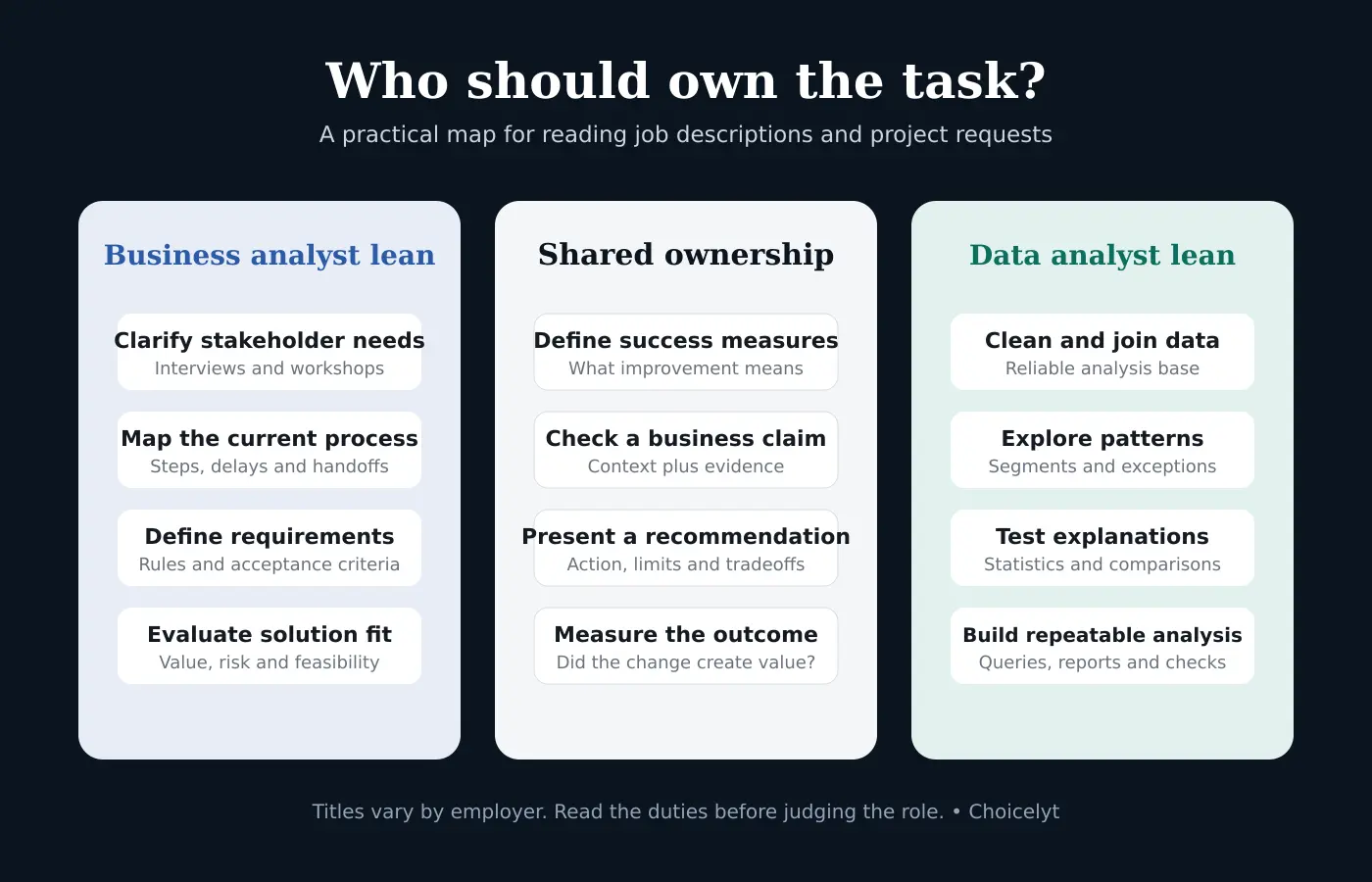
Which task would you volunteer to own?
Select the task that sounds most satisfying. The result explains the likely career lean and what to practice.
Choose a task above
This is a work sample, not a personality test. Several tasks require both roles.
How to choose the better path for you
- Read duties, not titles. Collect thirty current U.S. postings across several industries. Mark the deliverables, tools, meeting load and experience requested.
- Identify the uncertainty you enjoy removing. Choose change and stakeholder clarity for business analysis. Choose data and evidence clarity for data analysis.
- Complete the ninety minute experiment. Notice which half you want to improve after time ends.
- Build one credible portfolio project. Show decisions, checks and limitations, not only polished templates or charts.
- Choose a domain. Healthcare, finance, retail, manufacturing and government each reward knowledge that tools cannot provide automatically.
- Calculate the full education cost. Include tuition, fees, housing, commute, software and time away from work before purchasing a degree or certificate.
Final recommendation: do not choose based on which title sounds more prestigious or which generic salary is higher. Choose the daily work you can become unusually good at. Both careers reward clear reasoning, domain knowledge and the ability to explain a decision honestly.
Frequently asked questions
What is the main difference between a business analyst and a data analyst?
A business analyst clarifies organizational needs, processes, requirements and solution value. A data analyst prepares and examines data to answer questions, test explanations and communicate evidence. Many projects need both.
Which is better, business analyst or data analyst?
Business analysis may fit people who enjoy stakeholder discussions, process improvement and defining change. Data analysis may fit people who enjoy working directly with datasets, statistics, queries and evidence. Neither is universally better.
Which career requires more coding?
Data analyst roles usually require more regular SQL and may require Python or R. Business analysts may use SQL, but many roles emphasize requirements, process mapping, documentation and stakeholder communication.
Who earns more, a business analyst or a data analyst?
No single federal wage category represents either broad title. Pay depends on the actual occupation, industry, location, experience and responsibilities. Compare local postings and clearly matched BLS occupations.
Can a business analyst become a data analyst?
Yes. Business analysts can move toward data analysis by strengthening SQL, statistics, data cleaning and portfolio evidence. Their domain and stakeholder knowledge can remain valuable.
Can a data analyst become a business analyst?
Yes. Data analysts can add process mapping, requirements, stakeholder interviews, facilitation, solution evaluation and change planning. Evidence skills can strengthen business analysis when they are connected to stakeholder needs.
Can a business analyst work without coding?
Some roles require little coding, but technical literacy improves flexibility. SQL, data structures, system behavior and basic integration concepts can help a business analyst communicate with technical teams.
Is a business analyst the same as a business intelligence analyst?
No. A business analyst commonly focuses on needs, processes, requirements and change. A business intelligence analyst commonly focuses on reporting systems, shared measures and dashboards. Review the full business intelligence vs data analytics comparison for that boundary.
Do both roles use Excel and Power BI?
They can. Business analysts may use them for process evidence, option comparisons and reporting. Data analysts may use them for data preparation, analysis and visualization. Tool overlap does not make the responsibilities identical.
Will AI replace business analysts or data analysts?
AI can speed up meeting summaries, requirement drafts, queries, charts and first pass analysis. People remain responsible for defining needs, verifying evidence, resolving disagreement, judging tradeoffs and approving decisions.
Sources and research method
This guide uses current professional standards and U.S. government labor data. Salary and outlook figures are BLS May 2025 wages and 2025 to 2035 projections. Where no federal category matches a job title, this page says so instead of inventing a number.
- International Institute of Business Analysis, defining business analysis
- IIBA, starting a business analysis career
- U.S. Bureau of Labor Statistics, Management Analysts
- U.S. Bureau of Labor Statistics, Computer Systems Analysts
- U.S. Bureau of Labor Statistics, Market Research Analysts
- Microsoft Learn, Data Analyst career path
Last source review: October 17, 2026. Titles, salaries, tools and hiring practices change. Verify current local postings before choosing.