
Picture two sophomores at the same state university. This is an invented scene, used only to make the choice concrete. One spends a weekend building a small app to track her club's budget and loves the moment the code finally runs. The other spends the same weekend wrestling a messy spreadsheet of survey answers and loves the moment a pattern survives a second test. Both say they are "going into tech." Their weekends already point toward different majors, and this guide is about reading those signals before you pick.
Computer science vs data science: the short answer
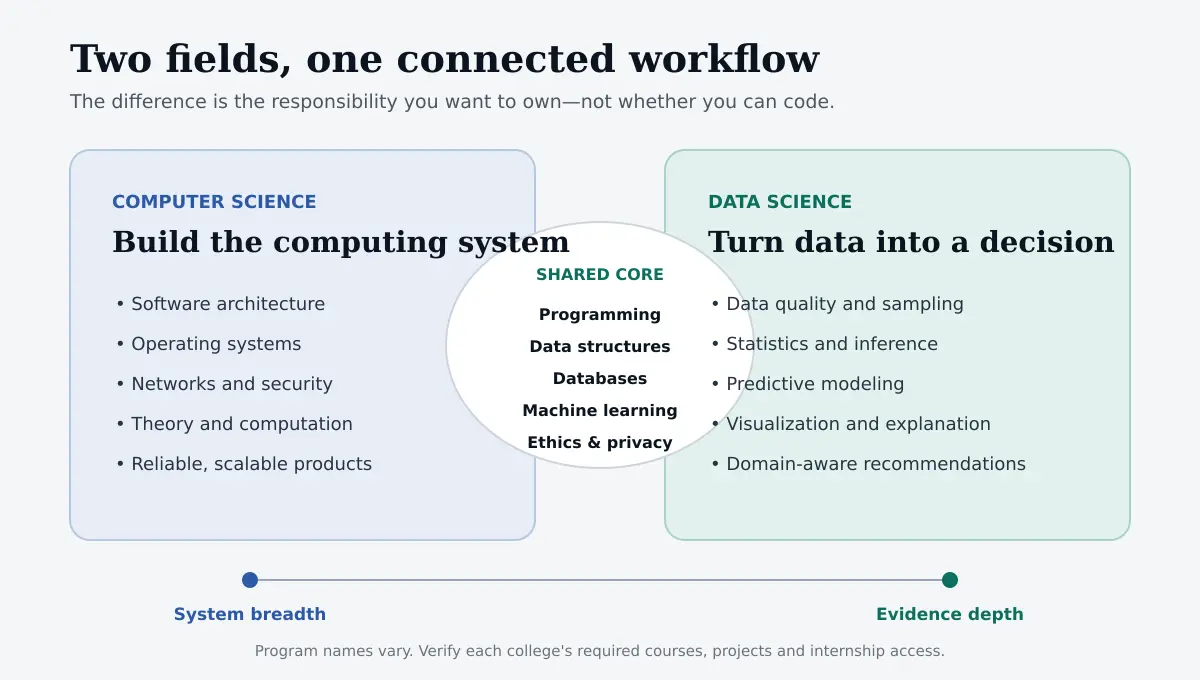
Choose computer science if you want the broader computing foundation: software, systems, networks, security, theory and the infrastructure behind AI. Choose data science if you specifically want to work across the data lifecycle: collecting and cleaning data, applying statistics, building and evaluating models, visualizing results and explaining what a decision-maker should do.
If you are an undergraduate who likes both but is still uncertain, a rigorous computer science degree with substantial statistics, machine learning and data coursework usually preserves more computing options. A strong data science degree can be the more direct route when you already know that evidence, uncertainty and domain questions interest you more than systems breadth.
What is the difference between computer science and data science?
The cleanest distinction is the object of responsibility. A computer scientist or software professional asks, “How should this computational system work, scale and remain reliable?” A data scientist asks, “What can this data support, how uncertain is the result, and will the model remain useful after deployment?”
| Decision factor | Computer science | Data science |
|---|---|---|
| Primary focus | Computation, software, systems and technical foundations. | Data quality, statistical evidence, models and decisions. |
| Typical questions | Can we build it? Is it correct, secure, efficient and maintainable? | Is the data representative? Does the pattern generalize? What action is justified? |
| Core mathematics | Discrete mathematics, logic, probability and statistics; calculus varies by program and specialization. | Probability, statistics, linear algebra, inference and optimization, usually applied repeatedly. |
| Programming | Broad and deep: applications, systems, abstractions, testing and software design. | Used to acquire, transform, explore, model, visualize and deploy data products. |
| Messiest challenge | Complex systems, changing requirements, hidden dependencies and production failures. | Missing or biased data, ambiguous targets, misleading correlations and uncertain conclusions. |
| Communication | Specifications, design decisions, technical documentation and team coordination. | Assumptions, uncertainty, visual evidence and recommendations to technical and nontechnical stakeholders. |
| Career breadth | Usually broader across software, systems, security, AI, data and research. | Usually more concentrated in analytics, modeling, experimentation, data products and decision science. |
A real project shows the difference better than definitions
Imagine a retailer wants a service that predicts weekly demand so stores can order enough inventory without creating excessive waste. This is not a classroom dataset. Promotions, stockouts, weather, new products and changing customer behavior make the data imperfect.
Shared project: a demand-forecasting product
Both professionals may write code, use databases and discuss model performance. Their center of gravity is different.
Computer science responsibility
- design reliable ingestion and storage;
- build services that request and return forecasts;
- manage access, testing and failure handling;
- schedule jobs and monitor latency;
- make the product secure and maintainable.
↔
LEARN
Data science responsibility
- define the forecast target and time horizon;
- detect leakage, missingness and selection bias;
- compare a simple baseline with stronger models;
- back-test across seasons and product groups;
- explain uncertainty and business tradeoffs.
The handoff is continuous. A model that performs well in a notebook can fail if the production pipeline changes a field. A technically sound service can still cause bad decisions if the target was defined incorrectly. Machine-learning engineering and data engineering sit in the overlap, which is why strong teams value both software discipline and statistical judgment.
Computer science vs data science degree coursework
The ABET 2026–2027 computing criteria provide a useful U.S. benchmark. They specify topics rather than forcing every college to use identical course names.
Broad computing foundations
ABET calls for at least 40 semester credit hours of computer science, including substantial coverage of software development, programming languages, computing theory, and algorithms and complexity. Students also encounter architecture, information management, networks, operating systems, parallel and distributed computing, different levels of abstraction and a major integrative project.
The criteria also call for at least 15 semester credit hours of mathematics and statistics, including discrete mathematics, probability and statistics, with rigor at least equivalent to introductory calculus.
The complete data lifecycle
ABET calls for at least 45 semester credit hours of data science. Coverage includes acquisition and representativeness, management, preparation and integration, analysis, model development and deployment, visualization and communication.
Cross-cutting topics include ethics and fairness, privacy and governance, inference, modeling, linear algebra, probability, optimization, data structures and algorithms. A program also needs advanced depth, an application area and an integrative major project.
The seven-course audit that prevents a bad choice
Before applying, open each catalog and mark whether the required curriculum, not merely the electives, includes:
- Programming progression: more than one introductory coding course, with software design, testing and team work.
- Data structures and computational thinking: essential for technical flexibility in either major.
- Mathematical depth: discrete mathematics for CS; probability, statistics and linear algebra for data science; calculus and optimization where relevant.
- Data systems: databases, data management, pipelines and enough systems knowledge to move beyond a notebook.
- Model evaluation: validation, baselines, error analysis, uncertainty and the difference between prediction and explanation.
- Responsible practice: privacy, security, fairness, governance and documentation.
- A real capstone: messy data or nontrivial software, a stakeholder, a deployed or reproducible result and a defensible evaluation.
Which degree is harder?
Neither is automatically easier. They punish different weaknesses.
Computer science feels harder when…
- abstract structures and formal reasoning feel unmotivating;
- you dislike debugging state, interfaces and system behavior;
- large codebases and invisible dependencies drain you;
- you want immediate application but the course begins with foundations.
Data science feels harder when…
- probability and uncertainty feel less comfortable than deterministic answers;
- you dislike cleaning data before modeling;
- you want one metric to settle a complex decision;
- you do not enjoy explaining assumptions and limitations.
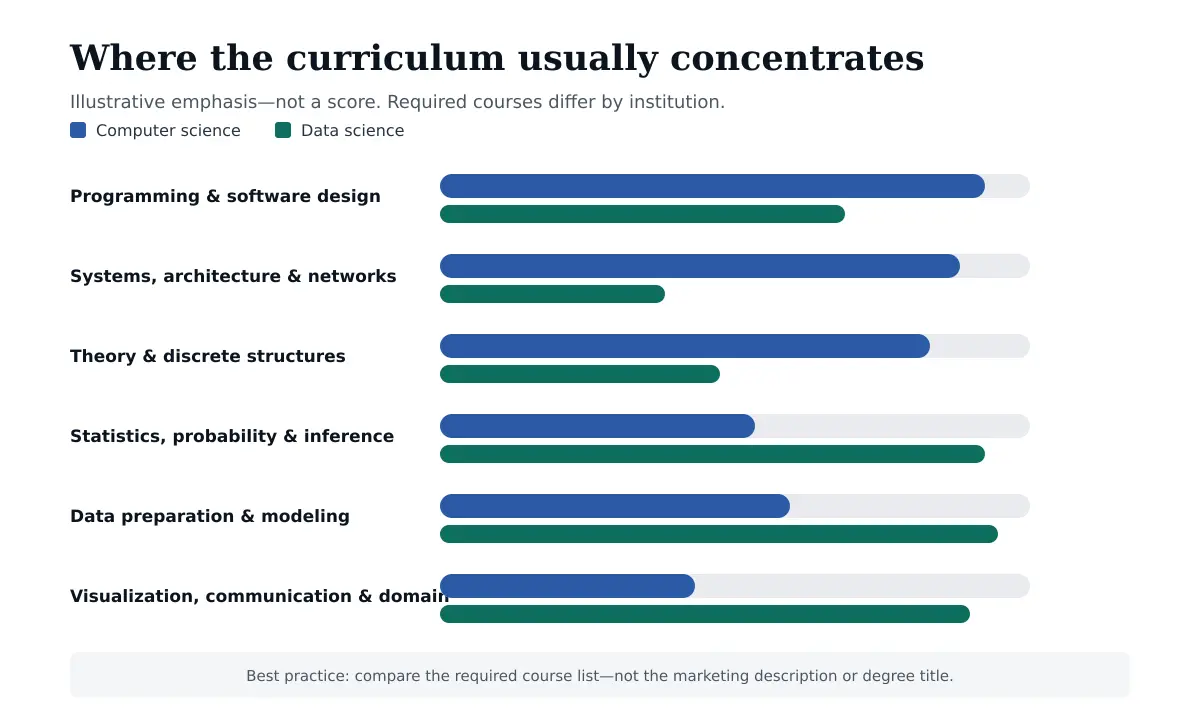
Data science usually uses more statistics, probability, linear algebra and optimization in day-to-day coursework. Computer science usually uses more discrete mathematics, abstraction and systems reasoning. Advanced machine learning can demand both.
Data science vs data analytics vs computer science
Students often search computer science vs data analytics when they actually mean data science. Data analytics commonly emphasizes SQL, reporting, dashboards, descriptive analysis and decision support. Data science usually extends further into inference, predictive modeling, machine learning and deployment. Computer science remains the broadest of the three in software and computing systems. These are tendencies, not universal definitions, so audit the curriculum.
Which degree is better for your target career?
| Target role | Usually the stronger starting fit | What closes the gap |
|---|---|---|
| Software developer or software engineer | Computer science | Data science students need deeper software design, testing, systems and production application work. |
| Data scientist | Data science is direct; CS is viable | CS students need statistics, experimental design, data preparation, visualization and domain-focused projects. |
| Machine-learning engineer | Usually CS plus ML/data depth | Model evaluation, data pipelines, deployment, distributed systems and monitoring. |
| Data analyst or BI analyst | Data science or data analytics | SQL, dashboards, business measures, clear communication and domain knowledge matter more than advanced modeling. |
| Data engineer | Often computer science | Databases, distributed processing, cloud systems, data quality and pipeline reliability. |
| Cybersecurity, operating systems or networks | Computer science | Role-specific labs, security practice and infrastructure knowledge. |
| Applied decision scientist | Data science | Deep knowledge of the application domain plus causal reasoning and stakeholder communication. |
| Computing research scientist | Computer science | Advanced mathematics and usually graduate study; BLS says the occupation typically requires at least a master’s degree. |
Computer science
Best when you want several technical exits: software, systems, security, AI, data engineering or research.
Data science
Best when statistics, imperfect data, models and translating results into decisions are the attraction, not merely "working in tech."
Hybrid paths
Machine-learning engineering, data engineering and AI products reward students who combine software quality with data and model judgment.
Which responsibility would you rather own every week?
Select the work you would most willingly practice even when it becomes repetitive or difficult. This is a reflection tool, not an aptitude test.
Build the complete product
You may prefer architecture, software design, testing and turning requirements into a dependable system.
Check next: required software projects, data structures, systems courses and internship access.Computer science vs data science salary and job outlook
There is no responsible single salary for a “computer science degree.” Computer science graduates enter many occupations, and data science graduates do too. Compare occupations, education requirements, location and experience, not two inflated degree averages.
May 2025 U.S. median pay. BLS counts about 275,600 jobs in 2025, projects 35% employment growth from 2025 to 2035 and expects about 24,800 openings per year.
May 2025 U.S. median pay. BLS projects 10% growth for software developers from 2025 to 2035.
May 2025 U.S. median pay. BLS projects 22% growth and about 2,900 openings per year, but the occupation typically requires at least a master’s degree.
BLS lists a bachelor’s degree as the typical entry-level education for data scientists and names mathematics, statistics, computer science, business and engineering among the common fields. A computer science degree is therefore a recognized route into the data scientist title, not a detour.
These are occupation-wide medians, not starting salaries, outcomes guaranteed by a major or direct proof that one degree “pays more.” For another data-centered role, BLS reports a May 2025 median of $88,940 for operations research analysts and projects 12% growth from 2025 to 2035.
What AI changes, and what it does not
AI can generate code, queries, visualizations, documentation and initial model experiments. That reduces the value of work that is accepted without inspection. It does not remove responsibility for defining the problem, testing the output, protecting data, operating the system or explaining the consequence of a decision.
Computer science after generative AI
- more code can be drafted quickly;
- architecture, testing and verification become more valuable;
- security and dependency risks still require judgment;
- engineers must understand unfamiliar generated code;
- reliable deployment remains an organizational responsibility.
Data science after generative AI
- exploration and boilerplate analysis become faster;
- bad targets and unrepresentative data remain bad;
- model comparison needs valid evaluation, not impressive demos;
- privacy, fairness, drift and uncertainty remain human-accountability issues;
- domain context becomes more important, not less.
Current BLS projections do not support the claim that either field is disappearing. BLS explicitly connects demand for software development to AI, automation and connected products, and connects data-scientist growth to data-driven decisions and AI integration. However, national long-term projections are not a promise of an easy first job.
Investopedia's September 2026 report on Indeed posting data described how software-development postings had rebounded from a February 2025 low but remained below pre-pandemic levels, while data-and-analytics postings were also below that baseline, with the recovery concentrated in senior roles. Treat that as one market snapshot, not a forecast: a degree should be paired with internships, substantial projects, evidence of teamwork and the ability to verify AI-assisted work.
The durable skill stack for either major
- Foundations: mathematics, data structures, databases and the ability to reason without a tool completing the thought.
- Evidence: testing, reproducibility, model or software evaluation and clear documentation.
- Production: version control, deployment, monitoring, security and realistic failure handling.
- Context: understanding the users, institution or scientific/business domain affected by the system.
- Communication: stating what you know, what you assume and what could make the conclusion wrong.
How to choose between data science and computer science
- Run two small experiments. Build a simple application, then analyze an unfamiliar dataset with a question that does not have a perfectly clean answer.
- Compare required courses. Count software, systems, statistics, mathematics, data lifecycle, ethics and capstone requirements.
- Read twenty U.S. job descriptions. Separate true entry-level roles from postings asking for several years of experience. Track repeated responsibilities, not trendy tool names.
- Inspect internship access. A program with employer projects, research groups and active career support may be worth more than a fashionable major title.
- Check flexibility. Ask whether CS students can complete a statistics or data track and whether data science students can take core systems and software-engineering courses.
- Review the capstone standard. Look for real stakeholders, reproducibility, testing, communication and an output that extends beyond a polished slide deck.
- Compare total cost and time. Use Choicelyt’s education ROI calculator to include tuition, housing, commuting, financing and the income you give up while studying.
Back to the two sophomores. Neither weekend was the wrong one. The useful question is which weekend you would repeat on purpose, because that is the work you will be doing in some form for years.
Our practical verdict: for an undecided undergraduate, computer science is often the safer broad base if the program is rigorous and you can add substantial statistics and data coursework. Choose data science directly when its curriculum is mathematically serious, includes software and deployment, not just dashboards, and you are confident that the data-to-decision lifecycle is the work you want.
Frequently asked questions
Which is better, computer science or data science?
Computer science is usually better for broad computing flexibility, software development, systems, cybersecurity and computing research. Data science is usually better for statistics, data preparation, modeling, visualization and domain-based decision work. The stronger choice depends on the required curriculum and target role.
Is data science harder than computer science?
Neither is universally harder. Computer science usually demands more abstraction, discrete mathematics, systems reasoning and software depth. Data science usually demands more probability, statistics, linear algebra, data ambiguity and communication of uncertain results.
Can a computer science major become a data scientist?
Yes. A CS student should add probability, statistics, linear algebra, experimental design, data visualization, data cleaning, model evaluation and a domain-focused portfolio. BLS lists computer science among the common degree backgrounds for data scientists.
Can a data science major become a software engineer?
Yes, but a data science student may need additional depth in data structures, software design, testing, operating systems, networking, version control and production-scale application development.
Which degree is better for AI and machine learning?
Computer science is often stronger for building AI systems and infrastructure. Data science is often stronger for statistical modeling, evaluation and data-centered applications. Strong machine-learning engineers combine software and systems depth with probability, model evaluation and data pipelines.
Does data science require more math than computer science?
Data science usually uses more statistics, probability, linear algebra and optimization in its core workflow. Computer science uses discrete mathematics and may include calculus, probability and advanced mathematics depending on the specialization.
Is data science the same as data analytics?
No. Data analytics often emphasizes querying, dashboards, reporting and decision support. Data science generally extends further into statistical inference, predictive modeling, machine learning, deployment and the full data lifecycle.
Which degree has the higher salary?
A major does not have one salary. BLS reports occupation medians. In May 2025, the median was $120,230 for data scientists and $135,980 for software developers. Those figures cover workers across experience levels and do not establish starting pay or guaranteed outcomes for graduates.
Is a bachelor’s in data science too specialized?
Not when the program includes strong mathematics, programming, data structures, databases, model evaluation, deployment, ethics and an application domain. It becomes risky when it is a shallow collection of tools with little software or statistical foundation.
Will AI replace computer science or data science jobs?
AI automates parts of coding, analysis and documentation. Organizations still need people who can define problems, verify evidence, design systems, protect data, evaluate models and accept responsibility for outcomes. The entry-level market may be competitive even while long-term BLS projections remain positive.
Sources and research method
This article prioritizes current U.S. curriculum criteria and federal occupational data. Salary and outlook figures are BLS May 2025 wages and 2025 to 2035 projections, and each is tied to an occupation rather than a degree.
- ABET: Criteria for Accrediting Computing Programs, 2026–2027
- ACM, IEEE Computer Society and AAAI: CS2023 curricular guidance
- U.S. Bureau of Labor Statistics: Data Scientists
- U.S. Bureau of Labor Statistics: Software Developers, Quality Assurance Analysts and Testers
- U.S. Bureau of Labor Statistics: Computer and Information Research Scientists
- U.S. Bureau of Labor Statistics: Operations Research Analysts
- Investopedia: September 2026 analysis of Indeed job-posting trends in AI-exposed roles
Last source review: October 18, 2026. Data checked against BLS and ABET pages on that date. Occupational projections and curricula change; verify the linked source and each college catalog before making a decision.