
Cybersecurity vs software engineering: the practical difference
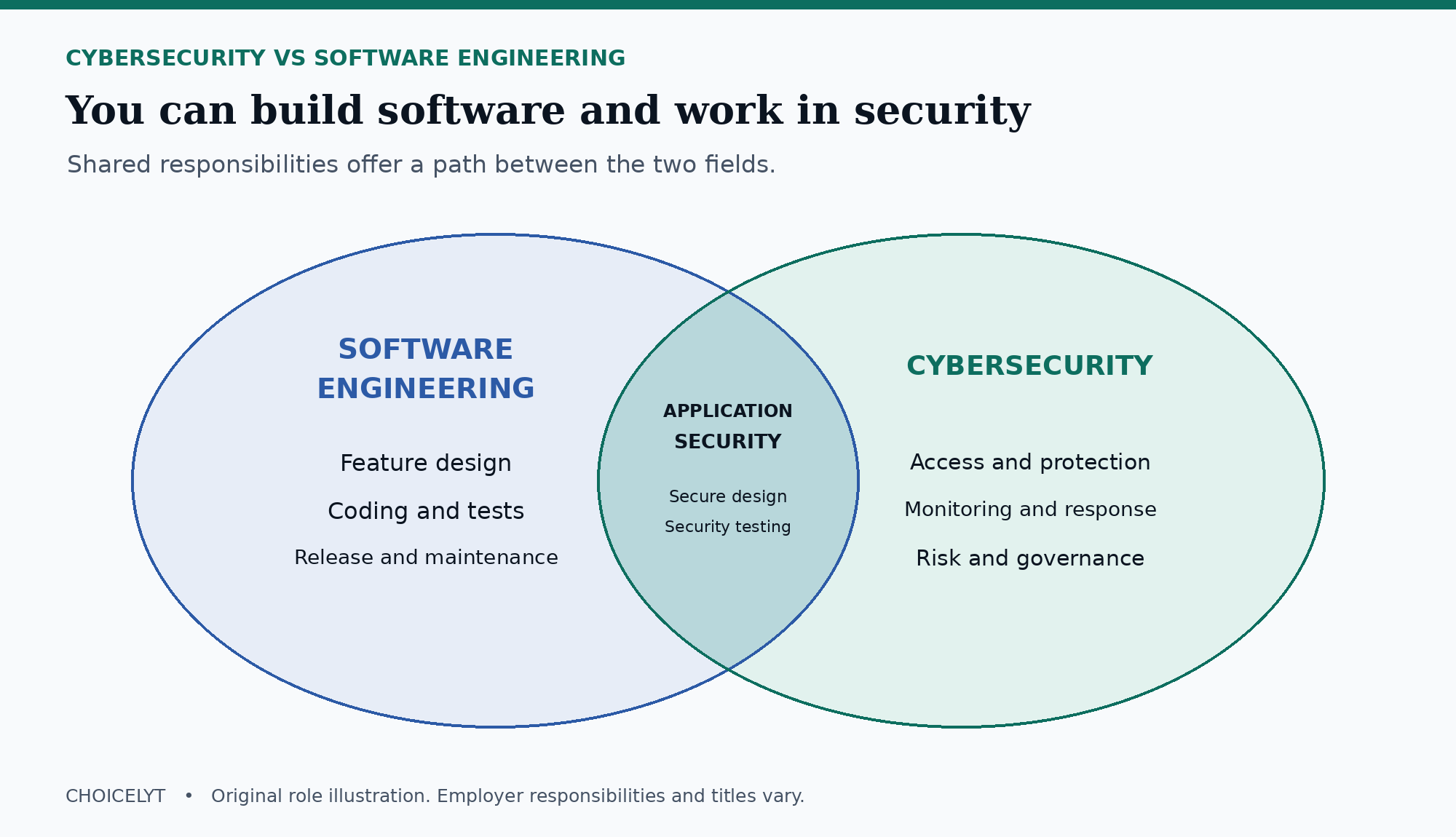
Software engineers design, build, test and maintain software systems. Cybersecurity professionals reduce risk to systems, information and the people who depend on them. While they have different primary goals, the fields share common ground in application security, product security, security engineering and secure software development.
Software engineering puts heavy daily emphasis on building and maintaining how a program behaves. Cybersecurity varies widely depending on your specialty. Some roles strictly involve investigation, tracking controls and defining risk. Other security engineering roles involve serious coding and systems architecture.
Do not let job titles confuse you. A software engineer might spend their whole week fixing a broken payment gateway. A security analyst could spend that same week tracking a suspicious login attempt to that exact system. Meanwhile, a security engineer might sit next to the developers writing code to prevent it from happening again. To pick the right path, you need to understand what each person is hired to deliver.
| Question | Cybersecurity | Software engineering |
|---|---|---|
| What do you own? | A layer of protection, an investigation, a security assessment or a documented risk decision. | A feature, a full application or an entire system that users depend on every day. |
| What fills the day? | It depends on your track. You might review alerts, test for weaknesses, improve system controls or document company risk. | You will clarify product requirements, design solutions, write code, run tests, review peers and maintain existing software. |
| How much coding? | It varies heavily. Some security engineering and automation roles require extensive software development. | Programming is the core foundation, even when design, architecture and team collaboration take up a lot of your day. |
| What do both need? | Exceptional troubleshooting skills, clear technical writing, solid system foundations, teamwork and an eye for how things fail. | |
Choose a cybersecurity specialty before comparing careers
Saying "I want to work in cybersecurity" is a great start, but it is too broad to build a study plan around. NIST’s NICE guidance specifically separates occupations, jobs and daily work roles. A single job posting might ask you to do three different types of work.
You investigate active alerts, piece together digital evidence and decide if an event needs to be escalated. You will want to ask potential employers about shift hours, the volume of alerts and how much support you get from senior staff.
You look at how software could be broken into, help developers fix structural weaknesses and improve automated security testing. This is a very strong direction to explore if you already know how to write code.
You manage who is allowed to use which systems, and what happens when employees join the company, change departments or leave. Strict permissions and dependable processes are the core of this role.
You assess corporate controls, gather compliance evidence and explain risks to business leaders. These roles may not require daily coding, but they absolutely demand strong technical comprehension and excellent writing skills.
Penetration testing is just one specific specialty, and it means actively testing a system for weaknesses with full authorization. Most cybersecurity jobs do not involve hacking a mainframe or staring at a wall of red alerts like in the movies. When looking at a job, ask what you will actually produce by Friday afternoon.
O*NET’s Information Security Engineers profile is a great resource if you are interested in designing and building protections instead of analyzing risk. That distinction is critical when comparing cybersecurity against software engineering. Security engineering often requires cloud architecture, automation, scripting and infrastructure skills that look very similar to traditional software engineering roles.
A feature can work perfectly and still expose private information
This scenario is invented for illustration. Imagine a customer portal where people can click a link to download their own service records. A developer builds the feature, and it looks flawless in a team demonstration. But what if someone manually changes the record number in their browser request and receives a total stranger's file? The feature itself succeeded in fetching a file, but safe behavior is not the same thing as successful behavior.
Building the feature
The software engineer designs the entire download flow. They retrieve the correct database record and handle any loading errors. Their tests cover normal requests, missing files and basic user permissions. However, the job is incomplete if the feature only works safely for the intended user.
Investigating the risk
A security specialist steps in to check if the permission rules actually hold up across different users and alternative web routes. They document the exact weakness, explain its business impact and help the team verify the final fix. Their goal is to protect the company, not just to find a clever flaw.
OWASP’s access control guidance makes it clear that permissions have to be enforced deep inside trusted server code. Simply hiding a button on the screen is not enough. The server that actually handles the request must independently verify if that specific person is allowed to see that specific record.
Modern secure development treats this as a shared team responsibility. NIST’s Secure Software Development Framework weaves security checks directly into the daily software building process. Even if you are not working in a dedicated security department, software engineers are expected to know fundamental security practices.
Cybersecurity vs software engineering salary in the U.S.
Headline salary numbers can make this career choice look much simpler than it really is. To get a fair comparison, we have to look at two specifically named U.S. occupations over the exact same time period. Here are the facts:
| Measure | Information security analysts | Software developers |
|---|---|---|
| Median annual wage, May 2025 | $129,180 | $135,980 |
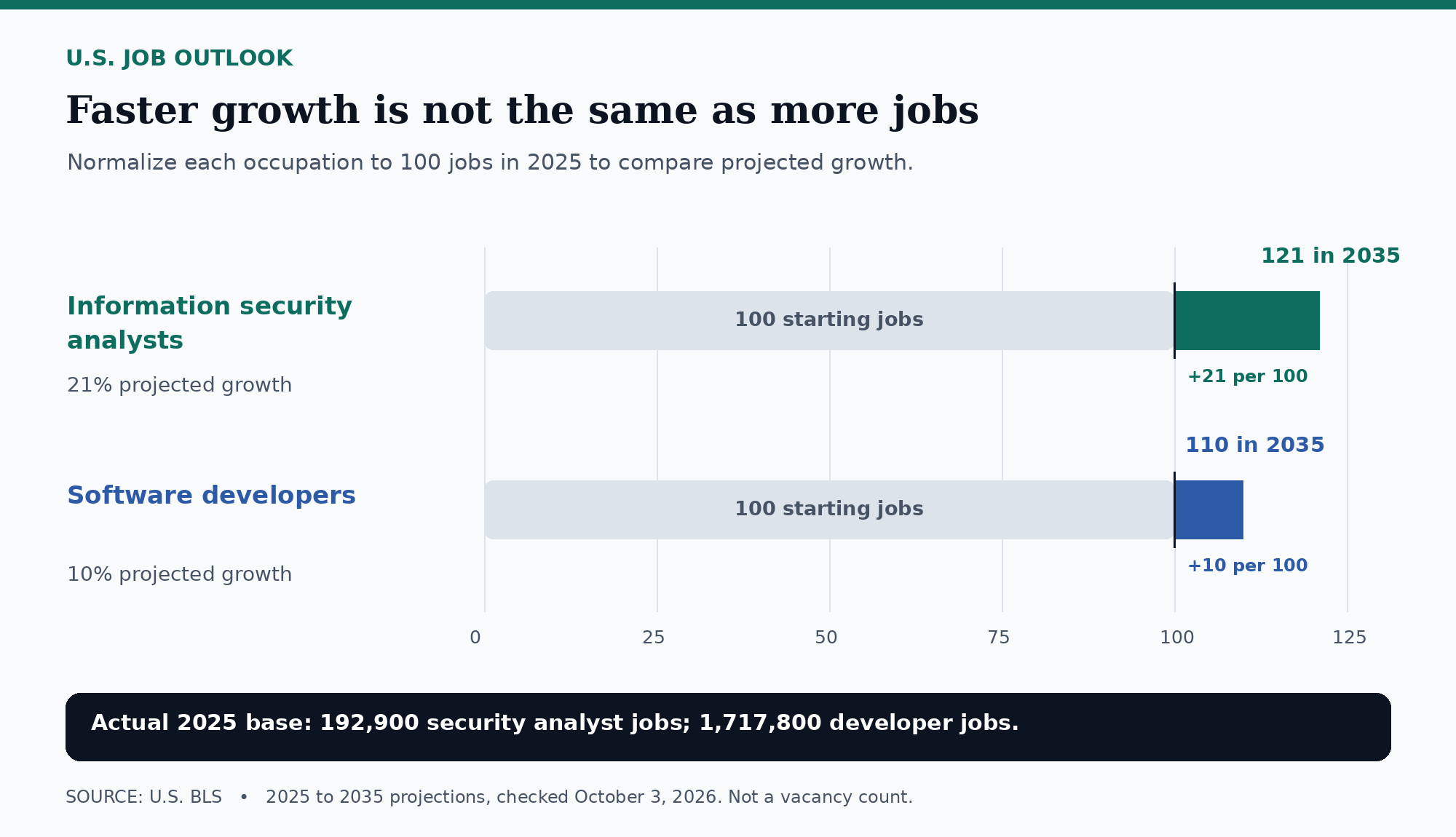
| Projected employment growth, 2025 to 2035 | 21% | 10% |
| Employment, 2025 | 192,900 jobs | 1,717,800 jobs |
| Average annual openings | 14,100 | BLS reports 106,100 for the combined Software Developers, QA Analysts and Testers group |
Sources: Information Security Analysts and Software Developers. Remember that these medians are not what a beginner is offered. Information security analysts are just one specific job within the wider cybersecurity field. The software numbers are specifically for developers, as the BLS separates out dedicated software testers.
Does a faster growth rate mean more job opportunities?
Not always. Information Security Analysts have a much higher projected percentage growth, but software development is starting from a massively larger pool of existing jobs. The BLS projects around 14,100 Information Security Analyst openings each year. On the other hand, they project roughly 106,100 annual openings for the combined software developer and tester group. Those top level numbers do not tell you how many of those jobs are actually entry level or located near you.
When you sit down to compare actual job offers, make sure you are looking at the same city, the same years of experience and similar daily responsibilities. Always separate your base salary from your bonuses and company stock. A senior security engineer’s advertised pay package will not tell you anything about what a junior software developer might earn in their first year.
Degrees, certifications and landing the first job
Is cybersecurity an easier field to enter?
Cybersecurity can be an excellent pivot for someone who already has IT, systems or software engineering experience, but it is rarely a shortcut around learning technical foundations. The BLS explicitly lists related work experience as typical for Information Security Analysts. That helps explain why so many security job postings are not built for true beginners. Software development also expects you to prove your skills, even if the role is advertised as junior.
If you are starting from zero, focus on building rock solid foundations in operating systems, networking, basic programming logic and clear technical documentation. Once you have that, pick a specific destination. A help desk or systems administration job can be a great stepping stone into security. An internship or junior developer role is usually the best path into software engineering. These are proven routes, not mandatory rules.
Which college degree makes the most sense?
The BLS notes that a bachelor’s degree is the typical entry requirement for both Information Security Analysts and Software Developers, though they mention that security analysts usually need prior related work experience. You should compare university programs based on their coverage of operating systems, networking, programming, secure development practices, hands-on projects and cost. A degree that simply has "cybersecurity" in the title does not automatically tell you what kind of job it prepares you to do.
If you are currently picking a major, take time to read Computer Science vs Cybersecurity and Software Engineering vs Computer Science. Before you take out loans for another qualification, always run the numbers on tuition, time spent and your forgone earnings using our education ROI page.
Do you need a CISSP certification to get started?
No. ISC2’s CISSP requirements generally mandate five full years of qualifying professional experience across at least two specific domains. While there are waivers and an Associate route for people who do not have the experience yet, passing the exam alone does not make a beginner a fully certified CISSP professional.
Instead, look at ISC2’s Certified in Cybersecurity, which has zero work experience requirements. It is a great foundation credential, but it is not proof that you are ready to perform every junior security job. Pick your certificates based on the exact roles you want to apply for, and always keep a portfolio of practical project evidence right next to them.
Try the work yourself before paying for a career change
You do not have to guess which kind of daily work you prefer. Build a very small application using fictional customer records, and then review your own access rules. You will walk away with two great pieces of evidence: a feature that actually works and a clear written explanation of what might make it unsafe. Only run security tests on systems that you personally own or have explicit, written permission to assess.
Your two part career test drive
Check off the evidence you create as you go. This is just a planning tool to get you moving, not a formal aptitude test.
Build something useful
Explain what could go wrong
Start with the feature requirement and access rules. Both activities depend on understanding the intended behavior.
Checks stay on this page only and reset when you reload. No information is submitted.
When you are finally done, take a step back and look at what naturally held your attention. Did you immediately want to start coding a second feature? Or were you much more interested in finding the hidden flaw, writing up the documentation and proving your fix actually held up? Keep both pieces in your portfolio. Your ability to explain the decisions behind the work matters significantly more than just taking a screenshot of a completed tool.
Switching careers and planning your progression
If you are a software engineer looking to move into cybersecurity, you should investigate application security, product security, security engineering or security automation. You will need to add a deep knowledge of permissions, threat modeling, vulnerability handling and the specific security frameworks used by the teams you want to join. Your development experience transfers incredibly well, but it does not automatically replace security specific judgment.
If you are a security professional who wants to move into software engineering, you need to show real experience building and maintaining long term applications. You should strengthen your understanding of program structure, automated testing, databases and team collaboration through formal code reviews. Knowing how to inspect software is a great skill, but it is completely different from owning its design and daily delivery.
Career progression in either field can mean taking on much deeper technical work or moving into team leadership. A developer might grow into a senior engineering or software architecture role. A security specialist might deepen their expertise in digital forensics, cloud engineering or corporate risk. Always evaluate your next role by asking what you will actually own, rather than assuming every new job title is a guaranteed step up the ladder.
Questions to ask before accepting a new role
- What specifically would I be expected to deliver in my first three months?
- How much of my time will be spent building new things versus investigating issues and writing documentation?
- Who will review my work, and what kind of support is available if I get stuck?
- Are there mandated shifts or incident response responsibilities outside of normal working hours?
- What specific experience would prepare me for the next senior role on this exact team?
Common questions before making your choice
What is the main difference between cybersecurity and software engineering?
Software engineering is centered around designing, building and maintaining how software behaves. Cybersecurity is entirely focused on reducing the risk to systems, private information and the end users. However, fields like application security and security engineering blend substantial parts of both roles.
Who earns more money, cybersecurity professionals or software engineers?
There is no universal answer because cybersecurity covers dozens of entirely different occupations. For the cleanest BLS comparison we have, the May 2025 median was $129,180 for Information Security Analysts and $135,980 for Software Developers.
Does a career in cybersecurity require less coding?
It entirely depends on your chosen specialty. Governance and some corporate risk roles may touch very little code. On the other hand, application security, security automation and Information Security Engineering can involve a massive amount of programming, scripting and cloud infrastructure development.
Is cybersecurity an easier field to enter than software engineering?
Generally, no. The BLS lists related work experience as typical for Information Security Analysts, meaning many security jobs fully expect you to have prior IT, systems administration or software engineering experience before you apply. Entry difficulty changes wildly based on the exact specialty, the employer and your location.
Can a software engineer easily move into cybersecurity?
Yes. Application security, product security, security engineering and security automation are very natural areas for a developer to investigate. You will just need to add specific security knowledge in access control, threat assessment, vulnerability management and secure development frameworks.
Can a cybersecurity professional become a software developer?
Yes, absolutely. The professional will need to demonstrate their ability in software design, maintaining long term codebases, writing tests, managing databases, building interfaces and collaborating through peer code review. Security knowledge is a massive bonus, but actually building the software is a distinctly separate responsibility.
Do I absolutely need a CISSP certification to start a cybersecurity career?
No. The CISSP generally requires substantial, verifiable work experience to attain. ISC2’s Certified in Cybersecurity credential has zero work experience requirements, but any certification you earn should always be paired with practical, hands-on evidence that is relevant to the job you want.
Which of these careers is safer from AI replacement?
There is no reliable universal answer to this right now. AI can heavily assist in coding, data analysis and security investigation in both fields. We will still need real people to validate software behavior, check permissions, weigh evidence, make final risk decisions and handle complex failures rather than blindly trusting plausible AI generated output.
Sources and research notes
Sources re-checked October 16, 2026. Salary figures identify their exact occupations and the provided data year. Because cybersecurity is much broader than just one BLS occupation, the Information Security Analyst evidence and Information Security Engineer evidence are explicitly labeled separately. The customer portal and checklist are original teaching examples. Read our methodology or report a correction.
- BLS: Information Security Analysts and Software Developers: duties, entry context, May 2025 wages and 2025 to 2035 projections.
- NIST NICE: Occupations, Jobs and Work Roles: interpreting cybersecurity responsibilities.
- O*NET: 2025 employer software demand for Information Security Analysts.
- O*NET: 2025 employer software demand for Information Security Engineers.
- O*NET: 2025 employer software demand for Software Developers.
- NIST: Secure Software Development Framework and OWASP: Broken Access Control: secure development and permission checks.
- ISC2: CISSP experience requirements and Certified in Cybersecurity: credential entry requirements.
- GitHub: Responsible use of Copilot agents: limitations, review and testing.