
Data engineer vs data analyst: the quick answer
Data engineers build and operate systems that collect, transform, store and deliver dependable data. Data analysts use data to define measures, investigate questions, explain patterns and support decisions. Engineers focus more on recurring delivery and reliability. Analysts focus more on interpretation and decision support.
Both roles use SQL and data-quality checks, but for different purposes. The useful comparison is whether you want to own the reliability of the reusable data system or the meaning of the result built from it.
On paper, that sounds simple. In practice, both people may spend hours inside the same database, writing similar SQL queries. You begin to see the difference when the numbers stop making sense.
Two revenue reports disagree. Who investigates what?
Picture a retailer preparing its June sales review. Finance reports $960,000. A sales dashboard shows $1,080,000. A manager is ready to raise the advertising budget based on the larger figure. But which number can the team trust? Before making that decision, someone has to explain the gap.
This is a simplified teaching example, not a company case study. Assume there are no currency conversions, taxes or other adjustments. The entire $120,000 difference consists of $75,000 in refunds that one report includes and $45,000 in sales counted twice after a data job was repeated.
The engineer follows the records
The engineer follows the trail back to the data load. The job ran twice, so some orders entered the table twice. Fixing the dashboard number would hide the problem, not solve it. The engineer corrects the records, makes repeat runs safe and adds a test to catch the problem if it happens again.
The deliverable is a dependable dataset and an explanation of which reports were affected. Simply editing the displayed total would leave the underlying failure in place.
The analyst follows the meaning
The analyst asks a different question: what does finance mean by “revenue”? Is it the amount sold before refunds, or what remains after refunds? They agree on a definition with finance, reconcile the totals and make that meaning clear in the dashboard.
The deliverable is a defensible measure and a recommendation. The advertising decision should wait until the corrected figures and the relevant business question are clear.
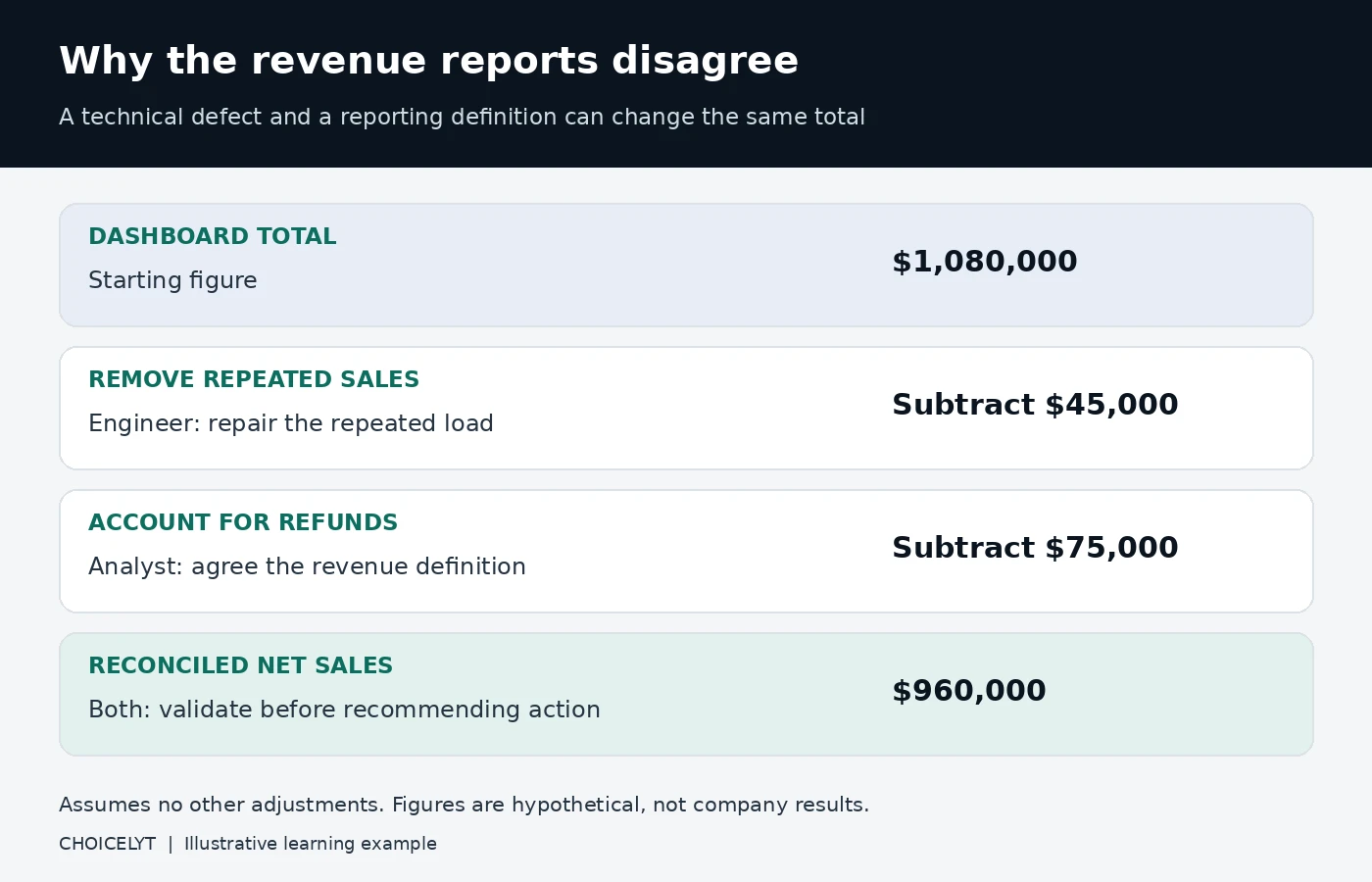
Notice how easily these jobs cross paths. An analyst might spot the duplicate records first. An engineer might be the one who questions the definition of revenue. The boundary is not who discovers the mistake; it is who takes lasting responsibility for the system and who stands behind the interpretation.
What each role does, beyond the job title
Microsoft’s engineering career guide emphasizes integrating, transforming and consolidating data while supporting reliable pipelines and stores. O*NET’s Data Warehousing Specialists profile similarly centers on data warehousing design, loading, transformation and support. For analysis, Microsoft’s analyst guide focuses on preparing, modeling and visualizing data, while O*NET’s Business Intelligence Analysts profile covers querying repositories, producing reports and identifying trends. Preparation belongs to both roles; the downstream responsibility differs.
| Decision factor | Data engineer | Data analyst |
|---|---|---|
| Main output | Reliable datasets, pipelines and data services. | Analysis, measures, reports and recommendations. |
| Recurring question | Will the right data arrive correctly and on time? | What does the result mean, and what action is justified? |
| SQL work | Transform data, design tables and improve recurring queries. | Investigate questions, calculate measures and validate results. |
| Other common tools | Python, databases, cloud services, scheduling and version control. | Spreadsheets, Power BI or Tableau, SQL and sometimes Python or R. |
| Quality checks | Missing records, repeated records, freshness and changes in inputs. | Definitions, filters, comparison groups, totals and misleading interpretations. |
| Typical pressure | A failed refresh, an expensive query or an upstream change. | An urgent question, an unclear request or a challenged conclusion. |
| Communication | Document data behavior, dependencies, access and recovery. | Explain assumptions, findings, limits and next actions. |
| Proof of good work | The system remains correct when rerun or when inputs change. | The conclusion survives scrutiny and helps a real decision. |
At a small company, one person may do all of this. At a larger one, the responsibility might be shared by a data engineer, an analytics engineer and an analyst. That is why the job description matters more than the title alone.
What a realistic workday can look like
An engineer might inspect a failed overnight refresh, discuss a changed source field, review a teammate’s transformation code and test a safe recovery. Improving performance can mean reducing unnecessary scans of a large table, not adding another tool.
An analyst might clarify why a manager wants a report, query sales by customer group, reconcile totals with finance and explain why a percentage rose even though the number of buyers fell. The chart may be what everyone sees. The harder work is making sure its denominator means what the audience thinks it means.
Which role needs more coding or math?
Engineering usually needs broader software and systems skills. Analysis usually needs more repeated practice interpreting business measures. Neither role is accurately described as “just coding” or “just making charts.”
SQL is the most useful shared starting point
Start with filtering, grouping and joining tables. Then deliberately break a query. Join two tables in a way that multiplies orders. Treat a missing value as zero. Use the wrong time zone for a date filter. These are the mistakes that teach you what correct data actually requires. In the revenue example, knowing SQL syntax is insufficient unless you understand whether each row represents an order, an item or a refund.
Analysts use SQL to investigate questions. Engineers use it to make transformations repeatable and maintainable. Both should explain why a result is correct rather than pointing to a query that ran without an error.
Python matters differently in each role
Engineering often uses Python for moving records, managing files, connecting services and automating checks. Build skills in functions, error handling, testing and readable code. Learn how the program behaves when a file is missing or a service is unavailable.
Analysis may use Python for cleaning data, repeatable investigations or statistical work. Some analyst jobs rely primarily on SQL, spreadsheets and a reporting tool. Others require substantial Python. Let actual target postings decide the learning priority.
Math is more than the number of calculus courses
Analysts need comfortable reasoning about percentages, averages, distributions, uncertainty and comparisons. Specialized experimentation or forecasting can demand deeper statistics. Engineers need logical reasoning, database concepts and an understanding of speed, storage and resource use. Advanced mathematics becomes important in certain engineering specializations, but it is not the defining daily requirement of every pipeline role.
There is another useful test: which kind of frustration can you live with? Analysts sometimes have to say, “The data cannot answer that.” Engineers sometimes spend hours tracing one broken field through several connected systems. Neither frustration is glamorous, but both are part of the job.
Which career is more approachable for a beginner?
If you know a business or scientific field but are new to programming, analysis may give you a more accessible first project. A spreadsheet investigation and a clear explanation can demonstrate useful skills before a complete production system is built. That is a learning advantage, not proof that analyst hiring is easy.
Someone already comfortable with software development, databases or IT operations may find engineering the more natural route. A junior engineering candidate still needs evidence that their work can handle failures and changing inputs, not only a script that worked once.
Education and certificates
Computer science, information systems and software engineering can provide useful engineering foundations. Statistics, economics, business, analytics and computing can support analytical work. A chemistry or other science graduate can bring domain knowledge, but must still demonstrate the required data skills.
O*NET places both Business Intelligence Analysts and Data Warehousing Specialists in Job Zone Four, which indicates considerable preparation and commonly includes bachelor’s-level education. That is useful context, not a rule for every employer. Some analyst roles accept broader educational backgrounds, while many engineering roles expect stronger software, database or infrastructure evidence.
A certificate can organize learning and show familiarity with a platform. It does not establish that you can investigate an ambiguous question or recover a failed process. Before paying for a program, check the required projects, feedback, internship access and the requirements in jobs you could realistically apply for.
Use the Choicelyt education ROI calculator to compare tuition, housing, commuting, financing and income forgone while studying. Enter your own estimates. A senior salary from an unrelated occupation is a poor starting assumption for a beginner’s education decision.
Read U.S. postings with a simple checklist
- Separate true beginner roles. Record the required years of experience, not just “junior” in the title.
- Identify the output. Will you maintain pipelines, create reports, investigate questions or do all three?
- Check the support. Ask who reviews your work and who handles failures outside working hours.
- Match the repeated skills. Prioritize requirements that recur across relevant employers, rather than every product named in one advertisement.
Data engineer vs data analyst salary in the United States
It is tempting to look for one number that settles this comparison. There is no reliable universal winner. A senior analyst at one company can earn more than a junior engineer at another. Base pay, bonuses, equity, location, industry, responsibilities and experience all affect the comparison.
The BLS Occupational Outlook Handbook does not provide a clean matched pair representing every job advertised as “Data Engineer” and “Data Analyst.” O*NET itself maps Data Warehousing Specialists to Database Architects wage and employment data, while analyst titles can fall under business intelligence, operations research, market research, finance, healthcare and other occupations. The figures below are context, not direct salary estimates for the two employer titles.
| Named occupation | Median pay | How to interpret it |
|---|---|---|
| Database architects | $139,500 | O*NET uses this wage series for Data Warehousing Specialists, but it is not a universal data engineer salary. |
| Database administrators | $104,620 | Related database operations work with a different scope. |
| Operations research analysts | $88,940 | Analytical work focused on decisions and mathematical methods; not every data analyst. |
| Market research analysts | $78,760 | Research into markets and customer behavior; not every reporting or product analyst. |
Think of a median as the middle of an occupation’s pay distribution, not the paycheck waiting for you after graduation. It is neither a starting-salary promise nor the expected return from a certificate. Follow the BLS links in the sources section for definitions and industry differences.
Compare offers that actually match
Build a small worksheet from current postings in your target U.S. location. Keep the same experience level, separate base pay from total compensation and note whether remote roles adjust pay by location. Mark missing salary information as missing. Do not fill the gap with a national average from a different role.
Ask whether an engineering offer includes production support or an on call rotation. Ask whether an analyst offer involves executive reporting, financial accountability or specialized industry knowledge. Responsibility and working conditions belong beside compensation in the decision.
What about job demand?
BLS counted about 69,500 Database Architect jobs in 2025 and projects about 76,000 in 2035, a 9% increase. That series is the federal employment benchmark O*NET uses for Data Warehousing Specialists, but it is not a forecast for every job advertised as Data Engineer.
BLS projects 12% growth for Operations Research Analysts and 7% growth for Market Research Analysts from 2025 to 2035. These are separate analytical occupations, not a combined national “Data Analyst” forecast.
For your own search, track relevant openings, beginner eligibility and repeated responsibilities. A growing occupation can still be difficult to enter, especially when employers are mainly hiring experienced workers.
Try both careers with the same small project
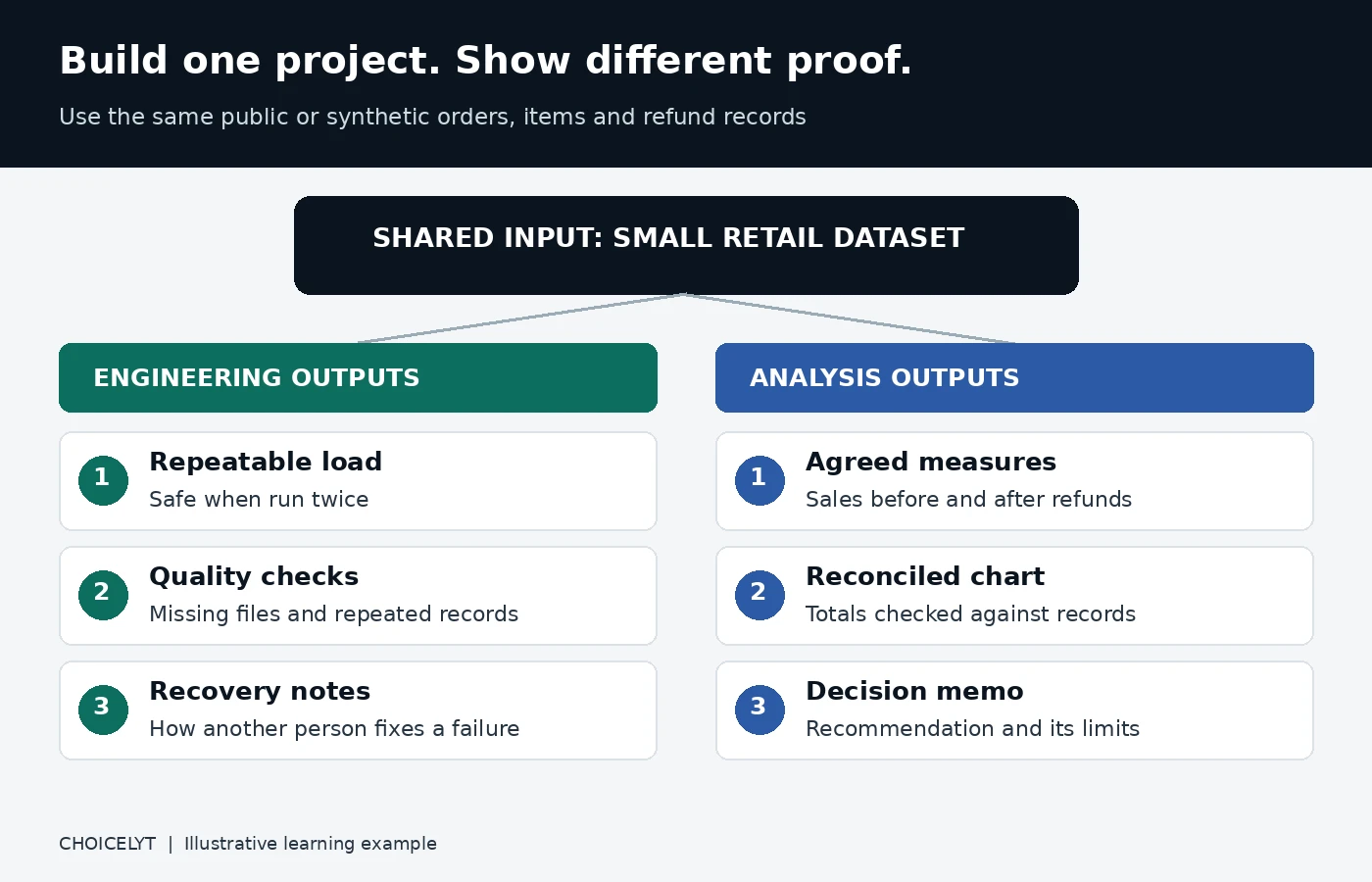
Use public or clearly labeled synthetic retail data with orders, order items and refunds. Keep it small enough to inspect manually. The question is: “Did net sales change, and should the business act?” The project can run locally; a large cloud bill is unnecessary for learning the basic distinction.
Engineering version
- Load the files into a database.
- Document what one row represents.
- Make repeated loads safe.
- Add checks for missing identifiers and repeated records.
- Test a changed input field and explain recovery.
Show the table design, tests, execution instructions and failure log. Explain what the next user can safely assume.
Analysis version
- Define sales before and after refunds.
- Reconcile the totals with sample records.
- Compare periods and customer groups.
- Explain whether the change reflects volume, price or refunds.
- Write a recommendation with a limitation.
Show the queries, a readable chart and a short decision memo. Explain what the business should do and what the evidence cannot support.
Now remove the refund file on purpose. The engineer should make the missing input visible instead of quietly producing a partial dataset. The analyst should refuse to call net sales final without it. The missing file is the same; what each person must prove is different.
What to explain in an interview
For engineering, discuss what happens when the process fails halfway through, how you detect repeated data and how someone else can rerun it. For analysis, discuss the denominator, the refund definition and why your recommendation follows from the evidence.
A tutorial is a reasonable place to start. But an employer learns more when you change an assumption, introduce a realistic failure and show how you responded. That is where borrowed instructions turn into your own work. Label synthetic data and hypothetical outcomes clearly.
Can a data analyst become a data engineer?
Yes. An analyst who understands SQL, reporting and what people need from the data already has a useful foundation. The new challenge is taking responsibility after the first successful run: rerunning safely, testing, tracking changes, controlling access and recovering when something fails.
- Turn a repeated query into a maintained dataset. Document its inputs, row meaning and intended users.
- Add version control and review. Track changes and make it possible for another person to inspect them.
- Build explicit tests. Check identifiers, repeated records and meaningful totals, not only whether the code runs.
- Automate execution. Record success and failure, and make another run safe.
- Learn one deployment environment. Understand access, costs and recovery before collecting more platform credentials.
Analytics engineering can be a bridge when the work centers on tested, documented transformations in a warehouse. It is a substantive role, not simply a new label for making dashboards. Seek supervised responsibilities that demonstrate the gap you are closing.
The reverse move is possible too. An engineer moving into analysis needs practice framing questions, comparing groups, explaining uncertainty and making recommendations. Reliable records are essential, but they do not automatically answer what the business should do.
Data analyst vs data engineer vs data scientist
An analyst explains measures and investigates decisions. An engineer maintains the data systems supporting that work. A data scientist may also use statistical experiments, predictive models and careful evaluation. People collaborate across these boundaries, and a small team may combine responsibilities.
For the modeling distinction, see Data Analyst vs Data Scientist. For the system and model handoff, see Data Engineer vs Data Scientist.
What is an analytics engineer?
Analytics engineering commonly sits between upstream data engineering and downstream analysis. The role often centers on transforming warehouse data into tested, documented datasets or models that analysts can reuse. Tools and team boundaries vary, so treat “analytics engineer” as a responsibility pattern rather than a single standardized occupation.
Is a database engineer the same as a data engineer?
Not necessarily. Database work may focus on database design, administration, performance or availability. Data engineering often includes movement and preparation across several sources. A posting can combine both. Look for the actual systems and outputs instead of assuming the titles are interchangeable.
Will AI replace data engineers or data analysts?
AI tools can assist with queries, scripts, chart drafts and written summaries. That changes how parts of the work are performed, but current occupational evidence still points to continued demand for data infrastructure and analytical work. BLS specifically notes that database architects remain important as organizations adopt AI and need sound database design, transition, backup and security. That does not predict hiring for every Data Engineer or Data Analyst title.
Return to the retailer for a moment. An AI assistant could generate a polished query and confidently report $1,080,000. It might never question the duplicate load or the refund definition. The result would arrive faster, but it would still be wrong. Speed does not replace knowing what the numbers mean.
An engineer must review how generated code handles repeated execution, permissions and failures. An analyst must check definitions, comparisons and whether the suggested explanation is supported. Do not send employer records to an external AI service without permission under the organization’s rules.
The practical response is to learn AI assistance alongside validation. Be able to show the records behind a result, the test that would catch a failure and the assumption behind a recommendation. This is an editorial skills recommendation, not a forecast of how many jobs AI will create or remove.
Which career should you start with?
Try the work, then choose
Select a task you would willingly practice. This tool suggests a learning experiment; it is not an aptitude test or a hiring prediction.
Notice which responsibility interests you
Use the suggested exercise to test your preference before paying for a course.
If business questions and communicating findings hold your interest, SQL, spreadsheets and one reporting tool form a useful analytical foundation. If building reliable processes holds your interest, SQL, Python, databases and testing form a useful engineering foundation. If both appeal, the shared retail project is a practical way to see which responsibility you want to deepen.
Your first job is not a lifetime commitment. Look for work you can learn from, people who will review it and responsibilities you can grow into. That may matter more than having the fashionable title on your résumé.
Frequently asked questions
What is the main difference between a data engineer and a data analyst?
A data engineer owns recurring data movement, transformation, storage and reliability. A data analyst uses data to define measures, investigate questions, explain patterns and support decisions. Both may use SQL and perform data-quality checks.
Who earns more, a data engineer or a data analyst?
Federal data do not support a clean universal title-to-title comparison. Data engineering can map to database and warehousing occupations, while analyst titles can map to several different analytical occupations. Compare the same seniority, location, industry and compensation components.
Which role needs more coding?
Data engineering generally requires broader recurring software and systems work. Data analysis can range from SQL, spreadsheets and BI tools to substantial Python or R. The actual coding depth depends on the team and role.
Can a data analyst become a data engineer?
Yes. Strong SQL and data-preparation skills transfer well. Add version control, testing, automated execution, data modeling, permissions, monitoring and recovery.
Can I become a data analyst without Python?
Yes in some roles. Current O*NET Business Intelligence Analyst postings show SQL more frequently than Python, while Power BI, Tableau and Excel are also common. Other analyst roles may require substantial Python or R.
What does an analytics engineer do?
An analytics engineer commonly maintains tested, documented transformations and reusable analytical datasets between upstream data infrastructure and downstream analysis. The exact boundary varies by organization.
Is data engineering harder than data analytics?
They are difficult in different ways. Engineering emphasizes recurring systems, testing and failure recovery. Analysis emphasizes ambiguous questions, metric definitions, interpretation and communication.
Will AI replace data analysts or data engineers?
AI can automate parts of querying, coding, chart creation and documentation. Engineers and analysts still need to validate data, definitions, system behavior, security and the consequences of decisions.
Sources and research method
This guide uses official role descriptions, current O*NET employer-demand data and U.S. occupational statistics. Related BLS categories are labeled rather than presented as universal salaries for employer titles that do not map cleanly to one federal occupation. The revenue example, portfolio exercise and learning recommendations are original editorial material. No employer hiring survey was conducted.
- Microsoft Learn: Data Engineer career path
- Microsoft Learn: Data Analyst career path
- O*NET OnLine: Data Warehousing Specialists, updated 2026
- O*NET OnLine: 2025 employer software demand for Data Warehousing Specialists
- O*NET OnLine: Business Intelligence Analysts, updated 2026
- O*NET OnLine: 2025 employer software demand for Business Intelligence Analysts
- BLS: Database Administrators and Architects
- BLS: Operations Research Analysts
- BLS: Market Research Analysts
Reviewed October 1, 2026. Pay figures refer to May 2025; projections cover 2025 to 2035. Verify current postings, program requirements and local compensation before making a decision.