
Computer information systems vs computer science: the short answer
Choose computer science if you want the deeper foundation for software development, algorithms, computing systems, artificial intelligence, data science or technical research. You should be comfortable with abstraction, programming and mathematical reasoning.
Choose computer information systems if you want to connect technology with business processes, data, people and organizational decisions. You will still study technical subjects, but the curriculum usually gives more space to systems analysis, databases, project management, enterprise technology and business context.
Still undecided? Think about where you want to spend your time. If you want to build software and understand the systems beneath it, computer science usually offers the more direct preparation. If you are drawn to figuring out what an organization needs and helping people make technology work, information systems deserves a closer look.
Here is the most important warning before you compare colleges: degree titles are not reliable enough on their own. One university may place Computer Information Systems inside a business school. Another may use a similar name for a much more technical program. The required course list is the evidence that matters.
CIS, IS and MIS do not always mean the same thing
Students often search for CIS vs computer science as if every college uses the abbreviations consistently. They do not. In this guide, CIS means Computer Information Systems. The related labels below can describe similar programs, but the balance of technology and business can change substantially.
Computer Information Systems
Often combines programming, databases, infrastructure, systems analysis and business courses. It may sit in a business school or a computing department.
Information Systems
Usually focuses on how people and organizations use data, processes and technology to achieve goals. Technical depth varies by institution.
Management Information Systems
Often has a stronger business core, with technology used for operations, analysis, management and strategy.
Computer and Information Science
At some colleges, CIS can mean Computer and Information Science. That program may resemble computer science much more closely. Read the full name and catalog.
The same caution applies to a Bachelor of Arts, Bachelor of Science or business degree. The letters on the diploma tell you less than the sequence of required courses, prerequisites, laboratories, projects and advanced electives.
What is the real difference?
Walk through a campus computing lab and you will see the split in person. One student is tracing a bug through a queue of requests. Another is sketching how an advising office actually approves a schedule change. Both students might learn Python, study databases and work on the same application. But as the degree progresses, they tend to spend their time differently. Computer science goes deeper into how computation and software work. Information systems puts more emphasis on how technology fits the people, processes and decisions of an organization. The difference is often clearest in the courses a program requires.
| Decision factor | Computer Science | Computer Information Systems |
|---|---|---|
| Central question | How should software and computing systems work? | How should technology, data and processes work inside an organization? |
| Typical academic home | College of computing, science or engineering. | Business school, information school or computing department. |
| Programming | Usually a longer required sequence with data structures, algorithms, software design and systems courses. | Usually enough for application development, databases, automation or integration, but advanced depth varies widely. |
| Mathematics | Commonly includes calculus, discrete mathematics, probability and statistics. Some programs add linear algebra. | Often emphasizes statistics and quantitative business methods. Calculus and discrete mathematics requirements vary. |
| Technical theory | Algorithms, complexity, computation, programming languages, operating systems and architecture commonly receive more depth. | Theory is usually lighter so the program can include process analysis, project work and an information systems environment. |
| Business context | May be available through electives, a minor or product-focused projects. | Often built into the degree through accounting, operations, management, analytics or industry courses. |
| Common project | Design, build, test and evaluate software or a computing system. | Analyze needs, select or configure a solution, connect data and processes, then manage adoption and improvement. |
| Natural career direction | Software, systems, AI, data, security and technical research. | Systems analysis, business systems, enterprise applications, databases, consulting, projects and technology operations. |
| Strong overlap | Application development, databases, security, cloud services, analytics, teamwork, communication and technology problem solving. | |
Do not reduce this to “CS builds and CIS uses.” Information systems graduates may build applications, write queries and automate workflows. Computer science graduates also work with users and business requirements. The distinction is about typical curriculum depth, not a rule that limits a graduate.
One project shows the difference better than ten definitions
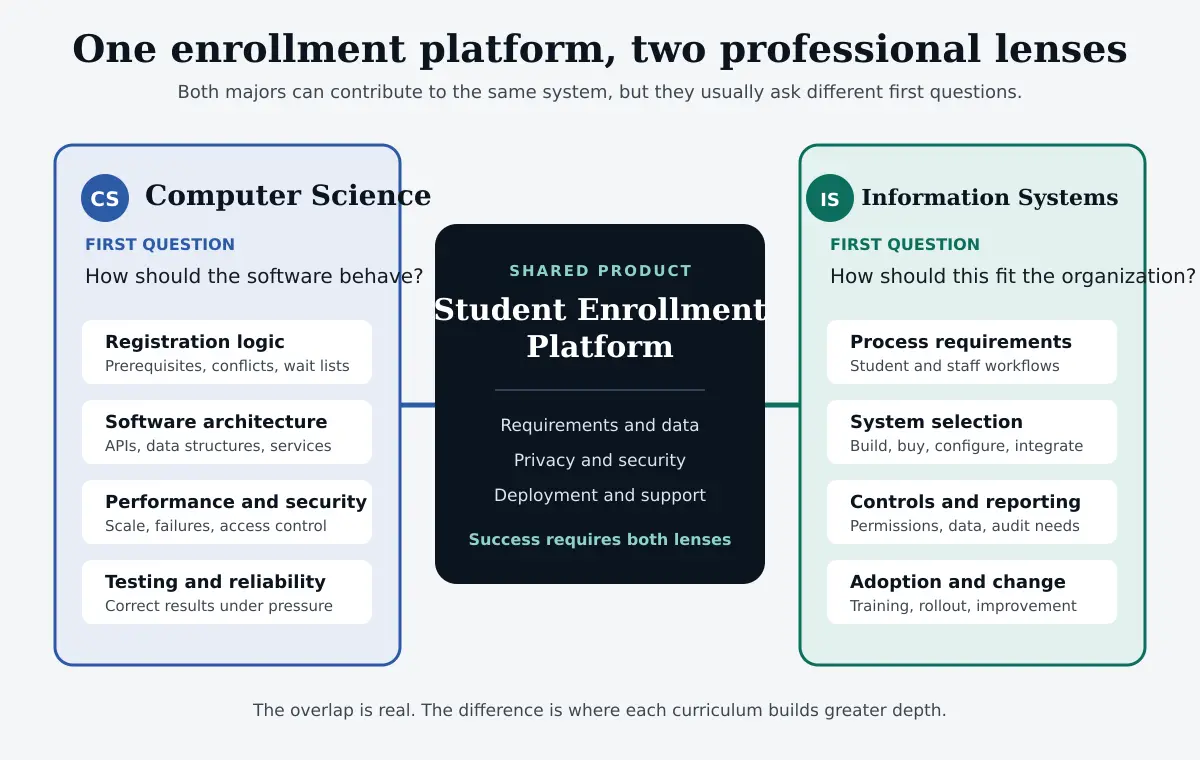
Imagine registration opens at 8 a.m. By 8:10, students are getting error messages, advisers cannot see accurate waiting lists and the billing system has stopped updating. The university needs more than a clever piece of code. It needs a dependable enrollment system that checks prerequisites, manages schedule conflicts, protects records and works with the people who use it. This is a hypothetical example, but the responsibilities are familiar in real technology projects.
Both majors can contribute, but they enter through different questions
Computer science depth
- design registration and conflict detection logic;
- select data structures and service boundaries;
- build secure application interfaces;
- test performance during peak demand;
- handle failures, concurrency and data consistency;
- evaluate whether the software remains maintainable as rules change.
Information systems depth
- map how students, advisers and staff currently work;
- separate required features from convenient requests;
- compare building, buying and configuring options;
- plan integration with billing, identity and reporting systems;
- define access, approval and audit requirements;
- coordinate rollout, training, feedback and process improvement.
Computer science vs information systems degree coursework
ABET offers a useful United States benchmark because its criteria distinguish the required emphasis of accredited computing programs. The criteria specify subject areas rather than forcing every college to use identical course names.
Computing depth and abstraction
ABET criteria for computer science call for at least 40 semester credit hours of computer science. The required coverage includes algorithms and complexity, theory, programming languages, software development, architecture, information management, networking, operating systems, parallel and distributed computing, several levels of abstraction and a major integrative project.
The criteria also call for at least 15 semester credit hours of mathematics and statistics. This includes discrete mathematics, probability and statistics, with rigor at least equivalent to introductory calculus.
Technology inside an organization
ABET criteria for information systems call for at least 30 semester credit hours covering application development, programming, data and information management, technology infrastructure, systems analysis, design and acquisition, project management and the role of information systems in organizations.
They also call for at least 15 additional semester credit hours that create a coherent information systems environment, a major integrative project and appropriate mathematical and statistical techniques.
These credit-hour figures come from the 2025 to 2026 ABET criteria. ABET revises its criteria by cycle, so check the version that applies to the program you are considering. Accreditation criteria describe what a program is meant to teach, not whether you will enjoy its classes or land a particular job. A good information systems degree can offer substantial programming, databases and security. A computer science degree can meet its formal requirements while offering limited project experience. Read the course sequence and examine actual student work.
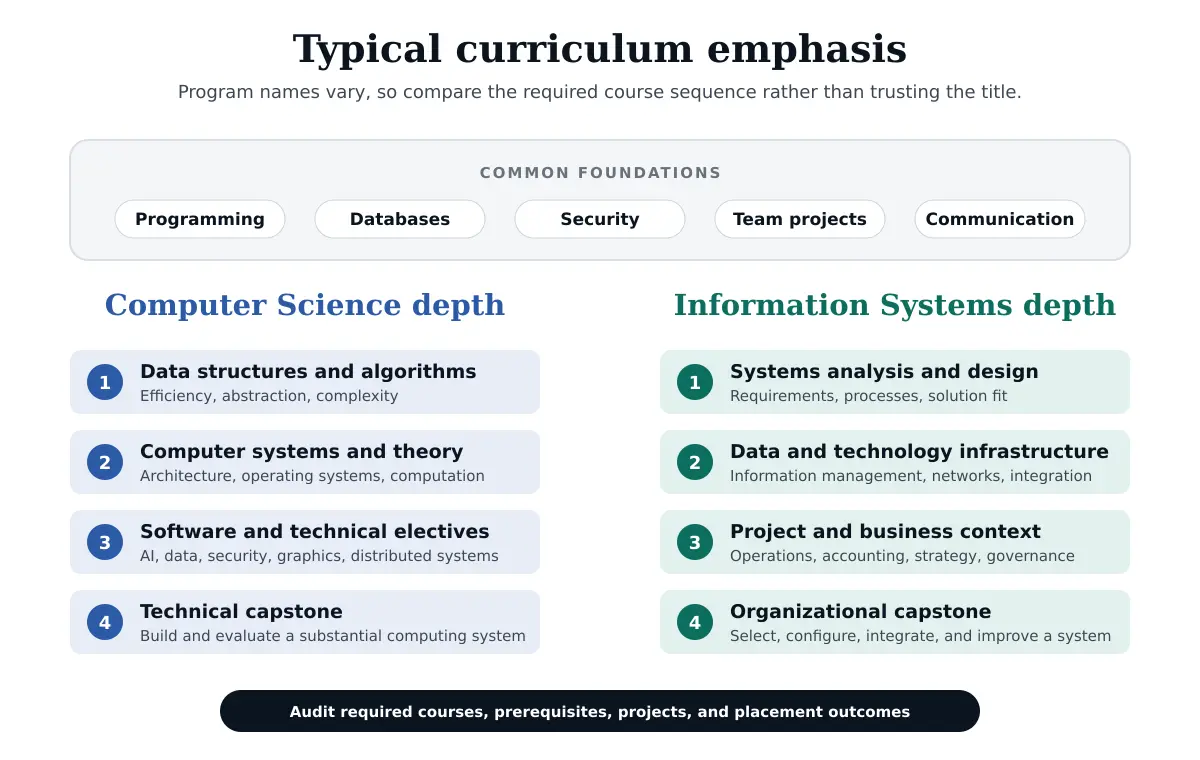
Typical computer science courses
- programming foundations and object-oriented design;
- data structures and algorithms;
- discrete mathematics and probability;
- computer organization and architecture;
- operating systems and networks;
- database systems;
- software engineering;
- theory of computation or programming languages;
- electives in artificial intelligence, data science, security, graphics or distributed systems.
Typical information systems courses
- programming and application development;
- database design and data management;
- systems analysis and design;
- technology infrastructure and cloud services;
- enterprise systems and integration;
- business process management;
- project management;
- information security, governance and controls;
- business analytics, accounting, operations or management courses.
Which degree has more coding?
Computer science usually requires more coding depth because programming supports later work in algorithms, systems, software engineering and technical electives. Information systems students also code, but some programs stop after introductory application development while others continue into web systems, databases, automation and enterprise integration.
A long list of programming languages can look impressive on a brochure. It tells you surprisingly little. Ask whether students build something substantial, learn data structures, test and review code, use version control and explain why their design choices work.
Which degree has more math?
Computer science usually has the stronger formal mathematics requirement. Discrete mathematics is especially important because it supports logic, algorithms, graphs, counting and proofs. Calculus, probability, statistics and sometimes linear algebra support artificial intelligence, graphics, data and scientific computing.
Information systems is not free of quantitative work. Statistics, analytics, finance and operations courses can be demanding, but the mathematics is often used to support organizational decisions rather than the theory of computation.
What does the required course list actually emphasize?
Open the official degree plan and select every item that appears as a requirement. Do not count optional electives. This tool evaluates emphasis, not program quality.
Select the required courses you can find
Choose every course that appears as a requirement, not an optional elective. The result will show the program emphasis.
Next check: Use the official catalog, not a marketing summary.Five checks that matter more than the degree title
- Read every required course. Separate requirements from electives that may not run every semester.
- Trace prerequisites. A course called advanced programming may remain introductory if earlier technical prerequisites are weak.
- Inspect the capstone. Look for real clients, substantial software, system integration, testing, documentation and evidence of individual contribution.
- Check internship and placement evidence. Ask for recent employers, job titles, placement definitions and the number of graduates represented.
- Compare total cost and time. Use the Choicelyt education ROI calculator with tuition, housing, commuting, supplies and lost earnings.
Computer information systems vs computer science careers
These degrees do not lead to two separate worlds of work. A computer science graduate may become a systems analyst, and a CIS graduate may develop software. What changes is the preparation you can show an employer and how many gaps you may need to fill along the way.
Software and systems
Software developer, software quality analyst, systems programmer, cloud engineer, platform engineer or technical consultant.
Systems and organizations
Computer systems analyst, business systems analyst, application analyst, enterprise systems consultant or technology project coordinator.
Data and security
Database work, business intelligence, security analysis, application support, cloud services and technology consulting can welcome either background.
Can a CIS major become a software engineer?
Yes, but the transcript and portfolio need to answer the employer's technical questions. A CIS student who wants software engineering should add data structures, algorithms, software design, testing, operating systems and substantial programming projects. A minor in computer science can help if it includes real depth rather than a collection of introductory electives.
The reverse move is also possible. A computer science student who wants systems analysis or technology consulting should learn requirements analysis, process mapping, databases, project work, accounting basics and an industry domain such as health care, finance, manufacturing or education.
Which degree is better for business analyst work?
Information systems is usually the more direct fit for technology-focused business analyst roles because it connects processes, requirements, data and system implementation. However, “business analyst” is a broad title. Some roles are mainly operational, some are data-focused and some require deep knowledge of a specific enterprise platform.
Which degree is better for software development?
Computer science is usually the stronger default because its required sequence is more likely to include algorithms, data structures, software design, systems and mathematical foundations. That does not guarantee job readiness. Students still need internships, team projects, version control, testing, communication and the ability to understand unfamiliar code.
CIS vs computer science salary: use occupation data carefully
A salary headline can make this choice seem easy. But there is no single national salary for a computer science degree or a CIS degree. Graduates enter different jobs, and those jobs pay differently. Mixing software developers, systems analysts and technology managers into one average would conceal more than it explains.
The current United States Bureau of Labor Statistics data below describe occupations. They are not starting salaries, not promises and not estimates of what every graduate from either major will earn.
Median annual wage in May 2025. Employment is projected to grow 10 percent from 2025 to 2035.
Median annual wage in May 2025. Employment is projected to grow 8 percent from 2025 to 2035.
Median annual wage in May 2025. The related database administrator median was $104,620.
BLS reports about 106,100 openings per year for the combined software developer, software quality assurance analyst and tester group over the projection period. It reports about 32,900 openings per year for computer systems analysts and about 7,300 for database administrators and architects.
Computer and information systems managers had a May 2025 median wage of $175,140 and projected growth of 16 percent. That number should not be presented as a normal CIS graduate salary. BLS lists five years or more of related work experience for these managers, so they are a later career step rather than a first job.
Location can change the outcome
Pay and opportunity differ by state, metropolitan area, industry and employer. A student comparing colleges should use BLS state and area data, local internship access and actual employer relationships. National medians are useful context, but a local labor market and the cost of living can change the financial decision.
How AI changes both degrees
AI changes what students need to practice, but it does not settle the CS versus CIS decision. Generating a few lines of code is easier than it used to be. Knowing whether that code is secure, whether the data is reliable and whether the solution belongs in the workflow is still difficult. Both degrees can help develop that judgment from different angles.
Computer science in the AI era
- AI can generate code, tests and explanations, but generated output still needs architecture, verification and maintenance.
- Algorithms, data structures, systems and security help graduates judge whether a solution is correct, efficient and safe.
- Demand is growing around AI-enabled products, data infrastructure, model evaluation, security and reliable deployment.
- A shallow portfolio made from copied AI output is easier to expose than a project the student can explain and defend.
Information systems in the AI era
- Organizations need people who can decide where AI is useful and where it creates unacceptable risk.
- Data quality, process design, access controls, vendor selection, integration and change management become more important.
- CIS graduates can help translate between business owners, data teams, security staff, vendors and software developers.
- Success depends on measuring whether an AI system improves the process, not simply whether the organization purchased one.
BLS ties part of the expected growth for software developers and computer systems analysts to the continued expansion of AI in organizations. That is a demand signal, not a guarantee for any single graduate. The safer strategy is not to search for an “AI-proof” degree. It is to build fundamentals, domain knowledge and the ability to verify work.
Which degree is better for artificial intelligence?
Choose computer science if you want to build models, algorithms, AI infrastructure or advanced software systems. Add linear algebra, calculus, probability, statistics, machine learning and data systems. Choose information systems if you are more interested in selecting AI tools, integrating them with organizational data, governing access, redesigning workflows and measuring business value.
Is CIS easier than computer science?
The difficult part depends on the work. Computer science may test your patience with proofs, algorithms and debugging a problem you cannot see. Information systems may challenge you with unclear requirements, competing priorities and decisions that affect real people. Neither is a shortcut around hard thinking.
CS may feel harder when
- abstract reasoning feels disconnected from practical work;
- discrete mathematics and proofs are major weak points;
- you dislike debugging invisible system behavior;
- you want clear procedures rather than open technical problems.
CIS may feel harder when
- you dislike interviewing users and clarifying vague needs;
- business courses feel unrelated to your interests;
- presentations, writing and group projects are stressful;
- you prefer one technically correct answer to an organizational compromise.
Do not pick CIS simply to avoid computer science mathematics. Do not pick CS only because the name sounds more prestigious. Choose the problems you would still be curious enough to solve after the excitement of your first semester wears off.
How to choose between CIS and computer science
You enjoy programming, algorithms, technical problem solving, software design and learning how systems behave below the interface.
You enjoy processes, data, requirements, enterprise tools, projects and communication between technical and business teams.
Choose computer science when most of these are true
- you want software development, AI, data, systems or technical research;
- you want a broad technical base that keeps many computing specializations open;
- you are willing to complete mathematics and theory even when the practical use is not immediate;
- you enjoy building, testing and improving software;
- you want the curriculum to force technical depth rather than depend on self study.
Choose computer information systems when most of these are true
- you want to connect technology with operations, data and organizational goals;
- you enjoy learning why users need a system and how work should change;
- you are interested in systems analysis, enterprise applications, consulting or technology projects;
- you want meaningful business coursework alongside technical study;
- the specific program has solid programming, databases, security, internships and a credible capstone.
Choose neither until you inspect the program when
- the website lists attractive electives but hides required courses;
- the program makes salary promises without naming occupations or data sources;
- placement claims do not explain the graduates, time period or job types included;
- the capstone is vague and sample student work is unavailable;
- you cannot tell whether important technical courses are taught regularly;
- the total cost requires debt that the likely local outcomes do not justify.
Best practical test: compare two official degree plans side by side. Highlight algorithms, systems and advanced software in blue. Highlight systems analysis, project management, enterprise technology and business courses in green. The pattern usually answers the question faster than the program description.
Back on registration morning, the frozen system needs both kinds of people. The student who understands concurrency finds the failure. The student who understands the process makes sure the fix does not strand advisers, billing and the students waiting on a seat. Your degree choice is really a choice about which of those two questions you want to be trained to answer first.
Frequently asked questions
Is computer information systems the same as computer science?
No. Computer science usually develops deeper knowledge of algorithms, computation, software and systems. Computer information systems usually combines technical study with systems analysis, data management, project work and the organizational use of technology. Individual programs can overlap, so compare required courses.
Which pays more, computer science or information systems?
A degree does not have one salary. Pay depends on the occupation, experience, industry and location. Computer science often creates a more direct route to software development, while information systems can lead to systems analysis, database, consulting and technology management paths. Compare target occupations rather than degree averages.
Can a CIS major become a software engineer?
Yes, but the student may need more depth in data structures, algorithms, software design, testing and substantial programming projects than the CIS core requires. Employers evaluate demonstrated skills as well as the degree title.
Can a computer science major become a systems analyst?
Yes. A computer science graduate can move into systems analysis by developing business process knowledge, requirements analysis, communication, data modeling and project experience. Industry knowledge is especially useful.
Is CIS easier than computer science?
Not automatically. Computer science often has more theory, algorithms and mathematical rigor. CIS may require more business analysis, project coordination, communication and organizational context. The harder degree is the one that conflicts with your strengths and the actual requirements of the program.
Is computer information systems the same as information technology?
No, although they overlap. Information systems usually emphasizes organizational processes, requirements, data and solution selection. Information technology often places more emphasis on infrastructure, platforms, networks, administration and user support. Program titles vary, so inspect the curriculum. Read our Information Technology vs Computer Science guide for the separate comparison.
Is a computer information systems degree worth it?
It can be worth it when the program has solid programming, database, systems analysis, security, project work, internships and credible placement outcomes that match your target roles. A weak program title alone is not enough.
Which degree is better for artificial intelligence?
Computer science is usually the stronger foundation for building AI models, algorithms, infrastructure and advanced technical systems. Information systems can be a strong route for selecting, integrating, governing and measuring AI tools inside organizations.
Can I switch between the two majors after I start college?
Often, yes, especially in the first year or two, but the rules depend on the college. The mathematics and programming sequence is usually the sticking point, so ask an academic adviser which courses count toward both majors before you register. Moving from information systems to computer science generally needs more early math and programming than the reverse.
Sources and research method
This guide uses United States curriculum standards and occupation data rather than unsupported degree salary claims. Labor figures are tied to occupations because BLS does not publish one salary for every holder of a particular degree.
- ABET, Criteria for Accrediting Computing Programs, 2025 to 2026. Used for computer science and information systems curriculum expectations.
- Association for Computing Machinery, Curricula Recommendations. Used to check current computer science and information systems curriculum frameworks.
- United States Bureau of Labor Statistics, Computer Systems Analysts. May 2025 wage and 2025 to 2035 outlook.
- United States Bureau of Labor Statistics, Software Developers, Quality Assurance Analysts and Testers. May 2025 wage and 2025 to 2035 outlook.
- United States Bureau of Labor Statistics, Database Administrators and Architects. May 2025 wage and 2025 to 2035 outlook.
- United States Bureau of Labor Statistics, Information Security Analysts. May 2025 wage and 2025 to 2035 outlook.
- United States Bureau of Labor Statistics, Computer and Information Systems Managers. Used with the experience requirement clearly stated.
Update note, October 17, 2026: The BLS occupation figures on this page (median wages, projected growth, openings and manager experience) and the ABET credit-hour criteria were rechecked against the linked pages on this date. The ACM link is a background reference for how computing degrees are framed and was not used for any figure.
Data note: BLS median wages describe all workers in an occupation, not starting pay and not the expected salary of a particular degree. Program requirements and outcomes change. Verify every college catalog, accreditation record, tuition figure and placement claim before enrolling.