Computer engineering vs computer science: the short answer
Choose computer science if you want the broadest route into software, algorithms, AI, data, cloud computing or research and prefer solving problems mainly through code and abstraction.
Choose computer engineering if you want to understand computing from circuits and digital logic through processors, firmware and embedded systems, and you like working with physical devices and are comfortable with physics, electronics and lab work.
Both degrees can lead to embedded software, robotics, operating systems, computer architecture or edge AI. To decide, look at where you want the greater depth: software and theory side or the electronics and physical-system side.
The difference is not simply “software vs hardware”
That shorthand misses some of the most interesting work between the two fields. Computer scientists also study computer architecture, operating systems and networks. Computer engineers also write code, often for microcontrollers, drivers, real-time systems, test automation or hardware design. The difference shows up in which constraints students learn to solve first: computational ones or physical ones.
| Decision factor | Computer science | Computer engineering |
|---|---|---|
| Central question | How should information be represented, computed and delivered through software? | How should computing hardware and software be designed together under physical constraints? |
| Typical depth | Algorithms, theory, software development, programming languages, data, AI and scalable systems. | Circuits, electronics, digital logic, processors, architecture, embedded systems, firmware and hardware validation. |
| Mathematics | Discrete mathematics, probability and statistics; requirements vary for calculus and linear algebra. | Calculus, probability and statistics, discrete mathematics and often differential equations or additional engineering mathematics. |
| Science | Usually some non-computing science; the amount depends on the college and degree type. | Calculus-based physics and science are normally integrated into engineering prerequisites. |
| Laboratory work | Programming, systems, data or software projects; fewer electronics laboratories in most programs. | Hands-on circuits, digital systems, instrumentation, embedded systems and engineering-design laboratories. |
| Common deliverable | A correct, maintainable and scalable software or computational solution. | A tested device or subsystem whose hardware and software satisfy timing, power, cost and reliability constraints. |
| Strong overlap | Programming, data structures, discrete math, computer architecture, operating systems, networks, cybersecurity, robotics and team design projects. | |
Do not choose from the title alone. A Bachelor of Arts in CS, Bachelor of Science in CS, engineering-school CS degree, Computer Science and Engineering degree and Computer Engineering degree can allocate courses very differently. Always inspect the required curriculum.
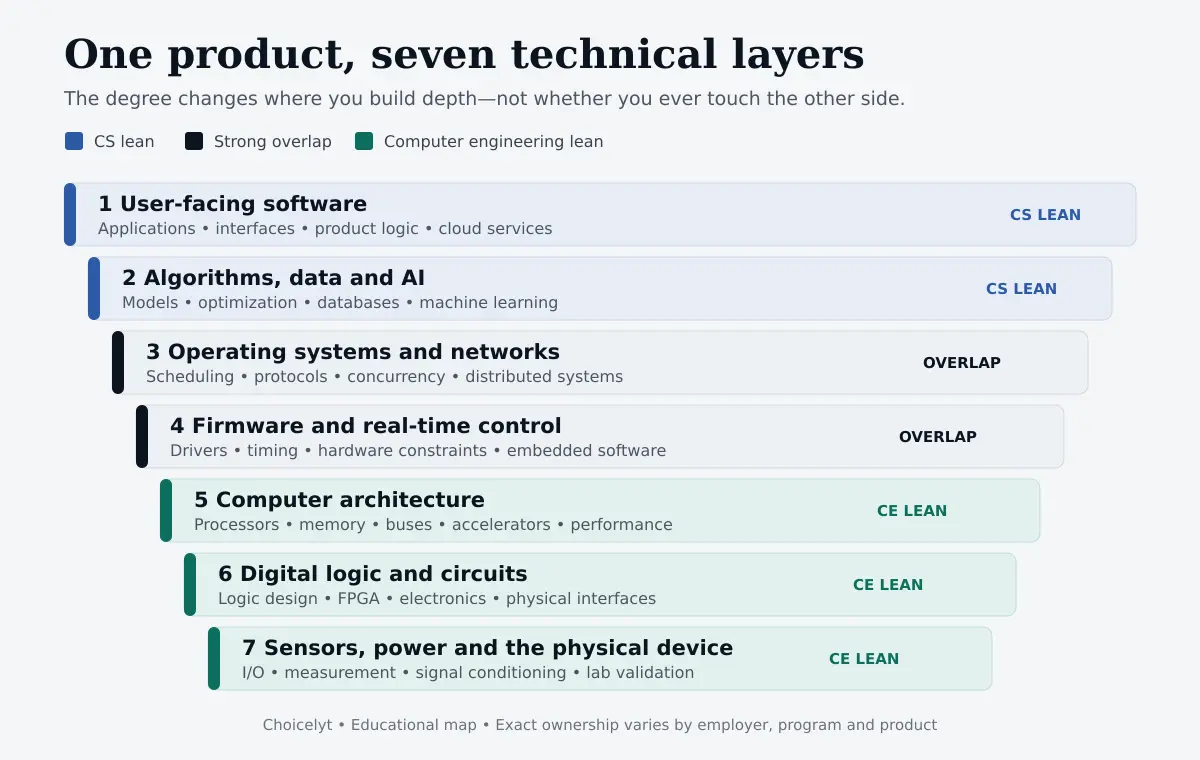
Take apart one product: an autonomous campus delivery cart
Picture a small delivery cart moving laboratory samples around a campus. It needs to navigate crowded hallways, sense obstacles and arrive safely. What happens when it hesitates or takes the wrong turn reveals the difference between these degrees.
A working device depends on every layer
Make the physical system dependable
- select processors, sensors, memory, buses and power components;
- design or validate digital interfaces and circuit behavior;
- write firmware and drivers that meet timing constraints;
- measure signals, heat, power draw and communication reliability;
- diagnose whether a failure is electrical, timing-related or architectural.
Make the computation useful
- design mapping, routing and obstacle-avoidance algorithms;
- structure data and build the fleet-management service;
- develop operator interfaces, APIs and monitoring software;
- simulate edge cases and test software behavior at scale;
- diagnose whether a failure is algorithmic, concurrent or data-related.
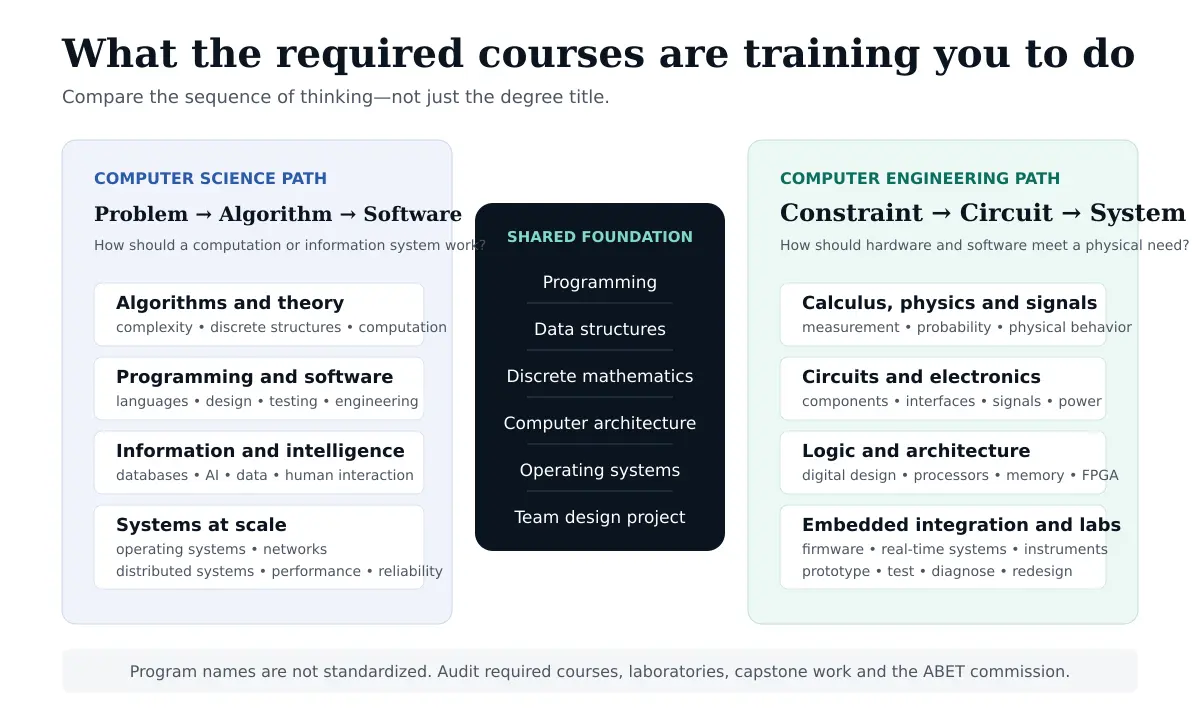
Computer engineering degree vs computer science degree coursework
The ABET 2026 to 2027 computing criteria and engineering criteria are useful U. S. benchmarks because they reveal the educational purpose behind each degree.
Computing depth and abstraction
ABET’s Computer Science criteria call for at least 40 semester credit hours of computer science. Coverage includes algorithms and complexity, theory, programming languages, software development, computer architecture, information management, networking, operating systems, parallel and distributed computing, multiple levels of abstraction and a major integrative project.
The criteria also require at least 15 semester credit hours of mathematics and statistics, including discrete mathematics, probability and statistics, with rigor equivalent to introductory calculus.
Engineering design under constraints
ABET’s general engineering criteria call for at least 30 semester credit hours of mathematics and basic science and at least 45 hours of engineering topics, plus a culminating design experience using engineering standards and multiple constraints.
Computer-named engineering programs must cover probability and statistics, calculus, science and engineering topics, including computing science, needed to analyze and design complex electrical and electronic devices, software and systems containing hardware and software. Discrete mathematics is specifically required.
Audit a curriculum in twelve minutes
- Open the required four-year plan. Ignore marketing electives at first. Required courses show what every graduate must actually learn.
- Count the electrical foundation. Look for calculus-based physics, circuits, electronics, signals, digital logic and laboratory work.
- Count the computing foundation. Look for programming, data structures, algorithms, architecture, operating systems, networks and software engineering.
- Inspect embedded depth. Check microcontrollers, firmware, real-time systems, FPGA or HDL work, interfaces and instrumentation.
- Inspect upper-level choice. See whether electives support your goal: AI, chip design, robotics, cloud, cybersecurity, architecture, data or application software.
- Read the capstone description. Strong evidence includes a working system, requirements, testing, documentation, teamwork and design tradeoffs, not just a presentation.
- Verify accreditation precisely. Search the exact program in ABET’s database and note whether it is accredited by the Engineering Accreditation Commission or Computing Accreditation Commission.
What does “Computer Science and Engineering” mean?
This phrase causes real confusion, and it is not a standardized U. S. degree label. At the University of Iowa, the Computer Science and Engineering BSE explicitly combines technical content from computer science and computer engineering. At MIT, the undergraduate Computer Science and Engineering major emphasizes algorithms, software, systems, human to computer interaction, graphics and AI. Other institutions use CSE for a department name rather than a distinct undergraduate major.
that “and Engineering” automatically means extensive circuits, electronics, physics laboratories or preparation for hardware design.
the degree awarded, required physics and circuit sequence, laboratory hours, embedded courses, capstone and ABET accreditation commission.
a CSE program with digital logic and embedded laboratories may be genuinely hybrid; one built mainly around algorithms and software may function much more like CS.
Which is harder: computer science or computer engineering?
There is no universal answer. Computer engineering often follows a tighter sequence of prerequisites: calculus and physics unlock circuits, which unlock electronics, digital design, architecture and embedded laboratories. Missing one prerequisite can delay several later courses. Computer science may offer more elective flexibility but asks for sustained abstraction, algorithmic reasoning and large amounts of debugging.
Computer science may feel harder when…
- proof-like reasoning and abstraction feel disconnected from real problems;
- you dislike spending hours debugging invisible software state;
- algorithms, complexity and discrete mathematics are frustrating;
- large software systems and changing requirements drain you.
Computer engineering may feel harder when…
- calculus-based physics and circuit analysis are weak points;
- you dislike laboratories, measurement uncertainty and physical troubleshooting;
- hardware constraints make programming feel restrictive;
- tightly sequenced prerequisites reduce the flexibility you want.
Does computer engineering involve coding?
Yes. An authentic computer engineering curriculum commonly includes programming, data structures, computer systems, microcontrollers, firmware and embedded development. The difference is context: code may have to fit limited memory, interact with registers, respond within a deadline, conserve power or communicate through a physical interface. Some computer engineers code daily; others focus on digital design, verification, circuit design, hardware testing or system integration.
Which failure would you rather investigate?
Choose the difficult problem you would still find meaningful after the novelty of technology disappears. This is a reflection tool, not an aptitude test.
Trace the software system
You may enjoy profiling code, redesigning data flow and reasoning about concurrency, storage and distributed behavior.
Audit next: algorithms, operating systems, databases, networks, distributed systems and substantial software projects.Computer engineering vs computer science careers
Most of these jobs are not restricted to graduates with one particular degree title. Employers look for relevant foundations, projects and experience. A computer engineering graduate can become a software developer; a CS graduate can work close to hardware. The transition is easier when the transcript and project portfolio cover the missing side.
| Career target | Usually the more direct degree | Evidence employers may look for |
|---|---|---|
| Application, backend or full-stack developer | Computer science | Data structures, software design, databases, testing, APIs, version control and deployed projects. |
| AI or machine-learning engineer | Computer science for model/software work | Linear algebra, probability, algorithms, ML, data engineering, evaluation and production software. |
| Embedded-software or firmware engineer | Computer engineering often aligns directly | C/C++, microcontrollers, interrupts, buses, real-time behavior, debugging instruments and hardware interfaces. |
| Computer hardware engineer | Computer engineering | Digital logic, circuits, architecture, schematic or PCB knowledge, laboratories, verification and design projects. |
| FPGA, RTL or digital-design engineer | Computer engineering | HDL, logic design, timing, simulation, verification, FPGA tools and hardware projects. |
| Operating-systems or systems programmer | Either | Architecture, concurrency, memory, compilers, C/C++, performance analysis and deep systems projects. |
| Robotics or autonomous systems | Either, a hybrid profile wins | Algorithms, controls, sensing, embedded systems, simulation, safety and integration. |
| Computer architecture or accelerator design | Computer engineering, often with graduate depth | Architecture, digital design, parallel systems, verification, compilers and performance modeling. |
| Cloud, data or distributed systems | Computer science | Networks, databases, operating systems, distributed computing, reliability and scalable software. |
| Semiconductor test or validation | Computer or electrical engineering | Electronics, instrumentation, automation, statistics, failure analysis and laboratory discipline. |
Computer engineering vs computer science salary and outlook
Neither degree comes with a single salary. Pay data describe occupations, not diplomas, and the size of each job market matters as much as the median.
May 2025 U. S. median pay. BLS projects 9% growth and about 4,100 openings per year from 2025 to 2035.
May 2025 U. S. median pay. BLS projects 10% growth for developers; the combined developer, QA and tester group has about 106,100 openings per year.
May 2025 median for electronics engineers except computer. This related occupation spans semiconductors, instruments, government and telecommunications.
Computer hardware engineers have a higher national median, but there are far fewer hardware jobs than software-development jobs. BLS counted about 76,100 computer hardware engineering jobs in 2025, compared with about 1.72 million software developer jobs. That makes software development roughly 23 times larger by employment count. Market size does not tell you which degree is better, but it does explain why a higher hardware median should not be interpreted as a broader set of job openings. BLS projects about 4,100 hardware-engineer openings per year, compared with about 106,100 annual openings across software developers, quality assurance analysts and testers.
Location, industry, internships, security clearance, graduate education, specialization and prior experience can change outcomes substantially. These figures describe workers across experience levels, not starting salaries and not promises attached to a diploma.
How AI changes computer science and computer engineering
AI creates work on both sides of the hardware and software divide. Models need software pipelines and reliable evaluation, but they also run on processors, accelerators and edge devices constrained by memory, power, latency and heat.
Computer science after AI
- less value in unverified boilerplate code;
- more value in architecture, algorithms, testing and evaluation;
- growing work in AI-enabled products, data systems and reliable deployment;
- continued responsibility for correctness, security and maintainability.
Computer engineering after AI
- AI-assisted circuit exploration, verification and test generation;
- new design challenges involving accelerators, sensors and energy-efficient edge systems;
- continued need to validate timing, power, heat and physical behavior;
- more hardware and software co-design for real workloads.
BLS links continuing software demand to AI, the Internet of Things, robotics and automation. It also expects hardware-engineer demand from products that contain processors and other components, including appliances, medical devices and automobiles. Rather than betting your career on one AI tool, build enough mathematical, software or physical-systems knowledge to check its output.
Try both degrees with one safe weekend project
Build a low-voltage environmental monitor
Use an inexpensive microcontroller and a temperature or light sensor. Send readings to a simple local application that stores data, detects a threshold and displays a small chart. Use only a safe low-voltage development board, never work on household mains.
Notice the CE questions
- Is the sensor wired and powered correctly?
- How stable and repeatable are the measurements?
- What sampling rate, interface and memory constraints matter?
- What happens if the device loses power or misses a timing event?
Notice the CS questions
- How should readings be represented and validated?
- What data structure and storage format make sense?
- How should the alert logic handle noise and missing data?
- How can the application remain understandable and testable?
What to notice: do not ask which part felt easiest. Ask which difficult part made you curious enough to keep investigating.
How to choose between computer science and computer engineering
- Choose a system layer. Decide whether you want to own applications and algorithms, devices and electronics, or the architecture and firmware between them.
- Audit required courses. Compare actual four-year plans using the seven-step curriculum audit above.
- Read thirty target job descriptions. Record repeated responsibilities, tools and prerequisites; do not rely on job titles alone.
- Inspect laboratories and projects. For CE, confirm real instrumentation and embedded or digital-design work. For CS, confirm substantial team software, systems and algorithmic depth.
- Check flexibility. See how easily CE students can add software electives and how easily CS students can add embedded, architecture or electronics courses.
- Verify outcomes. Look for internships, co-op participation, research, capstone examples and transparent graduate results, not only employer logos.
- Compare total cost. Use Choicelyt’s education ROI calculator to include tuition, housing, commuting, financing and time away from work.
The deciding question: if most of the work you want to do lives in software, AI, data or cloud systems, computer science is usually the more direct route. If processors, circuits, embedded devices, FPGA work or hardware and software co-design are what attract you, computer engineering builds foundations that are difficult to recreate through only a few electives. If both appeal to you, compare the exact overlap in each program: strong CE options should still offer serious algorithms and software work, while strong CS options for hardware-minded students should provide architecture, embedded systems and access to electronics laboratories.
Frequently asked questions
Which is better, computer engineering or computer science?
Computer science is usually the stronger fit for software, algorithms, AI, data and broad computing flexibility. Computer engineering is usually the stronger fit for processors, digital logic, embedded systems, electronics and products where software interacts directly with hardware. Neither is universally better.
Which is harder, computer science or computer engineering?
Neither degree is harder for everyone. CE typically adds calculus-based physics, circuits, electronics and tightly sequenced laboratories. CS typically goes deeper into abstraction, algorithms, theory and large software systems. Difficulty depends on which type of work matches your strengths.
Does computer engineering involve coding?
Yes. CE students commonly program in data structures, computer systems, microcontrollers, firmware and embedded courses. The code may be lower-level and constrained by timing, memory, power and hardware interfaces.
Can a computer engineer become a software engineer?
Yes. Many CE graduates enter software, systems or embedded-development roles. For application-heavy positions, they may need deeper projects in software architecture, databases, testing, web or mobile development.
Can a computer science graduate become a hardware engineer?
Some move into systems, architecture or hardware-adjacent research. Circuit, electronics, laboratory and engineering-design roles usually require additional electrical or computer engineering coursework and practical experience.
Which pays more, computer science or computer engineering?
Degrees do not have one salary. BLS reported May 2025 medians of $161,740 for computer hardware engineers and $135,980 for software developers. These are occupation-wide medians, not starting salaries or guarantees, and software development has many more annual openings.
What is Computer Science and Engineering compared with Computer Engineering?
CSE is not a standardized U. S. label. It may be a combined engineering program or primarily CS with engineering context. Compare required courses, labs, capstone work, degree type and ABET commission rather than trusting the title.
Is computer engineering just electrical engineering plus coding?
That description captures part of the foundation but misses the integration. CE focuses on computing systems: digital logic, architecture, embedded systems, hardware interfaces and the software required to control and validate them.
Which degree is better for robotics?
Either can work. CE aligns with sensing, electronics, embedded control and integration; CS aligns with perception, planning, simulation and AI. Robotics rewards a hybrid profile and strong project evidence.
Will AI replace computer science or computer engineering careers?
AI will automate parts of coding, testing, documentation, verification and design exploration. It also increases demand for software, processors, accelerators and edge devices. People still must specify constraints, verify behavior and remain accountable for real systems.
Sources and research method
This article prioritizes current U. S. accreditation criteria, official university curricula and occupation-level labor data. Competitor pages were reviewed to identify recurring questions and outdated comparisons; their wording and unsupported degree-level salary claims were not reused.
- ABET, Criteria for Accrediting Computing Programs, 2026 to 2027
- ABET, Criteria for Accrediting Engineering Programs, 2026 to 2027
- ABET, Accredited Program Search
- U. S. BLS, Computer Hardware Engineers
- U. S. BLS, Software Developers, QA Analysts and Testers
- U. S. BLS, Electrical and Electronics Engineers
- Duke University, Computer Science vs Electrical and Computer Engineering
- Oregon State University, Computer Engineering vs Computer Science
- University of Illinois, Computer Engineering Curriculum
- University of Iowa, Computer Science and Engineering BSE
Last source review: September 26, 2026. Programs and labor data change; verify the linked source and each university’s current catalog before deciding.