
Short answer
Choose biotechnology if you want to work with DNA, proteins, cells, microbes, assays or biological manufacturing. Choose biomedical engineering if you want calculus, physics, programming and engineering design applied to medical devices, biomaterials, imaging or physiological systems. In the U.S., biomedical engineering is normally an engineering degree, while biotechnology programs vary much more in structure.
What is the difference between biotechnology and biomedical engineering?
Imagine a clinic that wants to catch kidney problems earlier, without waiting for a lab appointment. One teammate spends months working out how to make a molecule that reliably recognizes a marker in a drop of blood. Another teammate works on how to read that recognition as a clean signal, fit it into a small handheld device and make sure a nurse can use it correctly. (This scenario is invented for illustration.)
Both people are doing essential work. The first is doing biotechnology. The second is doing biomedical engineering. Your major mostly decides which of those jobs you will be trained to do.
Biotechnology uses organisms, cells or biological components to create or improve products and processes. In healthcare, that can mean recombinant proteins, vaccines, molecular diagnostics, cell therapies, gene-based tools and biomanufacturing.
Biomedical engineering applies engineering analysis and design to medicine and human biology. It can involve medical devices, prosthetics, imaging, biosensors, biomaterials, biomechanics, rehabilitation technology, neural engineering or physiological modeling.
The difference is not simply "biology versus medicine." Biotechnology can produce a therapy. Biomedical engineering can develop the delivery system, sensor, manufacturing platform or clinical device that makes it usable.
Two routes to solving a healthcare problem
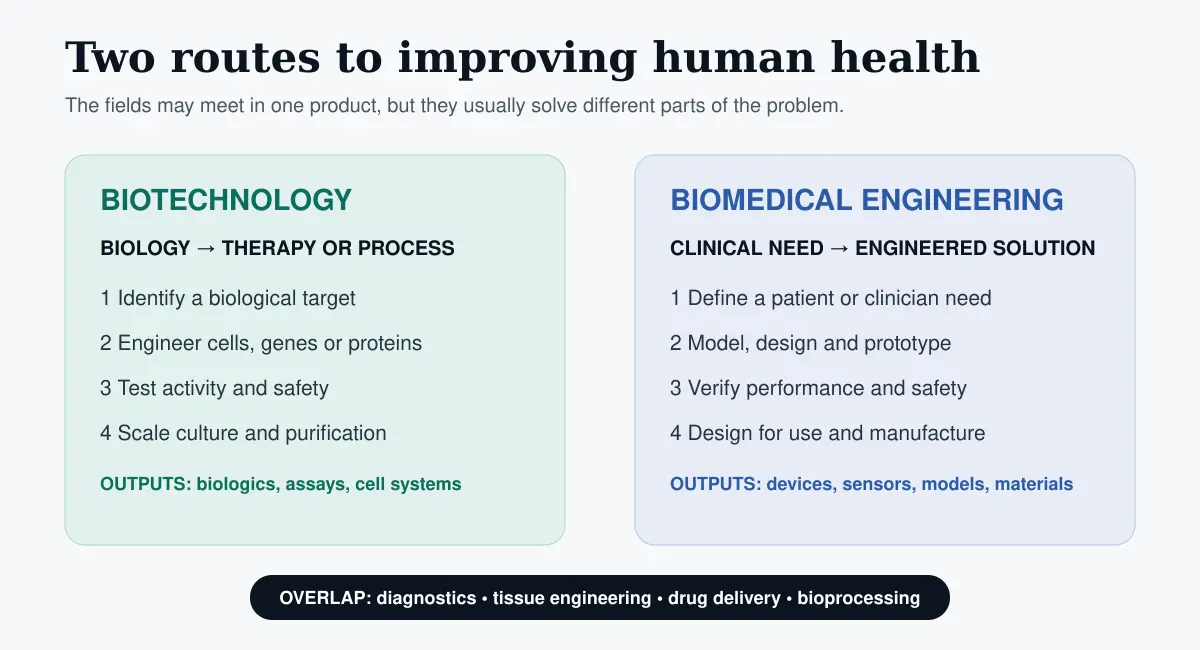
One problem, two technical routes
Biotechnology contribution: identify a biomarker, develop a recognition molecule, improve assay specificity and validate the biological response.
Biomedical engineering contribution: design the sensor, electronics, signal-processing method, skin interface, power system and user-centered device.
Biotechnology vs biomedical engineering at a glance
| Factor | Biotechnology | Biomedical engineering |
|---|---|---|
| Main focus | Using biology to develop products and processes | Engineering technologies for healthcare and human biology |
| Academic base | Life science, applied biology or sometimes engineering | Engineering |
| Core sciences | Molecular biology, genetics, biochemistry, microbiology | Biology and physiology combined with physics and engineering science |
| Math intensity | Statistics and quantitative analysis; calculus depth varies | Calculus, differential equations, statistics and modeling |
| Typical lab work | PCR, cell culture, assays, chromatography, fermentation | Instrumentation, prototyping, materials, signals and device testing |
| Typical outputs | Biologics, engineered cells, assays and bioprocesses | Devices, sensors, implants, models and biomaterials |
| Accreditation issue | No single engineering-accreditation pattern across all programs | Check whether the exact U.S. engineering program is ABET accredited |
| Strongest fit | You want biology at the center of daily work | You want design and quantitative problem-solving at the center |
How the U.S. degree coursework differs
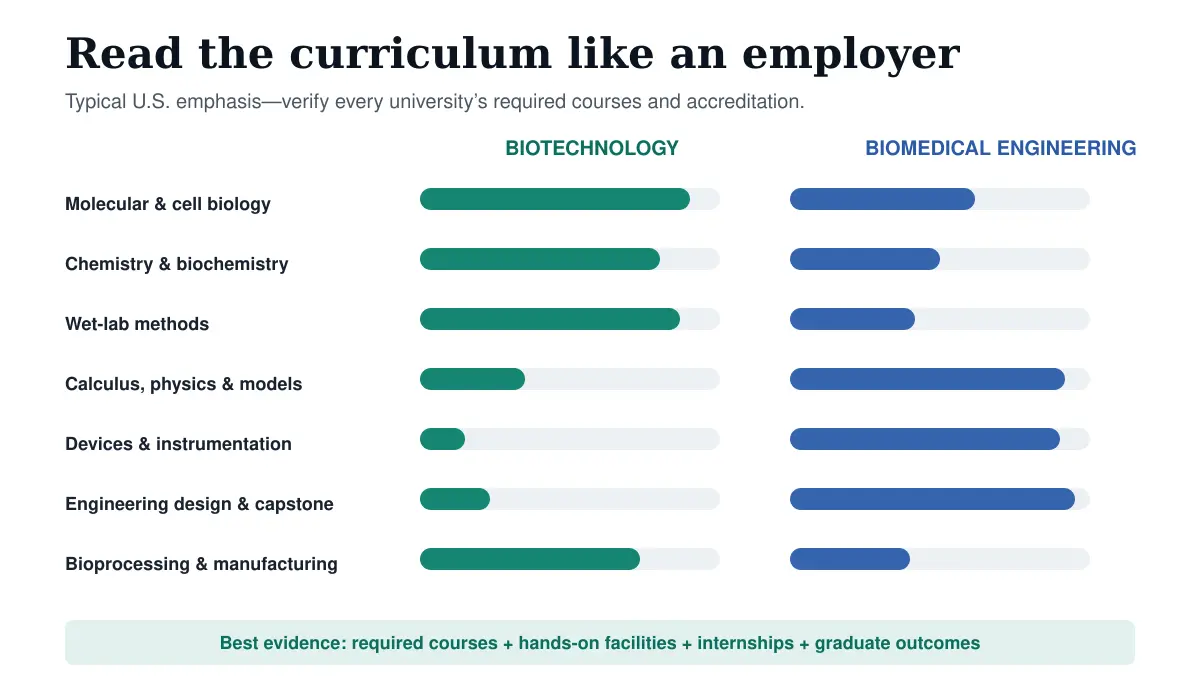
ABET's 2026-2027 criteria require biomedical and similarly named engineering programs to combine engineering with biology, physiology, chemistry, calculus-based physics, mathematics through differential equations and statistics. Students must also learn to analyze, model, design and realize biomedical systems, components, processes or devices.
Cells, molecules and production
- cell and molecular biology;
- genetics and genetic engineering;
- biochemistry and microbiology;
- cell culture and immunology;
- bioinformatics or biostatistics;
- fermentation and bioprocessing; and
- quality or regulatory science.
Analysis, devices and design
- calculus and differential equations;
- calculus-based physics;
- programming and numerical methods;
- physiology and biomechanics;
- biomaterials or bioinstrumentation;
- signals, imaging or transport; and
- engineering design and capstone.
What student life may actually feel like
A biotechnology project day
Prepare sterile media, culture cells, run an assay, troubleshoot contamination, analyze biological variability and document the experiment.
Frustration to tolerate: living systems do not always behave predictably.A biomedical engineering project day
Define requirements, model a system, build a prototype, collect signals, test performance and revise the design under safety constraints.
Frustration to tolerate: a mathematically sound idea may fail during physical testing or clinical use.Ask universities what undergraduates actually touch. A long equipment list means little if access is reserved for graduate researchers. Look for required laboratories, research placements, design teams, co-ops and capstones with real deliverables.
Which task would you rather own?
Select the responsibility that sounds most satisfying. The result is a discussion prompt, not an aptitude test.
Engineer the biological system
You may enjoy genetic engineering, cell culture, molecular methods and experimental optimization.
Check next: required wet labs, research access and whether the program teaches bioprocessing.Career paths and entry-level reality
Biotechnology-leaning
- research associate;
- cell-culture associate;
- molecular biology technician;
- bioprocessing associate;
- quality-control analyst;
- manufacturing associate; and
- validation or regulatory support.
Overlapping work
- diagnostics development;
- drug-delivery systems;
- tissue engineering;
- biomaterials testing;
- laboratory automation;
- bioprocess equipment; and
- technical product support.
Biomedical-engineering leaning
- biomedical engineer;
- medical-device design engineer;
- test or verification engineer;
- clinical engineer;
- biomaterials engineer;
- quality or validation engineer; and
- systems or product engineer.
Job titles can mislead, so read the requirements. A biotechnology role may prioritize cell culture, PCR, chromatography, aseptic processing or GMP documentation. A biomedical engineering role may prioritize CAD, MATLAB or Python, electronics, mechanics, risk analysis, design controls and verification testing.
Which degree has broader scope?
Biotechnology spreads across pharmaceuticals, agriculture, food, industrial biology and environmental applications. Biomedical engineering is more concentrated around medicine and healthcare technology. "Broader" does not automatically mean easier employment. Local industry, internships and the specificity of your skills matter more.
Biotechnology vs biomedical engineering salary
A clean degree-to-degree salary number does not exist. The Bureau of Labor Statistics reports occupations, not every major, and "biotechnology" covers multiple jobs. Combining their wages into one figure would be misleading.
U.S. median annual wage in May 2025. This is an occupational median, not a guaranteed starting salary for graduates. The lowest 10 percent earned under $71,850 and the highest 10 percent earned over $168,180.
BLS projection for 2025 to 2035, with approximately 1,200 openings per year on average.
For biotechnology, compare the actual occupation you want, such as biological technician, microbiologist, biochemist, quality specialist or manufacturing associate. Education requirements differ sharply. Independent research roles frequently require graduate education, while manufacturing, quality, technician and associate roles may accept a bachelor's degree.
Which field depends more on graduate school?
Biotechnology students aiming for independent scientist positions commonly pursue a master's or Ph.D., because advanced research roles demand deeper specialization. Bachelor's graduates can still enter laboratory support, manufacturing, quality, validation and operations.
Biomedical engineering also benefits from graduate study in research-heavy areas such as neural engineering, advanced imaging or tissue engineering. Even so, a strong ABET-accredited bachelor's program with internships, design projects and technical breadth can support entry into device, quality, test, systems and product-development roles.
A better way to choose your major
Marketing pages make every program sound similar. This short checklist cuts through that.
- Choose a target problem. Do you want to manipulate biology or design healthcare technology?
- Audit the prerequisites. Compare calculus, physics, programming, chemistry and biology, not marketing descriptions.
- Check ABET status. For biomedical engineering, verify the exact program in ABET's database.
- Inspect facilities and access. Identify the instruments, fabrication spaces, cell-culture facilities and software undergraduates actually use.
- Review internships and outcomes. Look for job titles and employers, not only placement percentages.
- Read twenty U.S. job descriptions. Create a repeated-skills list, then see which program teaches those skills.
If you are still undecided, go back to the clinic scenario. Ask yourself whether you would rather be the person perfecting the molecule or the person making it work in a nurse's hands, then check that the required courses match your answer.
Frequently asked questions
Which is better: biotechnology or biomedical engineering?
Neither is universally better. Biotechnology suits biological product and process development; biomedical engineering suits quantitative design for healthcare.
Which major has more math?
Biomedical engineering usually requires substantially more calculus, differential equations, physics, programming and mathematical modeling.
Can a biotechnologist become a biomedical engineer?
Some crossover exists in bioprocessing, validation, diagnostics and biomaterials. Device-design and analysis roles may require an accredited engineering degree or additional engineering preparation.
Can a biomedical engineer work in biotechnology?
Yes. Biomedical engineers can work in bioprocess equipment, tissue engineering, diagnostics, automation, modeling, manufacturing systems and validation.
Is biomedical engineering good for pre-med?
It can be, but engineering workloads are demanding and medical-school prerequisites still must be completed. It offers no automatic admissions advantage.
Which degree has more laboratory work?
Both can be laboratory-intensive, but the work differs. Biotechnology emphasizes wet biology; biomedical engineering emphasizes measurement, devices, materials and prototypes.
Does biotechnology pay less than biomedical engineering?
Not necessarily. Biotechnology includes many occupations with different education requirements and salaries. Compare specific roles, experience levels and locations rather than degree labels.
Is biotechnology the same as biomedical science?
No. Biotechnology focuses on using biology to develop products or processes. Biomedical science more commonly studies mechanisms of human health and disease.
Sources and research method
This guide prioritizes current U.S. occupational data, accreditation criteria and primary university curricula, and it keeps those sources separate from interpretation. The BLS wage and outlook figures were checked against the Occupational Outlook Handbook page, last modified August 27, 2026.