
Data engineer vs data scientist: the quick answer
Data engineers build and operate systems that collect, transform, store and deliver dependable data. Data scientists use data, statistics and modeling to investigate questions, develop predictions and evaluate whether those predictions are useful.
Engineers are usually accountable for whether data arrives accurately and reliably. Scientists are usually accountable for whether an analysis or prediction holds up under scrutiny. Both write code, work with imperfect data and depend on each other.
The distinction becomes clearest when something goes wrong: did the records arrive late or get counted twice, or did a model misunderstand an otherwise accurate pattern?
When a delivery prediction fails, who fixes it?
Imagine an online retailer warning customers that their orders may arrive late. One week, the system starts issuing far too many warnings. The symptom is visible to everyone, but finding the cause takes two different kinds of investigation.
The engineer checks whether the evidence reached the system intact
Suppose a shipping carrier renames a status field. Some updates are recorded twice; others arrive after the nightly processing deadline. The data engineer traces the records from their source, checks where counts diverge, fixes the mapping and safely reprocesses the affected days. Then they add a test so the next unexpected field change triggers an alert.
The scientist checks whether the prediction still means what it should
Fixing the pipeline might not fix the predictions. Perhaps a new delivery service changed which orders tend to arrive late. The data scientist checks recent performance against a simple baseline, examines unnecessary warnings and missed delays, and tests whether the model needs updating or should be paused.
A reliable pipeline can feed an ineffective model, and an excellent model can fail when its inputs change. In practice, the engineer and scientist need to compare findings rather than assume the failure belongs to the other team.
Four questions that reveal which work you prefer
- Why did the shipment record disappear between two systems?
- How can we safely process the same day again without counting orders twice?
- Does this score identify more late orders than a simple shipping rule?
- What happens when an unnecessary warning costs customer trust?
If the first two pull you in, investigate engineering. If the last two pull you in, investigate science. Enjoying all four may point toward a role where data systems and modeling meet.
Responsibilities, tools and daily work compared
Microsoft describes data engineering as integrating, transforming and consolidating data into structures suitable for analytics while supporting reliable pipelines and stores. O*NET’s Data Warehousing Specialists profile similarly includes loading, transformation, source-to-warehouse mapping and data-quality work. BLS describes Data Scientists as collecting and analyzing data, creating and testing models, visualizing findings and making recommendations from the analysis.
| Factor | Data engineer | Data scientist |
|---|---|---|
| Main output | Reliable datasets, pipelines, storage and access | Analysis, experiments, evaluated models and recommendations |
| Main question | Can others use the right data consistently? | Does this method produce a useful, defensible answer? |
| Common coding | SQL, Python, scripts, tests and system integrations | Python or R, SQL, experiments and evaluation code |
| Math emphasis | Logic, measurement, performance and system tradeoffs | Probability, statistics, inference and model behavior |
| Common tools | Databases, warehouses, workflow schedulers and cloud services | Statistical libraries, notebooks, model tracking and visualization |
| Quality measures | Freshness, completeness, correctness, uptime and cost | Performance against a baseline, uncertainty and decision value |
| Typical failure | Missing, delayed, duplicated or incorrectly transformed records | Misleading evaluation, wrong assumptions or unreliable predictions |
| Collaboration | Software teams, security, analysts, scientists and source owners | Product teams, domain experts, engineers and decision makers |
| Work pressure | Some teams include support rotations and urgent pipeline recovery | Some projects involve uncertain results and difficult validation decisions |
A realistic Tuesday
Engineering morning
Investigate a failed refresh, confirm the last successful delivery, restore affected tables and explain what downstream users can trust. Later, improve a slow query or review a change to the shape of incoming records.
Science morning
Review a model experiment, study where errors occur and ask whether the improvement matters in practice. Later, meet a product owner to clarify how the score will influence an actual decision.
Neither job is eight uninterrupted hours of coding. Ask prospective employers how much time goes into maintenance, experiments, meetings and production incidents. Those details often reveal more about the job than its title.
The most overlooked difference: what the handoff must guarantee
Tool lists rarely explain the most consequential part of the job: the handoff. For the delivery model, the scientist needs to know what counts as one order, when each field became available and whether the historical data matches what the live system will receive.
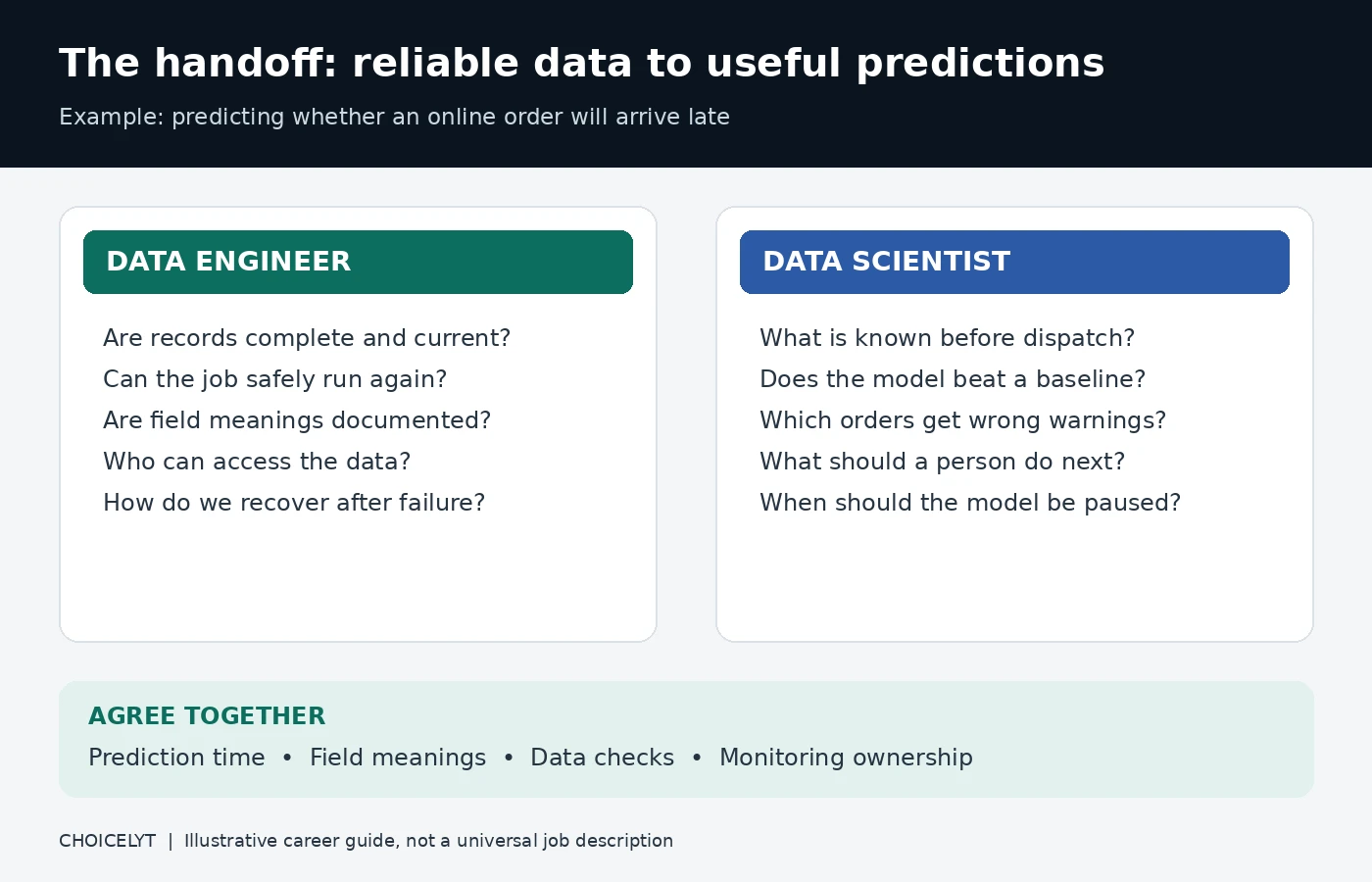
Engineering delivery checklist
- Describe what each row represents.
- Document fields, units, keys and timestamps.
- State how late or repeated records are handled.
- Provide quality checks and delivery expectations.
- Define access permissions and recovery procedures.
Science acceptance checklist
- Define the question and prediction time.
- Use only information available at that time.
- Compare a model with a simple baseline.
- Study errors across time and relevant groups.
- Explain the action, limits and monitoring needs.
A timestamp mistake can create data leakage, meaning a model sees information it would not have at the real decision time. For example, using a delivery completion status to predict a delay before dispatch makes an experiment look stronger than the live system will be. The scikit learn documentation warns that leakage creates overly optimistic evaluation. Splitting data before learning preparation steps is one important defense.
Which career needs more coding or math?
Both careers involve real programming. Engineers spend more time making repeated data processing safe and maintainable; scientists spend more time making analyses reproducible and testing whether findings generalize. Neither title guarantees more coding hours.
Engineering foundations worth learning first
Start with SQL, database design and Python. Learn to join tables without accidentally multiplying records, handle dates correctly, test transformations and understand how a change reaches downstream users. Then add version control, scheduling, logging, permissions and one cloud environment.
Understand the purpose of a tool before collecting certifications for it. A scheduler handles dependencies and retries; a warehouse makes data available for analysis; distributed processing splits large workloads across machines. A small, tested pipeline teaches these ideas better than a long list of product names.
Science foundations worth learning first
Start with statistics, probability, SQL and reproducible Python or R. Practice asking what would count as useful evidence, choosing a fair comparison and explaining uncertainty. For predictive projects, learn baselines, evaluation splits, error measures and the connection between a score and an action.
Science usually requires deeper mathematics, especially for research or specialized modeling. Engineering still requires strong reasoning about correctness, efficiency and resource use. A low mathematics course count does not make production systems easy.
Degrees, certificates and routes into the first job
For engineering, computer science, information systems, software engineering and related technical degrees can provide a useful foundation. Inspect courses in programming, databases, data modeling, systems and applied projects rather than assuming one degree title is required.
For Data Scientists, BLS lists a bachelor’s degree as the typical entry education, often in mathematics, statistics, computer science or a related field, while noting that some employers require or prefer graduate education. A master’s can add statistical depth or research experience, but it should solve a specific skill or hiring gap.
A beginner can target junior engineering, ETL development, database work or analyst roles with substantial SQL. ETL means extracting records, transforming them and loading them into a destination. A science candidate may begin in analysis, research assistance, experimentation or an internship involving model evaluation. These are possible routes, not promises of easy entry.
How to judge a course before paying
Look for projects involving imperfect data, feedback on your code, meaningful assessment and explanations of failure. An engineering course should cover tests, recovery and repeated execution. A science course should require baselines, leakage checks and honest evaluation. A collection of guided notebooks or cloud badges alone does not establish readiness.
Use the education ROI calculator to include tuition, fees, housing, commuting, equipment and income you give up while studying. A higher advertised salary should not be treated as your expected first offer.
Data engineer vs data scientist salary in the United States
There is no clean federal salary comparison covering every employer using the title “Data Engineer.” Data Scientist has a dedicated BLS occupation, while data engineering overlaps warehousing, database architecture, platform and software work. Treating Database Architect pay as universal Data Engineer pay would make the comparison misleading.
BLS May 2025 median for the data scientist occupation.
BLS May 2025 median for Database Architects. O*NET uses this wage series for Data Warehousing Specialists, but it is not a universal Data Engineer salary.
BLS May 2025 median for another distinct database occupation.
These medians describe workers across experience levels. They do not establish a starting salary, a guaranteed outcome or which of these two job titles pays more. For your decision, compare current postings with similar seniority, location, industry and responsibilities. Separate base pay from bonus, stock, benefits and support obligations.
Which has more demand?
BLS counted about 275,600 Data Scientist jobs in 2025 and projects about 371,000 in 2035, a 35% increase. BLS projects about 24,800 Data Scientist openings per year on average over the decade.
For the related Database Architects occupation, BLS counted about 69,500 jobs in 2025 and projects about 76,000 in 2035, a 9% increase. That series provides context for data infrastructure work but is not a national forecast for every Data Engineer title.
That 35% growth forecast is specific to the BLS Data Scientists occupation. It does not prove that data science has more entry-level openings than data engineering in your city. Check actual vacancies and their experience requirements.
One project that makes both careers visible
Build a delivery risk project with two separate success tests
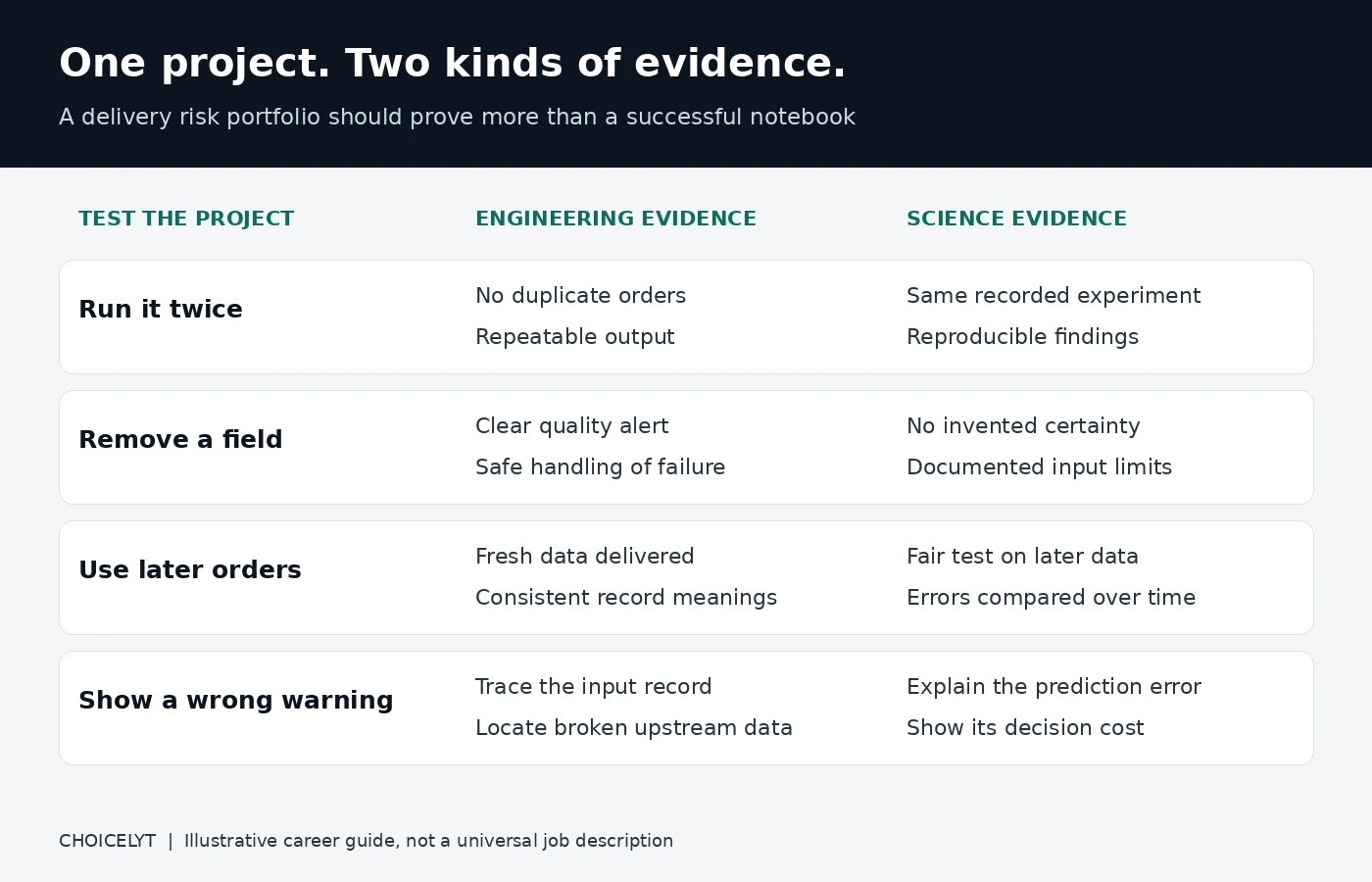
Use public or synthetic order events. Label synthetic data clearly. Your engineering success test is whether the same input can be processed again without creating duplicate orders, while incomplete records are detected and explained. Your science success test is whether a prediction improves on a simple rule when evaluated on later orders.
Write a short decision memo explaining what worked, what failed and what remains uncertain. A small project with visible checks is more persuasive than a large project whose impressive output cannot be audited.
Engineering interview evidence
Show table design, transformation code, tests, logs and a recovery exercise. Explain what happens when a field disappears, an input arrives twice or a task stops halfway through. Demonstrate how you protect access and keep processing cost reasonable.
Science interview evidence
Show a baseline, a sensible evaluation split, error analysis and a reason for the chosen measure. Explain what information exists at prediction time, what an incorrect score costs and how you would recognize deteriorating performance.
Interview formats vary. An engineer may receive SQL and a pipeline design exercise. A scientist may receive coding, statistics and a product modeling case. Ask the recruiter what is assessed, then practice explaining your reasoning rather than memorizing tool lists.
Can you switch between engineering and science?
Yes. The shared SQL and Python foundation helps, but the standard of success changes. Moving from engineering into science usually requires deeper statistics, experimental design and model evaluation. Moving from science into engineering requires stronger database design, automated testing, operations and recovery practices.
Try a supervised crossover project before committing to another degree. An engineer can help evaluate a prediction against a baseline. A scientist can help turn a recurring preparation task into a tested pipeline. The project should add ownership, not simply another tool to a résumé.
Data engineer vs data scientist vs data analyst
Make data usable repeatedly
Own reliable delivery, transformations and storage.
Test methods and predictions
Own evidence, models, validation and decision usefulness.
Explain a business question
Own measures, investigation, reporting and recommendations.
For the analyst boundary, read Data Analyst vs Data Scientist. Analytics engineers often build tested analytical tables and shared measures. Machine learning engineers often help deploy and operate model services. Those roles overlap this comparison, but their precise scope depends on the organization.
How AI changes both careers
AI can draft queries, suggest transformations, generate tests and produce initial model code. These capabilities change the work, but they do not establish that a pipeline is correct or a prediction is useful. Treat generated output as a candidate that needs review.
Engineering judgment still matters
A generated query can join at the wrong level and multiply revenue. A suggested retry can duplicate records. People must check definitions, permissions, dependencies, recovery and cost before releasing changes.
Science judgment still matters
A generated experiment can learn from future information or optimize an irrelevant score. People must check the target, baseline, uncertainty, errors and whether the output supports the intended action.
AI may make the first draft faster. It does not tell you whether duplicated rows inflated revenue or a model accidentally learned from future events. Learn to verify generated work independently; speed matters only after correctness.
Who should investigate first?
Select a symptom. These examples show typical first responsibilities; real teams investigate together.
Start with the failure you can observe
A failure in the output may begin in either the data system or the model. Check both before assigning blame.
Which career is better for you?
- Identify what you like fixing. Engineering rewards interest in reliability, structure and recovery. Science rewards interest in uncertain evidence, experiments and prediction.
- Try both halves of the delivery project. Notice which problems you want to keep working on after the exercise ends.
- Inspect local hiring evidence. Compare duties and junior requirements in your target U.S. market, including related titles.
- Ask about work conditions. Clarify support rotations, production ownership, mentorship and the balance between exploration and maintenance.
- Choose the smallest useful learning step. Fill a demonstrated gap before buying another qualification.
Frequently asked questions
What is the difference between a data engineer and a data scientist?
A data engineer builds reliable pipelines, storage and prepared datasets. A data scientist investigates questions, develops models and evaluates their usefulness. Both need programming, data quality and collaboration.
Who earns more, a data engineer or a data scientist?
There is no universal winner. Compare similar seniority, location and duties. BLS reports $120,230 for data scientists in May 2025, but it does not provide one equivalent category covering all data engineers.
Is data engineering easier than data science?
Engineering usually requires less advanced statistical modeling, but it adds system design, reliability and recovery challenges. Science usually requires deeper statistics and evaluation. Difficulty depends on your strengths and the actual role.
Can a data engineer become a data scientist?
Yes. Add statistics, experiment design, modeling, evaluation and communication about uncertainty. Demonstrate those skills in a project with a baseline and honest error analysis.
Can a data scientist become a data engineer?
Yes. Strengthen databases, software testing, scheduling, permissions, monitoring and recovery. Show that a pipeline can run repeatedly and handle failures safely.
Do both careers use SQL and Python?
Frequently, yes. Engineers use them to prepare and move data reliably. Scientists use them to retrieve data, investigate questions and build reproducible experiments. The tools overlap while responsibilities differ.
Do I need a master's degree?
Not for every role. BLS lists a bachelor's degree as typical entry education for data scientists, although some employers prefer graduate study. Check the actual education and experience requirements of the engineering or science roles you want.
Will AI replace data engineers or data scientists?
AI can assist coding and experimentation, but reliable systems and valid conclusions still require checks, context and accountable judgment. Future hiring varies, so develop skills that let you verify AI output.
Sources and research method
Role definitions and technical claims use official documentation, current O*NET employer-demand data and primary institutional sources. Salary evidence is tied to named U.S. occupations and clearly labeled where the occupational mapping is only adjacent. The delivery case is illustrative. Career advice and the incident tool are editorial guidance, not measured hiring outcomes.
- Microsoft Learn: Data Engineer career path
- O*NET OnLine: Data Warehousing Specialists, updated 2026
- O*NET OnLine: 2025 employer software demand for Data Warehousing Specialists
- O*NET OnLine: Data Scientists, updated 2026
- O*NET OnLine: 2025 employer software demand for Data Scientists
- BLS: Data Scientists
- BLS: Database Administrators and Architects
- scikit learn: Common pitfalls and data leakage
Sources checked October 11, 2026. Pay figures refer to May 2025. Confirm current local postings and program requirements before making an education decision.