
Short answer
Computer science usually fits students who want deeper programming, algorithms, software development, AI, computing systems or theory. Information technology usually fits students who prefer networks, cloud platforms, cybersecurity operations, systems administration, support and technology implementation. The degree title matters less than the required courses, hands-on experience and target job. Both fields overlap in cybersecurity, cloud, DevOps, databases and systems work.
What is the difference between IT and computer science?
Computer science (CS) studies computation: how problems are represented, how efficient solutions are designed, how software and operating systems work, and what computers can do. Programming is a major tool, but CS is broader than learning a programming language.
Information technology (IT) focuses on selecting, integrating, securing, operating and supporting technology for an organization. Its work can include networks, cloud services, endpoints, identity systems, cybersecurity operations, databases, automation, service management and user support.
The familiar shorthand is that CS builds technology and IT runs it. That gets at the emphasis, but it leaves out a lot. IT teams write scripts, automate deployments and sometimes build internal tools. CS graduates also work in cloud operations and security. What matters is whether you would rather design computing solutions or keep technology working for an organization.
How CS and IT divide responsibility in one company
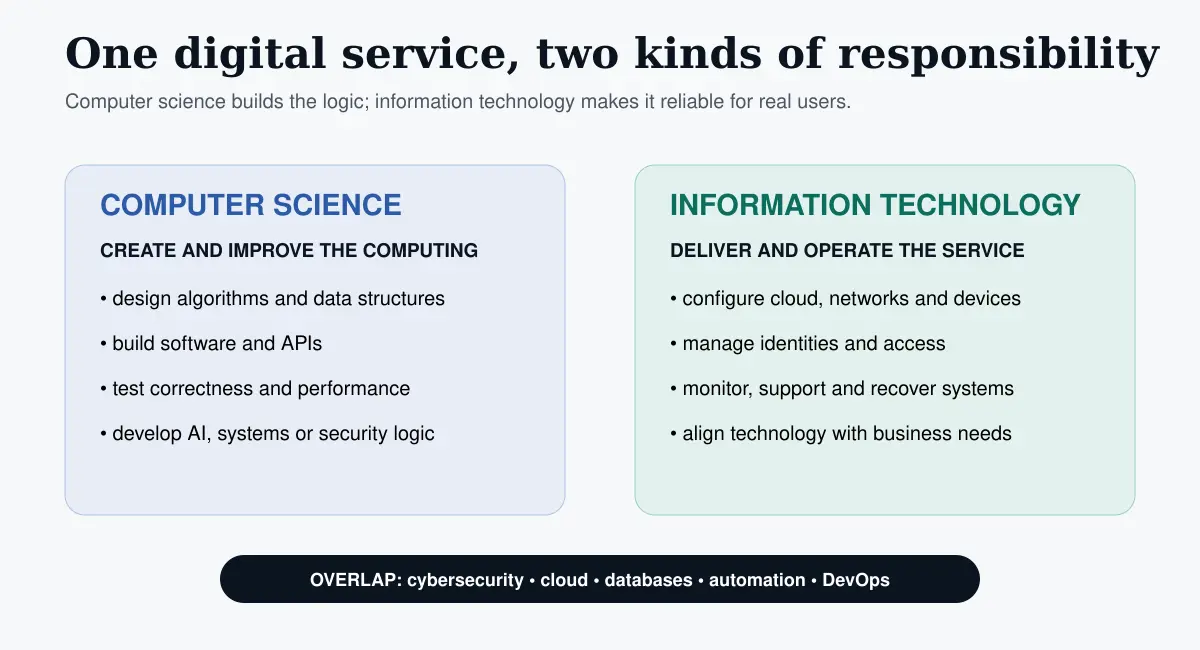
Computer science contribution
Design the application architecture, implement the registration logic, build APIs, optimize database queries, test software and improve scalability.
Information technology contribution
Configure cloud resources, accounts, networks, backups, monitoring, endpoint access, incident response and support for staff and students.
IT vs computer science at a glance
| Factor | Computer science | Information technology |
|---|---|---|
| Primary focus | Computation, software and computing systems | Technology infrastructure, services and users |
| Main question | How can we design or improve this computational solution? | How can we deploy, secure and operate technology reliably? |
| Programming | Central and usually deeper | Useful for scripting, automation and integration; depth varies |
| Mathematics | Usually more calculus, discrete math, probability and theory | Usually less theoretical math; program requirements vary |
| Networks and cloud | May study underlying principles and distributed systems | Usually emphasizes configuration, administration and operations |
| User interaction | Varies by software role | Often significant in support, administration and implementation |
| Common projects | Applications, compilers, AI models, operating systems and other systems software | Networks, cloud deployments, security labs and service solutions |
| Certifications | Optional for most software paths | Can be valuable when aligned with the target role |
| Strongest fit | You enjoy abstraction, coding and building systems | You enjoy practical systems, troubleshooting and reliable service |
Computer science vs information technology coursework
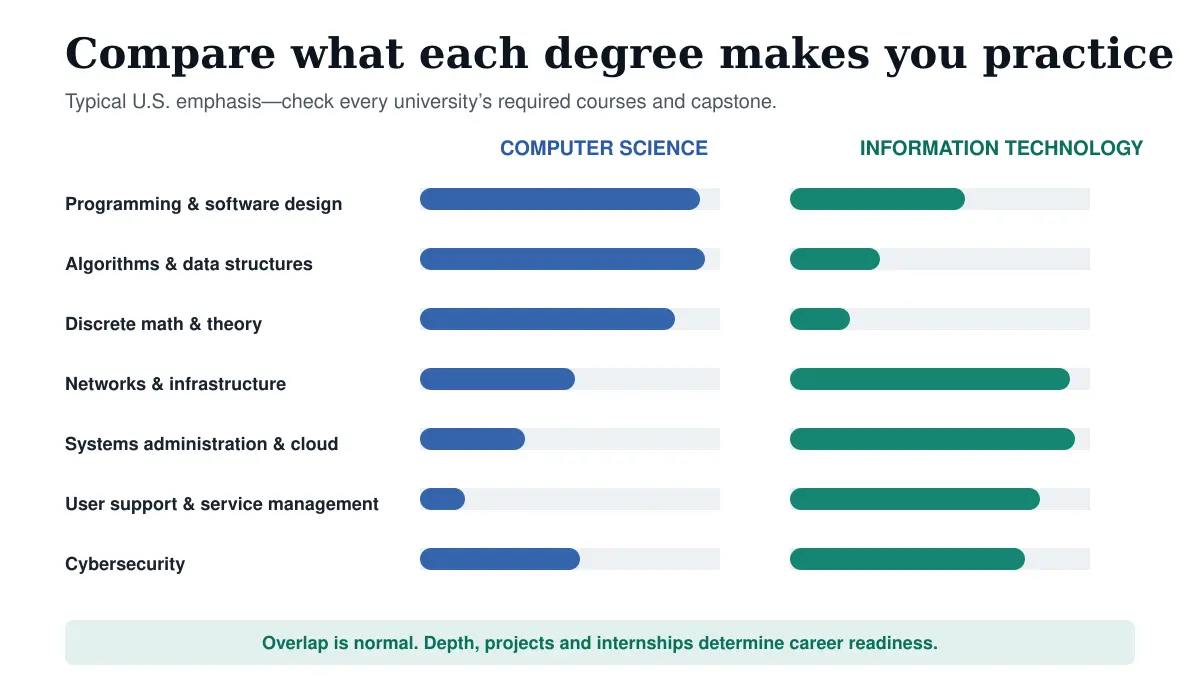
ABET’s 2026–2027 criteria provide one useful comparison, but they apply to programs accredited under those criteria, not every degree with these names. Computer science programs must include at least 40 semester credit hours of CS and 15 of mathematics and statistics. Information technology programs must include at least 45 credit hours of IT and six of mathematics. Course lists still matter: two universities can meet the standards while offering very different electives, projects and internships.
Build from computational principles
- programming and software development;
- data structures and computational efficiency;
- discrete mathematics;
- computer architecture;
- operating systems;
- databases and networks; and
- theory, AI, graphics or security electives.
Build dependable technology services
- networking and infrastructure;
- systems administration;
- cloud computing;
- cybersecurity operations;
- databases and web systems;
- scripting and automation; and
- IT project or service management.
Which degree is harder?
If you enjoy proofs, algorithms and abstract problem solving, CS coursework may feel natural. If you prefer configuring systems, tracing network failures and solving practical service problems, IT may be a better fit. Neither is automatically easier. A difficult outage, an insecure cloud deployment or a poorly designed network can be every bit as demanding as a programming assignment.
Information technology, information systems and CIS are not identical
Information technology
Usually emphasizes technology infrastructure, security, administration, integration and support.
Information systems
Usually emphasizes how organizations use technology, often combining business processes, data and systems analysis.
Computer information systems
Frequently blends practical computing with business applications, but its meaning varies by institution.
Which degree is better for your target career?
| Your target | Usually the stronger starting fit | What you still need |
|---|---|---|
| Software developer or machine-learning engineer | Usually computer science | Substantial projects, internships, testing, version control and deployment, not only classroom coding. |
| Cloud administrator, systems administrator or IT operations | Usually information technology | Linux, networking, identity, scripting, monitoring, cloud labs and incident-response practice. |
| Cybersecurity | Either, depending on the layer | CS often fits secure software and security research; IT often fits security operations, identity, networks and infrastructure. |
| DevOps, platform engineering or site reliability | Either-a hybrid profile wins | Programming plus operating systems, cloud, automation, observability, networking and production troubleshooting. |
| Data science, advanced AI or computing research | Usually computer science | Linear algebra, probability, statistics, advanced computing courses and often graduate education for research roles. |
| Network architecture or IT management | Often information technology | These are usually not immediate graduate roles; employers commonly expect related experience, and role-specific certifications may help. |
Which responsibility would you rather own?
Select the task you would be happiest practicing repeatedly. This is a reflection tool, not a prediction of ability.
Build the software product
You may enjoy programming, architecture, testing and turning requirements into working systems.
Check next: programming depth, data structures, team projects and software-engineering internships.Career paths: where the degrees lead
Computer-science leaning
- software developer;
- software engineer;
- data engineer;
- machine-learning engineer;
- QA automation engineer;
- systems programmer; and
- research or computing roles.
Overlapping careers
- cybersecurity analyst;
- cloud engineer;
- DevOps or platform engineer;
- database administrator;
- systems analyst;
- solutions engineer; and
- technical consultant.
Information-technology leaning
- systems administrator;
- network administrator;
- IT support specialist;
- cloud administrator;
- IT operations analyst;
- identity and access administrator; and
- IT project coordinator.
A job title can hide very different responsibilities. One cloud engineer writes infrastructure code; another spends most of the day on permissions, deployments or production incidents. Read the duties and tools in job ads before deciding that a position belongs exclusively to IT or CS.
Can an IT graduate become a software developer?
Yes, but the degree alone may provide less depth in computer-science theory, data structures and software engineering. An IT student targeting development should deliberately build programming foundations, data structures, Git, testing, deployment and several substantial software projects.
Can a CS graduate work in IT?
Yes. CS graduates can enter cloud, infrastructure, cybersecurity and systems roles, but may need hands-on experience with networks, operating platforms, identity, monitoring and operational tools.
Entry routes, certifications and degree flexibility
A bachelor’s degree is common in software development and many specialist roles, but not every technology job has the same entry requirements. BLS lists a bachelor’s degree as typical for software developers. Computer support jobs offer more varied routes: some require an associate degree, while some user-support positions consider relevant coursework or certifications. Always check the actual job posting and whether an advertised entry route leads to the work you want.
Degree plus evidence of building
If your goal is software development, build a few substantial projects that demonstrate programming, version control, testing, deployment and collaboration. An internship or evidence that you maintained real software can tell an employer more than a long list of beginner certificates.
Degree or role-specific pathway
For support, networking, cloud and security operations, hands-on labs and carefully chosen certifications can help demonstrate practical skills. Pick them based on the jobs you want and pair them with work you can explain, such as setting up a secure network or resolving a simulated outage.
The degree is a starting point, not a permanent boundary. An IT graduate can build toward software development through programming and substantial projects. A CS graduate can move toward infrastructure or security operations by practicing Linux, networking, identity, monitoring and incident response.
IT vs computer science salary and job outlook: compare occupations, not degree names
BLS does not publish a single salary for IT graduates or CS graduates. Someone running a support desk, developing software or designing a large network is doing different work, even when all three hold computing degrees. Compare the actual job you want, not two unsourced average salaries assigned to degrees.
$135,980
May 2025 U.S. median pay; employment is projected to grow 10% from 2025 to 2035.
$129,180
May 2025 U.S. median pay; employment is projected to grow 21% from 2025 to 2035.
$134,050
May 2025 U.S. median pay; employment is projected to grow 8% from 2025 to 2035.
These figures represent workers across experience levels, not what a new graduate should expect in a first offer. Industry, location and responsibility matter. Network architecture and IT management often require prior experience, so their national medians are especially poor starting-salary estimates.
Before judging a salary offer, check wage information for the state or metro area and compare roles at similar experience levels. A network architect or IT manager median is not a realistic estimate of a new graduate’s first paycheck.
How AI changes computer science and IT careers
AI tools can help write scripts, draft code, summarize logs and suggest fixes. That saves time, but it can also produce insecure configurations, incorrect assumptions or changes that fail in production. In both fields, understanding the system and checking what the tool produced remain essential.
- less value in producing unexamined boilerplate;
- more value in architecture and verification;
- greater need for data, security and system understanding;
- continued demand for people who can debug unfamiliar systems.
- more automated monitoring and routine support;
- greater emphasis on cloud, identity and security;
- more infrastructure as code and scripting;
- continued accountability for outages and business continuity.
BLS already reflects some automation pressure in its projections. It cites automated troubleshooting tools as one factor behind the projected decline in computer user support roles, and automation plus service outsourcing as factors affecting systems administration. At the same time, BLS projects strong growth for information security analysts and software developers. The practical response is to learn fundamentals, use AI as an accelerator and keep the ability to verify code, security advice and production changes.
How to choose between CS and IT
- Try both types of work. Build a small application, then deploy it, secure it, monitor it and troubleshoot it.
- Audit the curriculum. Compare required mathematics, programming, systems, networking, cloud, cybersecurity, experiential learning and capstone work.
- Read twenty target job descriptions. List the tools and responsibilities that repeat.
- Examine internship access. Look for software teams, help desks, security operations, cloud projects and employer partnerships.
- Use certifications strategically. Certifications can support an IT specialization but should accompany labs and projects, not replace them.
- Build public evidence. A GitHub project, documented home lab or cloud deployment demonstrates more than a list of course names.
Frequently asked questions
Is information technology the same as computer science?
No. Computer science focuses more on computation, algorithms, programming and software systems. Information technology focuses more on applying, integrating, securing and operating technology for organizations and users.
Which degree has more programming, IT or computer science?
Computer science usually requires more and deeper programming. IT programs still use scripting and software development for automation, integration, web systems and administration, but the amount varies by university.
Which degree has more math?
Computer science usually has more formal mathematics. Under ABET's 2026 to 2027 criteria, accredited CS programs require at least 15 semester credit hours of mathematics and statistics, while accredited IT programs require at least six semester credit hours of appropriate mathematics including relevant discrete mathematics.
Can an IT graduate become a software engineer?
Yes. The student may need to add deeper programming, data structures, software design, testing, version control, deployment practice and software-development internships beyond the minimum IT curriculum.
Can a computer science graduate work in IT or cybersecurity?
Yes. CS graduates can enter cloud, infrastructure, cybersecurity and systems roles. Operational roles often require additional practice with networks, Linux, identity, cloud platforms, monitoring and incident response.
Does computer science pay more than information technology?
There is no single salary for either major. BLS reports pay by occupation. In May 2025, the median was $135,980 for software developers, $129,180 for information security analysts and $134,050 for computer network architects, while support roles had lower medians and experienced IT management had a higher median.
Sources and research method
This comparison uses current U.S. occupational data and computing curriculum standards. Ranking comparison pages were reviewed to identify recurring search questions and content gaps, while salary and job-outlook claims were checked against primary sources rather than copied from secondary career sites.
- ABET - Computing Program Criteria 2026-2027
- ACM - Curricula Recommendations
- ACM/IEEE-CS/AAAI - CS2023 Curriculum
- ACM/IEEE - Information Technology Curricula 2017
- U.S. BLS - Computer and Information Technology Occupations
- U.S. BLS - Software Developers, QA Analysts and Testers
- U.S. BLS - Information Security Analysts
- U.S. BLS - Computer Network Architects
- U.S. BLS - Computer Support Specialists
- U.S. BLS - Network and Computer Systems Administrators
- U.S. BLS - Computer and Information Systems Managers