Short answer
Chemistry is usually the broader route into substances, reactions, synthesis, analysis and materials. Biochemistry brings that chemical knowledge closer to proteins, enzymes, metabolism and living systems. Neither degree is automatically better. The right choice depends on which questions interest you, what your university actually teaches and the work you hope to do.
The difference in one scientific question
Imagine two students examining glucose. One wants to understand its structure, reactions and how to measure it in a sample. The other wants to know how a cell uses it, which enzymes control the process and what happens when that system changes. Both are doing chemistry. The difference is where they direct their curiosity.
One molecule, two ways of thinking
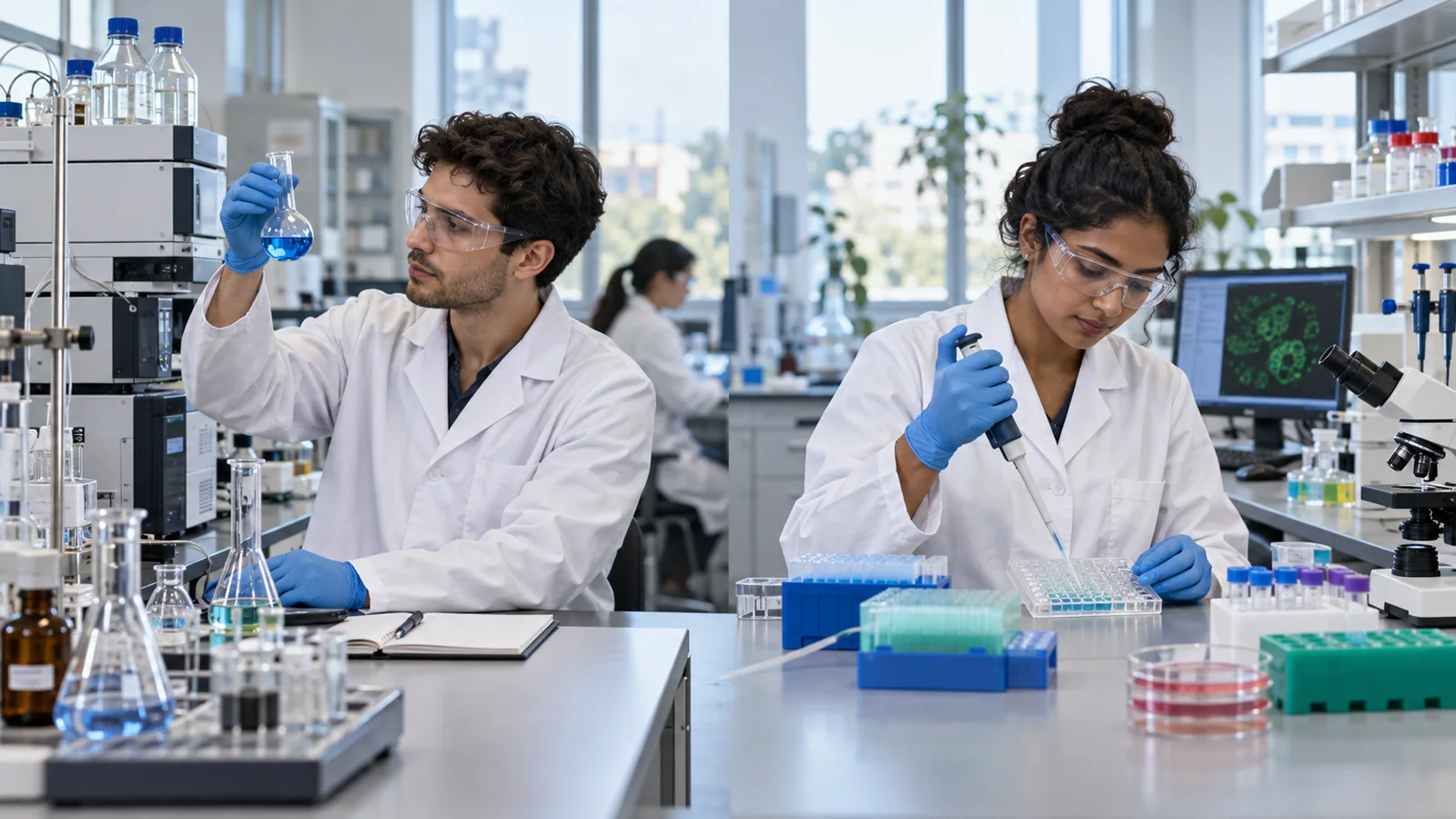
The distinction becomes clearer in the laboratory. A chemistry-focused project might test a measurement method, investigate a reaction or study a material. A biochemistry-focused project might follow an enzyme, a protein interaction or a metabolic pathway. The instruments can overlap. The scientific question changes.
That is why a course catalog tells you more than a degree title. Look beyond the introductory classes. Ask what you will study in your third and fourth years, which experiments you will perform and whether you can join a research group.
Which questions pull you in?
Select the statement that sounds most like you. This is a reflection tool, not a career test.
Start by comparing chemistry programs
You may prefer broader depth in synthesis, analytical chemistry, physical chemistry, inorganic chemistry and materials. Check how much biology the program lets you add.
Next catalog check: instrumental analysis, advanced lab, physical chemistry and elective flexibility.Biochemistry vs chemistry degree coursework
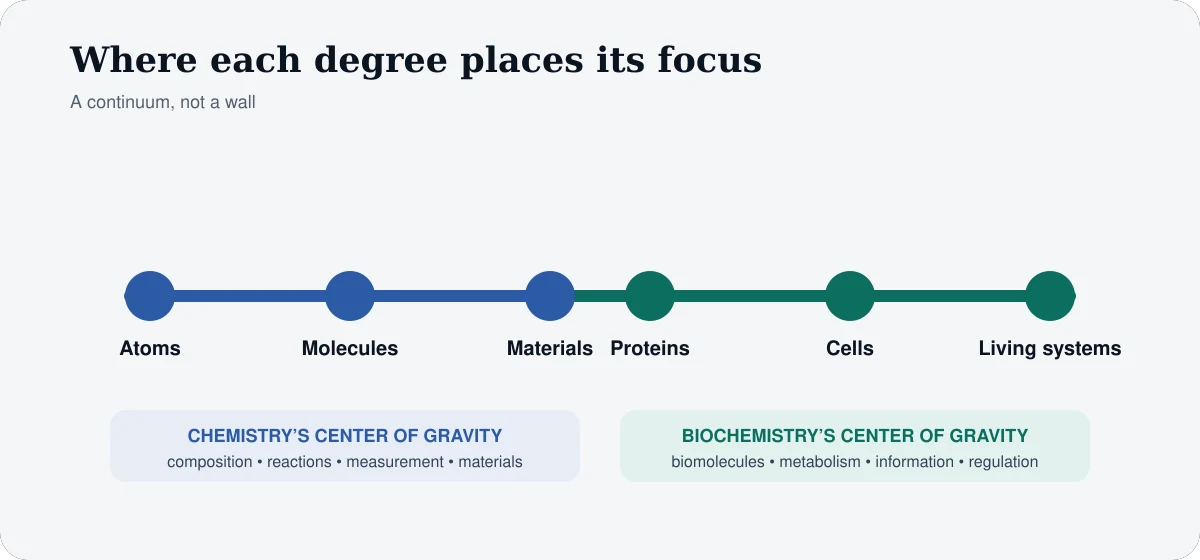
At first, the degrees may feel remarkably similar. You study atoms and bonds, work through organic reactions and learn to make measurements. The difference usually becomes more visible as the coursework advances: chemistry keeps more of the field in view, while biochemistry spends more time on molecular life processes.
ACS-approved chemistry curricula provide broad and in-depth chemical training. Current ACS guidance describes introductory, foundation and in-depth experiences; certified-degree students complete at least four in-depth courses. ASBMB uses an outcomes-based approach for biochemistry and molecular biology programs, emphasizing energy in biological systems, macromolecular structure and function, information flow, and quantitative discovery.
What jobs can each degree lead to?
This is where the choice becomes practical. Your first job is unlikely to be determined by the word on your diploma alone. Employers also look at the techniques you know, the instruments you have used, the projects you can explain and whether the position requires further study.
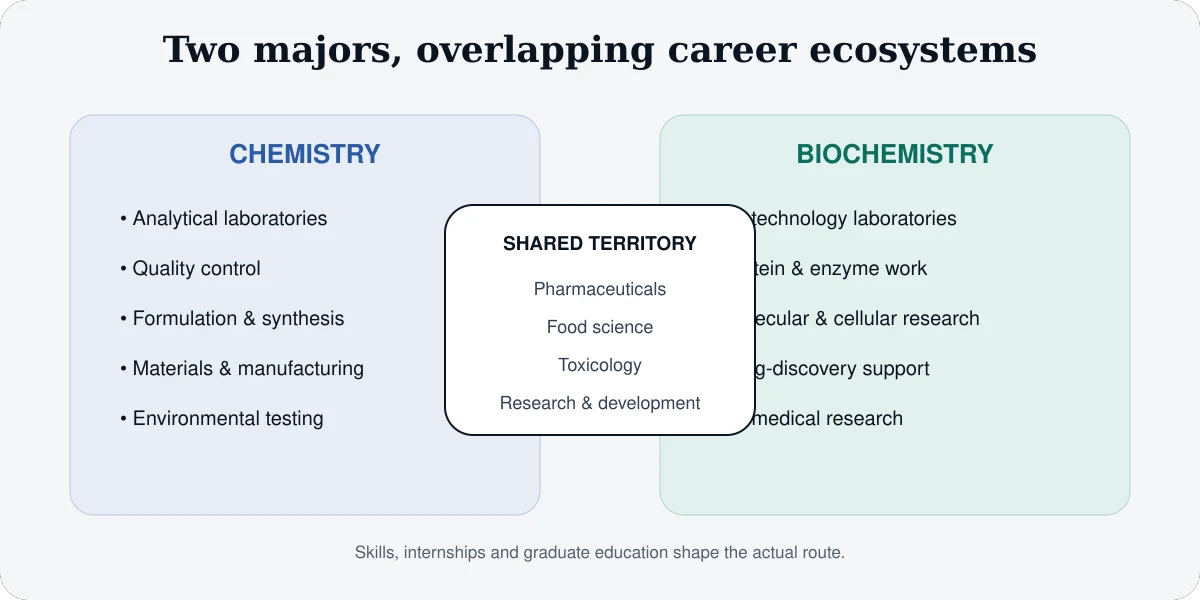
Chemistry-aligned routes
- Analytical or laboratory chemist
- Quality-control chemist
- Formulation and product development
- Environmental or forensic laboratory work
- Materials and manufacturing laboratories
- Research roles, sometimes with graduate study
Biochemistry-aligned routes
- Biotechnology laboratory roles
- Protein, enzyme or assay development
- Molecular or cellular research support
- Pharmaceutical discovery laboratories
- Clinical-research support roles
- Independent R&D, typically with a Ph.D.
There is substantial overlap in pharmaceuticals, food science, biotechnology, toxicology, diagnostics and research. Read job descriptions for techniques—such as chromatography, spectroscopy, cell culture, PCR or protein purification—rather than assuming a title belongs exclusively to one major.
Salary and outlook: read this carefully
A higher number can catch your attention. It can also give you the wrong impression if you compare unlike jobs. In May 2025, BLS reported a U.S. median annual wage of $91,240 for chemists and $127,410 for biochemists and biophysicists. Those are occupation-wide figures, not the earnings of chemistry and biochemistry graduates with otherwise identical qualifications. Independent biochemistry R&D generally requires doctoral training, while a bachelor’s degree is the typical entry education for chemists.
2025 median; 6% projected growth, 2025–35. Bachelor's degree is the typical entry education.
2025 median; 12% projected growth, 2025–35. Doctoral/professional degree is typical for the occupation.
How graduate school changes the decision
Picture the decision five years from now, not just on graduation day. A chemistry bachelor’s degree may lead directly to laboratory, testing, quality or manufacturing work. Some research paths call for graduate study. In biochemistry, bachelor’s and master’s graduates can qualify for some entry-level positions, but independent research and development generally requires a Ph.D. The extra study time and cost belong in your decision today.
If medical, dental or other professional school is your goal, neither major is automatically superior. Complete each target program's prerequisites, protect your academic performance and gain relevant experience. Choose the subject you are willing to study deeply—not the one that merely sounds more “medical.”
A better way to choose
- Compare two real degree plans. Highlight required courses, advanced labs and electives. Do not rely on program names.
- Inspect the laboratories. Look for instruments, biological facilities, safety training and undergraduate research access.
- Search local internships. Note the techniques and majors employers actually request.
- Model the full education path. Include graduate-school time and cost if your target work usually requires it.
- Choose the questions you can sustain. Four years of coursework matters more than a vague job-title preference.
A useful question is not “Which major sounds more impressive?” It is “Which set of problems would I still want to understand after the assignment ends?” Give yourself time to answer it.
Frequently asked questions
Is biochemistry harder than chemistry?
Neither is universally harder. Chemistry may demand more breadth across physical, inorganic and analytical chemistry; biochemistry may demand more biology, molecular detail and pathway integration. Compare the actual curriculum and your strengths.
Is biochemistry the same as biological chemistry?
Often the terms refer to closely related study, but schools may design the programs differently. Check required courses and learning outcomes before treating the names as interchangeable.
Which is better for medical school?
Neither major guarantees an advantage. Both can work if you complete prerequisites. Academic performance, admissions-test preparation, clinical exposure and other requirements also matter.
Can a chemistry major become a biochemist?
Yes, especially with biochemistry, biology and research preparation, but independent biochemistry R&D commonly requires graduate study. Exact employer requirements vary.
Can a biochemistry graduate work as a chemist?
Some analytical, quality, pharmaceutical and laboratory roles overlap. Chemistry-heavy roles may require specific instrumental, synthesis or physical-chemistry preparation.
Which degree has more job options with only a bachelor's?
Chemistry often aligns directly with a broader set of bachelor's-level testing, quality and laboratory occupations. Biochemistry also supports entry-level laboratory and biotech roles, but independent research usually requires a Ph.D. Local employers and acquired techniques can change the picture.
Should I study organic chemistry or biochemistry?
Organic chemistry is a chemistry subdiscipline focused on carbon-containing compounds and reactions; biochemistry applies chemical principles to living systems. Most biochemistry degrees require organic chemistry, so this is usually a course or specialization question rather than a simple either-or choice.
Sources and methodology
This U.S.-focused guide separates curriculum standards, degree choices and occupation outcomes. Data were checked September 22, 2026.
- American Chemical Society: Bachelor's program coursework guidance
- ASBMB: Characteristics of an accredited BMB program
- U.S. BLS: Chemists and Materials Scientists
- U.S. BLS: Biochemists and Biophysicists
BLS figures are national occupation statistics—not starting salaries or guaranteed outcomes. University curricula and employer requirements vary.