
Picture a small contract lab at 4:40 p.m. on a release day, when an unexpected peak shows up on the HPLC. This is an invented scene, used only to make the idea concrete. The QC chemist's first move is to follow the procedure: check system suitability, record the result and escalate. The analytical chemist's first move is a question: what is that peak, and is the method hiding something? Same instrument, same sample, two different jobs. This guide explains how to tell them apart before you apply.
Short answer
Analytical chemist usually means work centered on measurement: working out what is in a sample, how much is there, whether the result can be trusted and, in many roles, developing or validating the method. Quality control (QC) chemist usually means analytical work done inside a quality system to decide whether raw materials, in-process samples or finished products meet specifications.
The titles overlap: O*NET places both under its Chemists occupation, and BLS does not publish separate salary statistics for the two titles. In practice, QC is a work function in which analytical chemistry supports decisions against specifications, not a completely separate scientific discipline.
The practical difference: what decision does the work support?
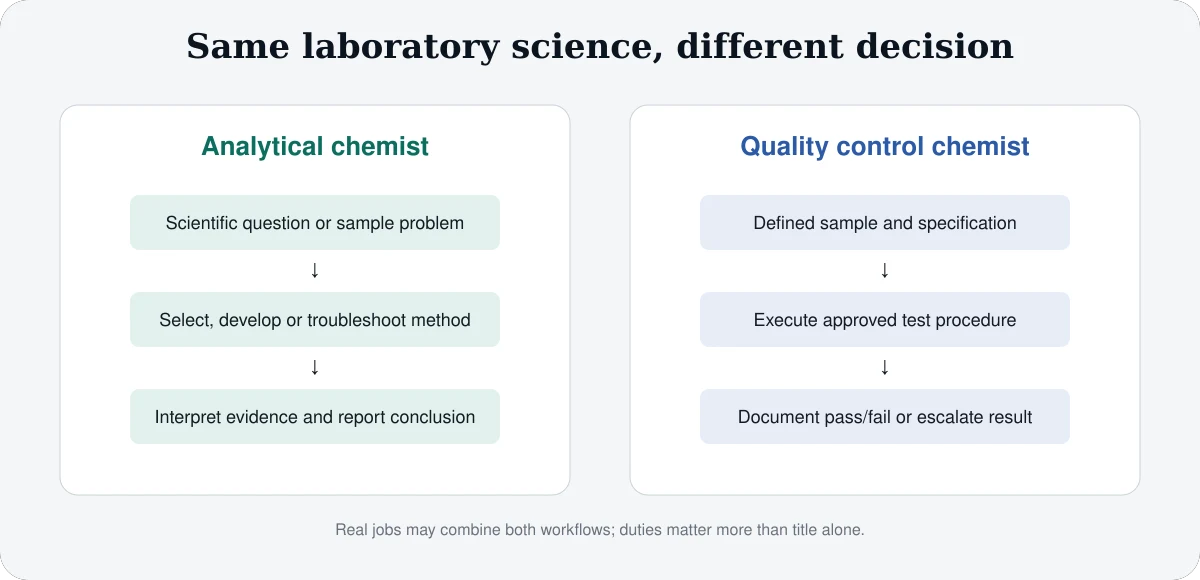
Analytical work often asks, “What is in this sample, how much is present, and can the measurement be trusted?” QC work often asks, “Does this defined sample meet the approved specification, and is the result documented well enough to support a quality decision?” The first may require a new approach. The second typically starts with agreed acceptance limits, although investigating an unusual result may require just as much scientific judgment.
| Factor | Analytical chemist | Quality control chemist |
|---|---|---|
| Primary purpose | Generate and interpret chemical evidence; may develop, improve or troubleshoot methods | Verify that raw materials, intermediates or finished products meet predefined specifications |
| Typical work pattern | Often includes non-routine investigations and method optimization | Often follows approved methods, sampling plans and release timelines |
| Decision output | Identity, concentration, structure, purity, method performance or a technical conclusion | Test result against acceptance limits, input to batch disposition, or escalation |
| Success looks like | A defensible conclusion, or a method that is fit for its purpose | Correct, timely, traceable results and sound escalation when something looks wrong |
| Common pressure | Explaining unexpected signals or making a method work | Accuracy, repeatability and turnaround without bypassing procedure |
Federal data treat the two as one occupation. In the O*NET Chemists profile, developing or improving analytical methods is a core task with an importance rating of 80 out of 100, and conducting quality control tests is also a core task, rated 73. The same occupation includes both kinds of work, so a chemist can reasonably be asked to do either.
What each role does day to day
Analytical chemist
BLS describes analytical chemists as chemists who identify the elements and compounds in a substance to determine its structure, composition and nature, and notes that some specialize in developing new methods of evaluation. O*NET’s Chemists profile lists analyzing compounds with chromatography, spectroscopy or spectrophotometry, maintaining instruments and writing technical reports among its tasks.
Depending on the employer, that can mean investigating an unknown peak, comparing techniques, establishing detection limits, validating a method, or supporting formulation, stability and manufacturing investigations.
Quality control chemist
A QC chemist tests defined samples against approved specifications. Typical work includes sample receipt, preparing standards and solutions, system-suitability checks, running instruments, calculations, reviewing results, and escalating atypical or out-of-specification findings.
The O*NET Quality Control Analysts profile is the closest federal description of this work. Its core tasks include routine and non-routine analyses of raw materials, in-process materials and finished goods, interpreting results against specifications and control limits, investigating questionable results, and taking part in out-of-specification investigations.
That profile also lists validating or transferring analytical methods as a core task, and developing and qualifying new test methods as a supplemental one. So QC is not method-free. The distinction is not an absolute ban on development within QC. It is the degree of control over methods used for official quality decisions.
Titles are not standardized. “QC chemist” and “QC analyst” are used loosely, and a bachelor’s-level QC chemist may be classified with chemists while a technician-style QC analyst may map to a technician occupation. Judge a role by its duties and stated education requirement, not by the title alone.
Do they use different instruments?
Often they use the same ones: HPLC, GC, UV-Vis, FTIR, titration, dissolution equipment, balances, pH meters and laboratory information management systems (LIMS). What differs is the question the instrument is answering.
Documentation and investigations: where QC leaves less room to improvise
Both roles need defensible records. QC often operates under formal procedures and review requirements, especially when results support regulated product release. The chemist has to show which sample was tested, which approved method and instrument were used, how results were calculated and whether acceptance criteria were met.
Analytical development is also documented carefully, particularly when a method will be transferred, validated or used in a regulatory submission. The practical difference is freedom to change things. A development chemist may change experimental conditions under an appropriate development plan. A QC chemist using an approved method must follow the applicable change-control and deviation procedures rather than quietly altering the test.
Pharmaceutical laboratories show how formal this can get. FDA’s data integrity guidance for drug manufacturers says FDA expects all data to be reliable and accurate, and its separate guidance on out-of-specification results describes how laboratories are expected to investigate results that fall outside specification.
How to tell which role a job posting really describes
Employers use “analytical chemist” and “QC chemist” inconsistently, so the duties matter more than the title. Some postings titled analytical chemist describe routine release testing, and some titled QC chemist expect method troubleshooting.
| What the posting emphasizes | What it usually points to |
|---|---|
| Running approved methods against specifications, release or stability testing, controlled records, supporting out-of-specification investigations | QC-focused work |
| Developing, validating or transferring methods, characterizing unknowns, troubleshooting, supporting formulation or process development | Analytical development or research-focused work |
| Routine testing plus method validation, transfer or improvement | A hybrid role; ask how the time is split |
Before accepting an offer, ask who owns method development, who investigates unexpected results, and who has authority to approve or reject a batch. The answers are more revealing than the job title.
Education and skills
BLS says chemists typically need at least a bachelor’s degree in chemistry or a related field, and that some jobs, such as research positions, require a master’s degree or Ph.D. Because O*NET lists both Analytical Chemist and QC Chemist under Chemists, that is the most defensible federal benchmark for chemist-level roles in either direction.
O*NET’s Quality Control Analysts profile points to a lower entry bar. The two profiles differ in clear ways:
| Measure | O*NET Chemists | O*NET Quality Control Analysts |
|---|---|---|
| Job Zone | Four: considerable preparation | Three: medium preparation |
| Education a new hire needs, per survey respondents | 56% bachelor’s degree, 30% doctoral degree, 10% master’s degree | 38% high school diploma, 28% bachelor’s degree, 10% post-secondary certificate |
| Wage series used | Chemists | Life, Physical, and Social Science Technicians, All Other |
| Knowledge rated highest | Chemistry (98) | Mathematics (79), then Production and Processing (76); Chemistry is 69 |
Read the table as a comparison of two occupation profiles, not two job titles. A bachelor’s-level QC chemist job sits closer to the Chemists profile, and a technician-style QC analyst job sits closer to the other. BLS lists an associate’s degree or two years of postsecondary education as the typical entry route for chemical technicians, a related but separate occupation.
Skills that matter in both roles
- Quantitative analysis: sample preparation, calibration, separation, detection and calculation
- Instrument competence, including system checks and troubleshooting
- Statistics for precision, accuracy, trends and method performance
- Clear technical writing for methods, deviations and reports
- Documentation discipline: recording and maintaining information is the top-rated work activity in both O*NET profiles (85 for Chemists, 86 for Quality Control Analysts)
Both occupations place a premium on accurate work. O*NET work-context responses report a greater share describing exactness as extremely important among Quality Control Analysts than among Chemists; that does not mean analytical development tolerates inaccurate results.
Salary and job outlook: what the numbers mean
There is no separate BLS wage series for these two job titles. O*NET lists both titles under Chemists (19-2031.00), so the best federal figure describes chemists as a whole. BLS reported a $91,240 median annual wage for chemists in May 2025. Half of chemists earned more and half earned less; the lowest 10% earned under $58,460 and the highest 10% earned over $160,830. This is a national median across all experience levels, not a starting salary.
BLS median annual wage, May 2025. Covers every chemist, including those titled Analytical Chemist or QC Chemist.
BLS May 2025 industry medians run from testing laboratories to the federal government.
Industry shifts the picture more than the title does. These are BLS May 2025 median wages for chemists in major employing industries:
| Industry | Share of chemist jobs | Median wage, May 2025 |
|---|---|---|
| Chemical manufacturing | 33% | $88,890 |
| Scientific research and development services | 16% | $105,930 |
| Testing laboratories and services | 11% | $66,140 |
| Federal government, excluding postal service | 6% | $137,720 |
| State and local government, excluding education and hospitals | 6% | $81,830 |
BLS does not divide this wage table into analytical and QC functions, so it cannot tell us which title pays more. It is tempting to read the testing-laboratory median as “QC pay,” but testing laboratories do many kinds of work. What the table does show is that employer type moves pay a great deal, so compare offers within the same industry.
For technician-style QC roles, two federal figures apply, and neither is a chemist salary. O*NET’s Quality Control Analysts wage page uses BLS data for Life, Physical, and Social Science Technicians, All Other, with a 2025 median of $62,280. BLS separately reports a $60,390 median for chemical technicians. Do not set either number beside the chemist median as if the titles were equivalent.
Outlook. BLS projects chemist employment to grow 6% from 2025 to 2035, from about 84,900 jobs to about 90,300, compared with 3% for all occupations. That describes the chemist occupation as a whole. BLS does not forecast analytical and QC work separately, and a national growth rate says little about hiring in a particular city or industry. For chemical technicians, BLS projects 5% growth over the same period.
Which role is likely to suit you?
Analytical chemistry may fit you if
- you like working out why an instrument produced a particular result;
- you want method development, validation or troubleshooting work;
- you prefer open-ended scientific questions; and
- you are comfortable interpreting complex data.
QC chemistry may fit you if
- you value clear procedures and objective acceptance criteria;
- you can stay accurate during repetitive or time-sensitive testing;
- you take documentation and traceability seriously; and
- you want a direct link to manufacturing and product release.
These preferences describe working conditions, not fixed personalities. Small companies may combine both responsibilities in one position.
Can you move between analytical chemistry and QC?
Yes, especially when you can show the skills needed on the other side. Similar instruments make the transition possible, but job titles alone will not demonstrate readiness.
A QC chemist who wants analytical development work should look for chances to take part in method validation, method transfer, troubleshooting, investigations, robustness studies and statistical evaluation. An analytical chemist moving into QC should be ready to show controlled execution, contemporaneous documentation, awareness of specifications and comfort working to release timelines.
Graduate study can matter on the development side. BLS notes that some chemist jobs, such as research positions, call for a master’s degree or Ph.D., so check whether a development-focused posting lists one.
Back to the 4:40 p.m. peak. The QC chemist protected the release decision by following the procedure, and the analytical chemist protected the next one by working out what the peak was. Pick the question you would rather be asked when the instrument surprises you.
Frequently asked questions
Is a QC chemist an analytical chemist?
Partly. A QC chemist does analytical work, and O*NET lists both titles under Chemists. But “analytical chemist” is the broader label. It can include method development, characterization and research that never touches product release, while “QC chemist” describes analytical work done to support a quality decision.
Do I need a bachelor’s degree for either role?
For chemist-level jobs, BLS lists a bachelor’s degree in chemistry or a related field as the typical entry education. Technician-style QC jobs often state lower requirements: O*NET places Quality Control Analysts in Job Zone Three, which typically involves vocational training, related experience or an associate’s degree. Some employers ask for a bachelor’s degree anyway, and 28% of O*NET’s respondents for that occupation said a new hire needs one. Rely on the posting.
Which role pays more?
Official data cannot say. No federal wage series separates the two titles, and some QC positions are classified under technician occupations. Chemist pay varies far more by industry, from a $66,140 median in testing laboratories to $137,720 in the federal government (BLS, May 2025).
Is QC work repetitive?
Often more than analytical work, but not entirely. In O*NET, 46% of Quality Control Analyst respondents rated repeating the same tasks as extremely important, compared with 33% for Chemists. The same QC profile also lists investigating questionable results and taking part in out-of-specification investigations among its core tasks, so routine testing is only part of the job.
Can QC experience lead to R&D or analytical development?
It can, especially when the experience includes method validation, troubleshooting, investigations and data analysis. R&D roles vary widely and some call for graduate study, so treat QC as a route you can build on rather than a guarantee.
Is QC the same as QA?
No. QC directly tests materials or products. QA focuses more broadly on the system, procedures and evidence used to ensure quality. Read Quality Assurance vs Quality Control.
Sources and methodology
Choicelyt compares duties and decision responsibilities rather than assuming job titles are standardized. Wage figures appear only with their official occupational classification, and technician data are not presented as chemist salary data. See our editorial methodology.
- O*NET OnLine: Chemists (19-2031.00), updated 2026
- O*NET OnLine: Quality Control Analysts (19-4099.01), updated 2026
- O*NET OnLine: Quality Control Analysts national wages
- U.S. BLS Occupational Outlook Handbook: Chemists and Materials Scientists (page last modified August 27, 2026)
- U.S. BLS Occupational Outlook Handbook: Chemical Technicians (page last modified August 27, 2026)
- FDA: Data Integrity and Compliance With Drug CGMP: Questions and Answers (December 2018)
- FDA: Investigating Out-of-Specification (OOS) Test Results for Pharmaceutical Production (revised May 2022)
Sources checked October 18, 2026, including BLS wage, industry and outlook figures and the O*NET profiles. Wage figures are BLS May 2025 estimates. Duties, education and classification vary by employer and industry.